

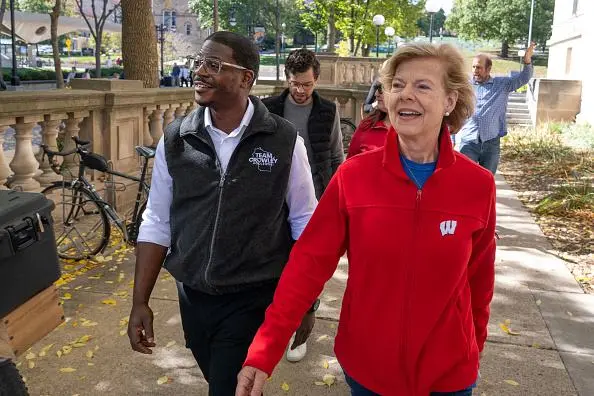
MADISON, WISCONSIN - OCTOBER 20: Wisconsin Democratic gubernatorial candidate David Crowley arrives with Sen. Tammy Baldwin (D-WI) for a get-out-the-vote rally on the University of Wisconsin–Madison campus on October 20, 2026 in Madison, Wisconsin. Today is the first day of In-Person Absentee Voting (early voting) in the state. Crowley is running against Republican Tom Tiffany. (Photo by Scott Olson/Getty Images)
Q&A: Tammy Baldwin on 2026 midterms, David Crowley and a progressive agenda

It’s hard to overstate Tammy Baldwin’s impact on Democratic politics in Wisconsin.
With more than 40 years of public service, the number of Democratic political operatives, insiders, staffers, and fellow elected officials who have been connected to the three-term U.S. senator is likely too numerous to count.
Republicans have attempted to throw daggers and get down in the mud during election cycles to attack Baldwin, but she has always prevailed in the end. In public polling, she consistently ranks near the top in popularity among Wisconsin politicians.
Now, her immediate focus is the 2026 midterms and returning to a Democratic control of Congress.
Baldwin sat down with the Milwaukee Courier for an interview on Oct. 27, where she discussed what Congress looks like under Democratic control, from accountability to passing progressive policies and finding common ground with President Donald Trump.
She also weighed in on the filibuster, Medicare-for-All, the Second Amendment, the war in Iran, election security, whether this is her final term, and of course, the closely-watched race for governor and control of the state Legislature.
Here is a Q&A with Baldwin that has been lightly edited for clarity.
If the Democrats win control of the U.S. Senate and all of Congress, what does that look like for the average Wisconsinite?
As I've been campaigning on behalf of other candidates, I've gotten a lot of input from Wisconsinites on what they're hoping for, both if there's change in the statehouse, as well as in Congress. And especially at the congressional level, with this president still in office for at least two more years. People want oversight and accountability, but they also want to queue up progress. And some of that's reversing some of the damage that's been done, as he's had a red trifecta. And so, we can walk and chew gum at the same time. So I think we can do both. In terms of oversight and accountability, I believe it's so important to our democracy moving forward that we make sure that we can never have a set of events like we've seen happen again. The level of corruption, the level of law breaking, the level of flouting the Constitution. And so that requires both, discovering in a very public way what all has gone on, and showcasing that to the American public to digest, but also putting in guardrails to make sure that things don't repeat themselves. Now, that'll be difficult to do with this president, because there'll be things that we will put on his desk that he won't sign. But that shouldn't discourage the exercise, nor should it discourage us from trying to take other steps. By way of example, we budget on a yearly basis at the federal level. And we can build guardrails to force the administration to do certain things moving forward, even while he's still president. So that's on the oversight and accountability side. On making progress, there's drastic attacks and cuts that he's overseen that harm Wisconsinites, cutting Medicaid by the tune of close to a trillion dollars over the next 10 years. Not sustaining the Affordable Care Act tax credits, so people can afford their healthcare on Obamacare. We can start to push back on those, but also look at larger reforms we want to do in the healthcare system to make it affordable going on. Healthcare's sort of my thing, so that's where I'm starting. But in so many other ways, so many other respects, they also cut SNAP. Because of the fact that people can't afford things right now... One of those things is food, and more and more people rely on nutrition assistance at a time when the federal government has cut, and so those are the types of things we can restore. Hopefully, and even get this president to sign a bill.
What do you say to the section of the public that doesn’t want the Democrats to spend time on investigations and accountability in lieu of passing progressive, popular ideas?
There will be, within the family, disagreements on what oversight and accountability look like. You know, one option that many people would love to see would be impeachment. Having been through a few, I can tell you that it takes all the oxygen out of the place, and probably nothing else would be accomplished. I’d still keep an open mind to it. I mean, it’s certainly deserved. If we see Democratic majorities at the statehouse and in Congress, I think people will expect something for placing the trust in us. And so there'll have to be something to show for it. It doesn't necessarily mean there needs to be a whole bunch of bills that we get Trump to sign into law. But we have to show how hard we're trying and what we're trying to make a difference on. So people say, look, they're the ones fighting for us. They're the ones who hear us, see us, feel us, and are fighting. One other thing I'll say on that is that there's a difference between oversight and accountability and revenge. I talk to a lot of voters who would love to see us spend some time on revenge. I don't think that's gonna be a productive thing to do.
Is there any common ground with President Trump that you can work with him on to get legislation passed?
Certainly. I think about the fact that he did sign all of our funding bills into law this year. And hope that he would want to see the government avoid a shut down, and work with us in doing that in future years. I am biased. I'm on the Appropriations Committee that writes those bills. But I do think that would be something that we could work together on. I've always found that there's a few issues. I always look for common ground. One of the things that I would like to work with the president on is making sure that we're spending taxpayer dollars on supporting U.S. workers and U.S. businesses. So the By America policy, the By America agenda, brings back jobs that have been offshore. It continues to be something, and especially when you represent a state like Wisconsin, where we make things. I was just actually texting with some colleagues about the Ships Act. We used to dominate in shipbuilding. Wisconsin's a Great Lakes state. We have shipyards. We can build ships here. But that business has, in some cases, left the country. In other cases, it's just sort of anemic here. I think that's something that we could work with the president on. I know that's a very narrow example, but it's not nothing, and it's thousands of jobs.
Will Democrats in Congress be in a position to pass popular, progressive ideas?
Yes. And we have to. Look, if we earn the trust of the voters, we have to do the best we can to deliver on what they've asked, and address the concerns that I've been hearing, even though I'm not on the ballot, I'm listening to what people are telling me about their concerns and their challenges, and what they want to see done. And so, I think we have to stand up. And fight as hard as we can.
Are you open to getting rid of the minimum 60-vote filibuster in the Senate?
I would like to reform it. Not abolish it. One of the things, the last time we tried to reform it was with a talking filibuster. And it was when we were trying to pass the John Lewis voting rights bill. It was a bill that deals with our fundamental democracy, and Republicans were blocking our efforts to further it. So we attempted to get sufficient votes to do what's called a talking filibuster. If we were to do that, every senator would have a really ample opportunity to debate the bill. But after that, there would be a simple majority vote. And the reason it would only be used rarely, is because if you give 100 senators 10 hours each to debate, it's gonna take weeks and weeks to consider a bill. And so you would be judicious about how often you would demand a talking filibuster, because you want to get stuff done. I think that is an example of a compromise that could work. There are many who would say, just outright, get rid of it, but I think what that would mean is that we would have volatile shifts in policy. Republicans could gain control, and they would ban reproductive freedom. And then Democrats, and we would restore it, and then voting rights would go this way and that way. And I don't think that's healthy for the nation. But I do think there are some major things that we need to deal with, but we just haven't been able to get 60 votes for it.
What has been your experience working with Milwaukee County Executive David Crowley, the Democratic nominee for Wisconsin governor?
I've had the chance to work with him so closely. I met him when he was in the state Legislature. But then, when he was elected county executive for Milwaukee. It's the biggest county in the state. I work closely with him on all sorts of topics that are important to the entire state. Start with affordable housing. He came in, he said, “We’re having a crisis, we need to do things,” and we partnered up, and I was able to secure some federal funding to work in partnership with local funding. That has helped, but his leadership has created over 1,000 units of new affordable housing across the county. That's pretty incredible. I've watched him in tons of crises, like the extreme flooding that happened over a year ago in Milwaukee, where he put the hard hat on and toured the damage, and then helped neighbors rebuild. I’ve seen his advocacy on getting rid of lead in people's homes, children's homes, whether that's the drinking water, pipes, or the paint. I've seen his leadership on getting more funding for addiction support. The list is long. And I want to see that type of leadership at the state level. I also know about his upbringing and some of that I relate to. He gets us because he is us. And I find that such a contrast to his opponent, who voted with Donald Trump time after time after time, every cost increasing scheme. He supported Trump and the tariffs, and the trade wars, in the war in Iran, all of which are making our lives more expensive and more challenging.
If Democrats win the trifecta — control of both chambers and governor’s office — can legislation be passed quickly to weaken these issues facing residents?
I talked to some of the leaders in the state Legislature who are poised to not be minority leader, but majority leader. And so I know that they've been thinking deeply about what they would like to move if they had a chance to lead. And this is a historical moment. There hasn't been an opportunity for really electing a Democratic majority in both the Assembly and the Senate for 15, 16 years. It’s been a long time. I think everyone realizes the moment and has prepared for the moment. Both on the campaign side, but preparing to lead. And so, I think they'll be ready on Day 1. And there's gonna be some new ideas that David brings as governor, but there's also things that the incumbent Democratic legislators have been trying to do for years and have been plagued at every turn by their Republican counterparts, and they're gonna have a chance to start taking action. We need to pick up five seats in the Assembly to have the majority, two seats in the Senate. And that's really important to me. I work closely with the governor and the state Legislature, and I want one that's moving things forward, not blocking everything.
What do you make of the nature of the attacks during this election cycle?
Well, I lived through one of those just two years ago. It feels so darn familiar. It saddens me that we have gone from a place where we could agree on what the challenges are, but we might have different policy solutions. You know, like affordability. There's nobody who should disagree that's an issue right now, but the Republicans might have one approach, Democrats might have another. We've gone from disagreeing on solutions to personal attacks, character attacks that I don't think really help the democracy. And, sadly, our president has been the leader and purveyor of that, and therefore made it sort of acceptable. You know, if the president can do something… And, you know, telling lies, that shouldn't be acceptable. But we live in a society right now where that's the case. And I think a lot about how we can bring civility back, how we can have a more civil discourse. But it's gonna be really challenging. It's kind of like putting a genie back into the bottle.
Do you think the president will accept the results of the election?
I've been studying the rhetoric and the actions of this president regarding elections very closely, because he is just threatening things to keep people on edge, and intimidate voting, or whether he intends to carry through with some of his threats. This is serious stuff. Elections are how we further the democracy. And so it's vital to me that every vote is counted, that everyone has access to the polling places. I've been engaged in a lot of scenarios playing with the folks in Wisconsin that need to be thinking about that. Everything from local election officials, that I've had several meetings in Milwaukee at Central Count, in Green Bay, in Lacrosse, and Madison. This week, I'm gonna be meeting with local election officials in Stevens Point in central Wisconsin to make sure that they're thinking about what they would do under several scenarios, but also, the state attorney general, the governor's office, the leaders of our biggest cities. Are they ready? And I take everything that Trump says seriously. If he's saying it, it could happen. And then what, how would we react? So everything from he’s gonna send federal agents or ICE to polling places. What would be the response? Or, he believes that foreign governments have infiltrated our voting machines and our tabulation machines. Okay, are they gonna seize them? What about seizing ballots? We saw them do that with the 2020 ballots recently in Fulton County, Georgia. What does that mean? I just think we have to be ready. It's sad that we should do tabletop exercises on this, but we need to think through every scenario to make sure that we can assure voters in Wisconsin that our elections are safe, secure, accurate, and fair. So, all your readers go out and vote, because it's gonna be safe, secure, accurate, and fair.
Elections are administered by the states, but is there any role you play on the federal level?
I have a platform. I can inform the public about what I've seen. So at these meetings I've had with local election officials, they’re talking about how they're training the Election Day workers. How they make sure that everything is safe and secure, that the ballots have a chain of custody, and asking them what they would do if they were having trouble with the postal service. And then highlighting that for the Wisconsin public so that they can hear that their election officials are on top of it, training the folks that will be working on Election Day. All the election officials have to do testing of their voting machines. And it has to be available to the public to watch. I've seen some of these tests, and I want to see more to make sure that they are tabulating accurately. So people can have confidence that their vote is gonna be counted the way they filled it out, their ballot.
What can Democrats do to stop the war effort in Iran?
Yeah, without question. It is an illegal war. Wars are declared by Congress. And even if all out war was not declared by Congress, Congress authorizes use of military force, the only exception to that is when the United States is under attack. Then the commander-in-chief has total control to say, I'm gonna defend this nation, or even assets, and U.S. people overseas. He has absolute authority to protect us. But we weren't under attack, and we were not under any imminent threat of attack. And so this is a war of choice. The way we would need to go about it is through the funding mechanisms, to say, you cannot use appropriated funds for an illegal war, and that would be the way that this would be unwound. When it started, I was in close conversation with several colleagues who said, we can't just let this go. We can't just have one vote and say, we disagree. We're gonna have to bring this up over and over again. And that's why you've seen the Senate vote on, I think, it's 12 War Powers Resolutions. And putting our colleagues on record, are you for this or are you against this? They didn't have quite as many on the House side, but that's how I can tell you that Tom Tiffany voted five times to keep this war going.
What if Trump refuses to obey Congress and instead continues the war?
Again, it's the power of the purse strings, so not only does Congress through the Constitution have the authority to declare wars or to authorize use of military force in situations where we're not under attack. We also have the power of the purse strings. And so we will put together a budget, and we can restrain. We can fully fund the Defense Department, but talk about what uses they can make of that support.
Former President Barack Obama recently campaigned with Abdul El-Sayed, Senate candidate in Michigan, where Obama said El-Sayed would go to Congress and continue the work he did on healthcare. To many that means transitioning to a single-payer system like Medicare-for-All. Would you want to see that?
Oh, I'm a single-payer advocate. Always have been. Medicare for all, I think, is the way to make it high quality, affordable. Most seniors on Medicare are very pleased with the coverage they have. But, I also want to be politically pragmatic, and so probably where I would start, and maybe this is what President Obama was alluding to, is that we wanted to have a Medicare like option within the Affordable Care Act. Believing that it would probably be the most popular of all the health plans offered in the Affordable Care Act and gain momentum and gain political support, then you could ultimately transition. And I think we should revive that view. The Affordable Care Act got passed with only private health insurance options, and there wasn't a public option. And so, that to me is probably the most politically pragmatic path to getting there. But, definitely, I believe that’s where we need to end. Medicare is very, very popular and it's just that people under 65 don't get a chance to experience that.
Wisconsin has made significant strides in public safety, particularly Milwaukee in recent years. But shootings and homicides are still far too common. What can Congress do about this?
There's no one answer to that. It's obviously very complicated. I'm a big fan of community policing. And so the COPS program at the federal level, within the Department of Justice, has been something that has enabled cash strapped cities and communities to be able to hire more community oriented police. And, in too many ways, because so many communities have very little resources, that's been one of the things that have been sacrificed. So that's one thing that I would support. I think we've struggled at the federal level to figure out how to respect the Second Amendment, but also place reasonable safety restrictions. I believe that they are compatible. I’m familiar enough with the Supreme Court's interpretation of the Second Amendment, and they've certainly told us what you can't dictate in law that would run afoul of the Second Amendment. They've also said, there are things you can do. And I think that there's a lot we can do about safe storage. There's a lot we can do with regard to regulating what I would describe as more weapons of war. It's a very emotional challenge for me, because I know a lot of people who believe that the Second Amendment protects that. After the Uvalde (Texas) school shooting, for the first time in almost 30 years, Congress came together and passed some regulation that dealt specifically with firearms, but also went sort of beyond that. One of the things that we talked about was red flag laws. Wisconsin doesn't have them, but other states do, where somebody who is adjudicated to be at risk themselves or others, can temporarily have their firearms taken away. And I think that's a fair thing to do, a reasonable thing to do. It has not run afoul of the Second Amendment. And so that's actually one where we can partner with the state, and they could pass some red flag laws here that would then result in more ability for law enforcement to be able to step in and take firearms away from somebody who's maybe going through a psychotic episode or something like that.
Your third term expires in 2030. Is this your final term?
Oh, I have no idea. I have goals for the four years that I have left. And that's what I'm focused on is achieving them. And I will say that when I was elected on the same ballot as Donald Trump two years ago, there was a part of me that said, Wow, I'm gonna need to focus a lot on defense. There's a lot of things that I know Donald Trump would like to do that I want to fight against and I have been fighting against. I'd rather be solving problems, and working on… I'll go back to healthcare, 'cause that's sort of my passion. I'd rather be reforming the system, making it higher quality, more affordable, more accessible. Instead of fighting the Big Ugly Bill, where he's cutting Medicaid, but had to spend a lot of time trying to blunt the damage done in that bill.

Drake Bentley is the general assignment reporter for the Milwaukee Courier, covering politics, sports and the community. He is an award-winning investigative journalist who has worked for the Milwaukee Journal Sentinel, Wisconsin State Journal, Newsweek, Heavy and The Sporting News. He is a northside Milwaukee native, former political staffer and graduate of the University of Wisconsin-Whitewater and the University of Nebraska.


