

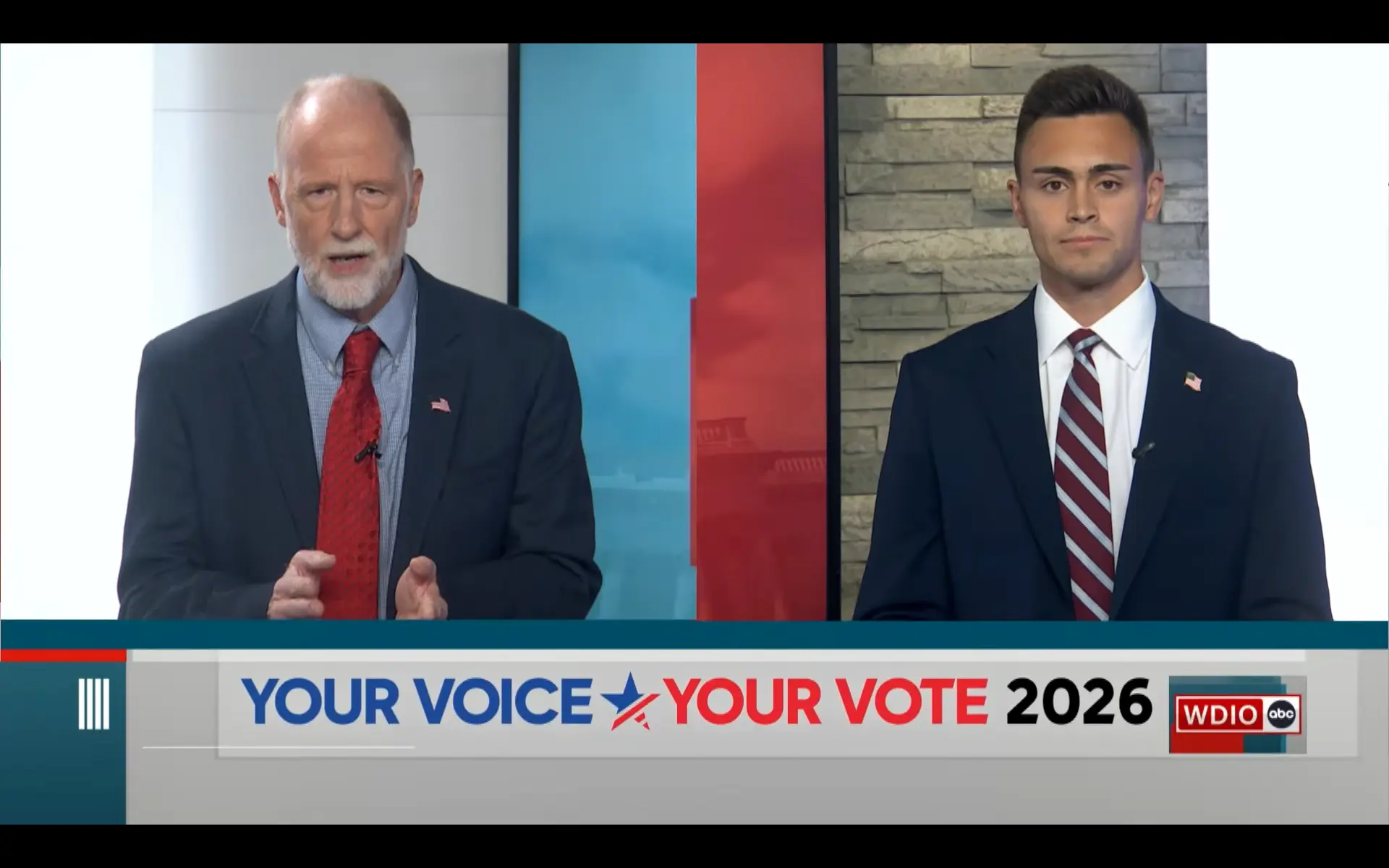
Democrat Fred Clark, a former state lawmaker, and Republican Michael Alfonso, the son-in-law of U.S. Transportation Secretary Sean Duffy, met Wednesday for a debate in Duluth.
Source: WDIO-TV
Alfonso, Clark discuss Line 5, data centers in 7th Congressional District debate
The candidates addressed concerns over Enbridge's Line 5 pipeline and data center development during what could be their only debate before the November election.

Oct 11, 2026, 11:00 AM CT
Share


The two candidates running for Wisconsin's 7th Congressional District met Wednesday for what could be their only debate before the November election.
Republican Michael Alfonso and Democrat Fred Clark met in Duluth, Minnesota, for the debate hosted by WDIO-TV.
Among the issues discussed was Enbridge's Line 5 pipeline, which has faced renewed scrutiny following a major natural gas liquids spill in Iron County and environmental concerns surrounding construction of its reroute around the Bad River Reservation.
When asked about Line 5, Alfonso expressed support for the pipeline. He also said protecting northern Wisconsin's lakes, forests and farmland doesn't have to come at the expense of building energy infrastructure.
“Line 5 is one of these things that brings costs down for every single family in Northern Wisconsin. I really look at this issue and say, if you truly want prices to come down, how can you not support it.”
Alfonso had earlier said Clark opposed Line 5. Clark disputed that claim and said his concerns were with Enbridge's environmental record.
“I have put out a statement calling on the Wisconsin DNR to hold the Enbridge company accountable for the set of environmental problems they've had. This company has not operated in good faith and until they're willing to do that, we need the state to hold them accountable and stop work until there are reforms.”
The candidates were also asked about data centers, which have become a growing concern in Wisconsin over their potential impact on water supplies and electricity costs.
Clark called for state and federal regulations to protect communities from the environmental and financial risks of data center development.
“We need that badly to protect our water resources, absolutely, to make sure that consumers of energy are held harmless by the huge power demand these things generate, absolutely,” Clark said.
Alfonso agreed that water use and electricity costs need to be addressed, but said local communities should decide whether to allow data centers.
“If you were to ask me, do I want a data center in Hayward, Wisconsin, where I live? Absolutely not,” Alfonso said. “But I'll tell you what, the federal government does not have a role in stepping in and telling local municipalities what they can and cannot do.”
Clark then questioned Alfonso about President Donald Trump's efforts to limit state regulation of artificial intelligence.
"So are you willing to tell the president that he's wrong to want to preempt states from having regulations around artificial intelligence and that he's wrong to let Mark Zuckerberg and Jeff Bezos basically run the table the way they want to with AI and data centers?” Clark asked.
Alfonso responded that Trump supports local control.
“President Trump was actually very clear with this. He said, if you're a local municipality and you don't want one, you don't need one. President Trump truly listens to the people,” Alfonso said. “I mean, when we look at issues like the data center issue, it's very clear. People in northern Wisconsin don't want it. But I can't say the same for Kansas. I've never been there. If they want one, it's not the federal government's job to step in and say, no, it's the state or local government.”
The full debate is available to watch on WDIO-TV's website.

Maddie Schaffer is a reporter at WBZH and WHSM, covering the Hayward area and surrounding areas in the Northwoods. Email her at maddie.schaffer@civicmedia.us.


