

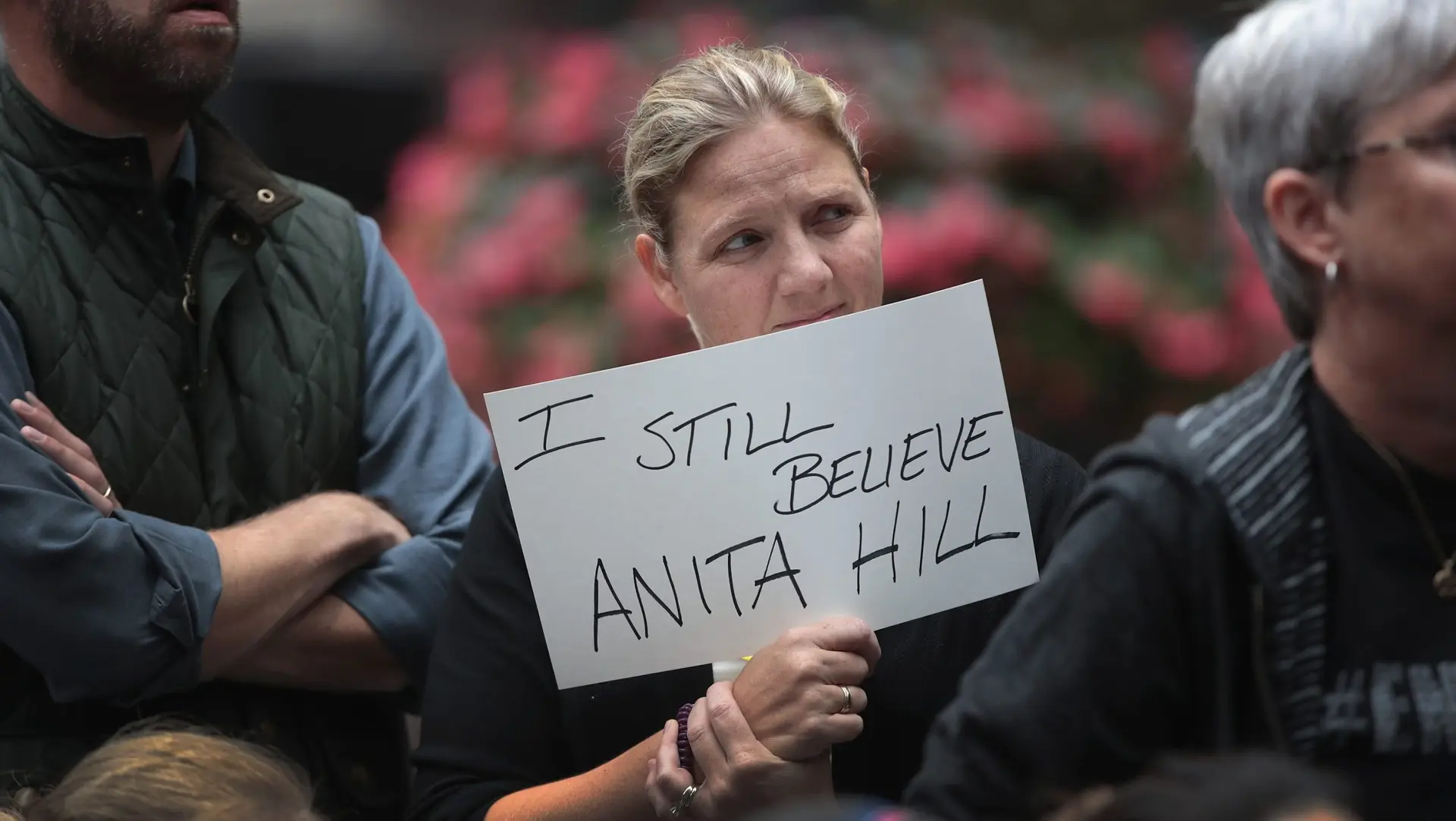
CHICAGO, IL – SEPTEMBER 28: Activists and advocates for survivors of sexual abuse gather in the Federal Building Plaza to protest the confirmation of Supreme Court nominee Brett Kavanaugh on September 28, 2018 in Chicago, Illinois. (Photo by Scott Olson/Getty Images)
Tom Tiffany’s anti-worker record includes votes weakening protections for sexual harassment victims

Aug 25, 2026, 12:35 PM CT
Share


During his time as a legislator, Republican candidate for governor Tom Tiffany has produced one of the most conservative records, which includes championing the anti-worker agenda.
The Milwaukee Courier is revisiting Tiffany’s record both as a U.S. congressman and state legislator. The 68-year-old has attempted to bury his record while painting himself as the common, working class man in comparison to his Democratic opponent, Milwaukee County Executive David Crowley.
The Courier’s series has shown Tiffany’s efforts to maintain lower wages for female workers and weaken child labor laws. Also, the former state legislator was a close ally to former Gov. Scott Walker and helped foster two major anti-union laws in Wisconsin.
In recent years, Tiffany has brought that sentiment to the U.S. House, where he voted numerous times against workers’ rights, by subjecting them to risk, blocking pension relief, and even voting to weaken protections for victims of sexual harassment in the workplace.
Both in 2021 and 2023, Tiffany co-sponsored The Fair and Open Competition Act, which prohibited federal contracts from requiring project labor agreements that protect workers. PLAs are unique to the construction industry and are a type of collective bargaining agreement.
According to the Department of Labor, “Essential elements of PLAs include: provisions that bind all contractors and subcontractors to the agreement; no-strike, no-lockout clauses; and grievance/arbitration procedures. Usually, PLAs also specify the wages and fringe benefits for all workers on a project and generally require contractors to hire workers for the project through a union hiring hall that is responsible for supplying skilled labor. PLAs may also include clauses: outlining goals for hiring local community members on projects; incorporating equity plans; detailing strategic recruitment policies for workers from underserved communities; and requiring participation of small businesses.”
The AFL-CIO, the largest federation of labor unions in the U.S., said “state lawmakers, backed by construction industry CEOs, want to cut the wages of those workers by eliminating prevailing wage laws and project labor agreements (PLAs) on public construction projects.”
While in Congress, Tiffany also voted for The Custom Health Option and Individual Care Expense (CHOICE) Arrangement Act, which would roll back basic health protections for workers.
The CHOICE Act would roll back protections from former President Barack Obama’s signature health care legislation, the Affordable Care Act, and codify regulations from the era of President Donald Trump.
“House Republicans have advanced a package of bills that could reduce health insurance costs for certain businesses and consumers, partly by rolling back some consumer protections. Rather than outright repeal, however, the subtler effort could allow more employers to bypass the landmark health insurance overhaul’s basic benefits requirements and most state standards,” an NPR article from the time states.
“At the same time, the Biden administration seeks to undo some of the previous administration’s health insurance rules, proposing to retighten regulations for short-term plans. […] The plans don’t have to cover all the benefits required of ACA plans, for example, and can bar coverage for preexisting medical conditions, can set annual or lifetime limits, and often don’t include maternity care or prescription drugs. Despite notices warning of a plan’s limitations, consumers may not realize what isn’t covered until they try to use it.”
The AFL-CIO said the legislation would subject “workers to financial risk” and is not a “stable form of coverage.”
Tiffany has advocated for Congress to pass The Regulations from the Executive in Need of Scrutiny (REINS) Act, which would weaken regulations and halt the implementation of critical new public health and safety safeguards by requiring a vote on major rules.
“What they want to do is to make it impossible to regulate,” Nicholas Bagley, a law professor at the University of Michigan, told the New York Times at the time.
“‘The practical impact of this in a time of divided government like we have now is that I think no major rule would ever get done,’ said Jonathan Siegel, a law professor at George Washington, who has written about the bill at length. “If the Republican House wanted to deny the Biden administration policy wins, it could simply vote no on every regulation it proposed. Those might include rules that explain how major portions of last year’s Inflation Reduction Act are meant to work. In a REINS Act world, the Republican House could just block those rules, effectively thwarting legislation passed by a previous Congress.”
The AFL-CIO wrote, “The REINS Act is an extreme measure that would make it virtually impossible for agencies to issue any meaningful rules, threatening the health and safety of workers and the public. […] The REINS Act would cripple a regulatory process that already causes excessive delays in the issuance of crucial worker and public protections.”
An alliance of over 150 labor, scientific, research, government, faith, community, health, environmental, and public interest groups, including the UAW, AFSCME, ATU, The International Brotherhood Of Teamsters and the United Steelworkers, were strongly opposed to the measure.
“The REINS Act represents one of the most radical threats in generations to our government’s ability to protect the public from harm,” the coalition wrote in a letter. “The bill’s clear aim is to halt the implementation of critical new public health and safety safeguards, financial reforms, and worker protections – making industry even less accountable to the public. It would do nothing to improve protections for the American public, but instead would benefit only those corporations that wish to game the system and evade safety standards.”
In 2022, Tiffany voted against The Forced Arbitration Injustice Repeal (FAIR) Act, which would have banned mandatory, pre-dispute arbitration agreements.
“The FAIR Act would prohibit corporations from forcing working people and consumers into pre-dispute forced arbitration agreements and class action waivers, which are hidden in many non-negotiable employment and consumer contracts. […] Pre-dispute forced arbitration agreements and class action waivers harm working people and consumers while allowing corporations to escape accountability for wrongdoing,” according to The Leadership Conference on Civil and Human Rights.
Nearly a decade ago about 60 million American workers lacked access to protect their employment rights due to forced arbitration, which reduced employers’ liability for employment law violations, according to the Economic Policy Institute.
The FAIR Act would have barred the enforcement of the agreements for workers alleging sexual harassment or assault. The #MeToo law, which was signed by former President Joe Biden that same year, specifically banned the agreements for #MeToo allegations.
Tiffany also voted against The Ending Forced Arbitration of Sexual Assault and Sexual Harassment Act, which would make arbitration agreements invalid and unenforceable for someone alleging sexual assault or harassment in the workplace, thus allowing the allegations to be heard in court.
The bill overwhelmingly passed the House, including with the support of 113 House Republicans, but not Tiffany.
Tiffany has skipped some votes over the years on legislation aimed at protecting workers. In 2022, he skipped a vote to expand eligibility for retirement benefits for disabled federal first responders and in 2021 he skipped the vote on The Protecting the Right to Organize (PRO) Act, a wide-ranging labor reform bill to protect workers.
Tiffany voted against the American Rescue Plan Act, which included pension relief for 22,000 Wisconsin workers and retirees who were facing huge benefit cuts. The bill would have raised the federal minimum wage, something Tiffany has voted against multiple times.
He has voted against anti-discrimination protections for older workers and pregnant women and working mothers. He said he supports repealing The Davis Bacon Act, which established that local prevailing wages must be paid on public works projects.
In his run for governor, Tiffany attempts to make the case that he cares about the average person, but his record reflects the opposite.
On the other hand, Crowley has been supported by most major labor unions.
Election Day is Nov. 3.

Drake Bentley is an award-winning investigative journalist who has worked for the Milwaukee Journal Sentinel, Wisconsin State Journal, Newsweek, Heavy and The Sporting News. He is a northside Milwaukee native, former political staffer and graduate of the University of Wisconsin-Whitewater and the University of Nebraska.


