

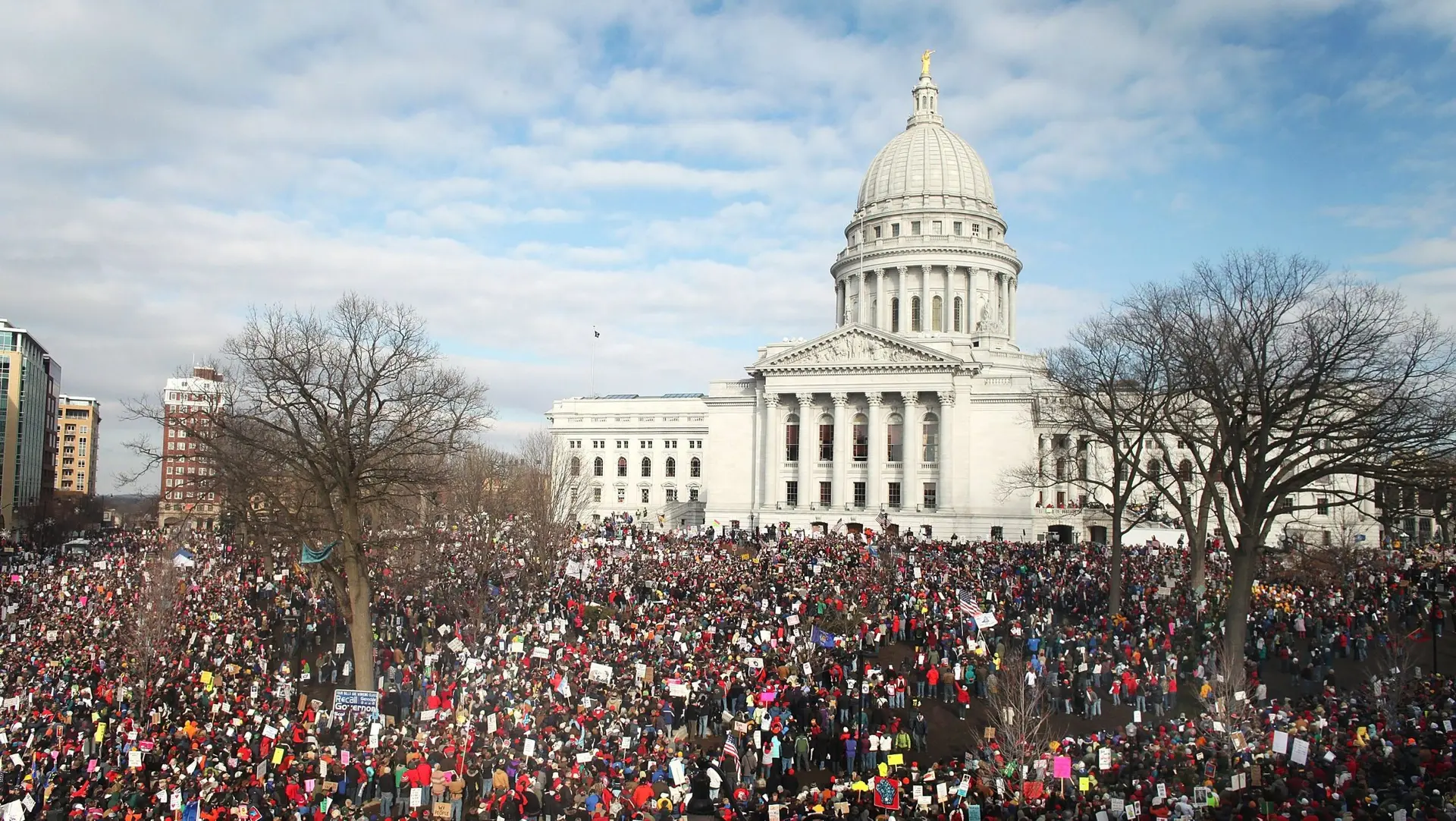
MADISON, WI – MARCH 12: Thousands of demonstrators protest outside the Wisconsin State Capitol March 12, 2011 in Madison, Wisconsin. Organizers were expecting thousands of participants to attend the rally to voice their opposition to Governor Scott Walker’s budget repair bill which essentially eliminated collective bargaining rights for state workers. (Photo by Scott Olson/Getty Images)
From Wisconsin to D.C., Tiffany has pushed the anti-union agenda from the start

Aug 21, 2026, 2:30 PM CT
Share


Republican candidate for Wisconsin governor Tom Tiffany has one of the most anti-worker legislative records from both his time in the State Legislature and U.S. House.
Now facing Democratic candidate David Crowley, Tiffany has attempted to bury his record, but the Milwaukee Courier is bringing light to it.
The first entry into Tiffany’s disastrous record highlighted his work in maintaining lower wages for female workers and embracing child labor, now the Courier looks at Tiffany’s efforts to push to make Wisconsin’s controversial Act 10 the law for the entire country.
While in the state Senate, Tiffany was a close ally to former Gov. Scott Walker and in 2011 helped pass Act 10, the anti-union law that ended collective bargaining rights for public employees and led to mass protests at the State Capitol.
As many as 100,000 people showed up at the Capitol for weeks on end standing in solidarity with public employees, a lot of whom were school teachers.
The measure significantly reduced paychecks for public employees. Public workers earning $50,000 a year saw their take-home pay shrink by about 8.5% because they had to pay more for their benefits, according to an analysis by the nonpartisan Legislative Fiscal Bureau at the time.
Between 2010 and 2019, Wisconsin lost about 137,000 union members, according to the Bureau of Labor Statistics.
A Dane County judge overturned Act 10 in 2024, ruling it unconstitutional. But that didn’t stop Tiffany from touting the law as a success. The decision is currently being appealed and therefore remains fully in effect for now until it is heard by the Wisconsin Supreme Court, which has a 5-2 liberal majority.
“Today’s Act 10 ruling is yet another example of judicial activism by a radical Dane County judge,” Tiffany said on X at the time. “The Left’s relentless efforts to undermine Act 10 are nothing more than an attempt to raise your taxes and expand government control. This is the same playbook we’ve seen before with Capitol riots, recalls, and politically motivated John Doe investigations. Despite this, the savings of Act 10 speak for themselves.”
Earlier this year, Tiffany attacked former Lt. Gov. Mandela Barnes for promising to end Act 10 and restore bargaining rights.
“I was in the state assembly at the time and I voted for it. Saved property taxpayers billions of dollars,” Tiffany said on “The Terry Schilling Show” in January.
Tiffany said he doesn’t want to see the Supreme Court overturn the bill.
“You know, I really don’t know what the court is thinking. I sure hope they don’t, that was, I mean, I was there in the legislature, I voted for the bill. It was constitutional,” Tiffany said on “The Dan O’Donnell Show” in January. “I mean, we ran that through the paces to make sure that it was a constitutional bill. … So there’s no reason for them to overturn this, and I hope they see the light of day in regards to this, because if this governor’s race could be the only thing between us becoming Minnesota or Illinois.”
Another controversial anti-union law passed in 2015 called “Right to Work,” which banned mandatory union dues at private sector businesses, which weakened unions across the state.
Tiffany touted “Right to Work” while running for Congress in 2020.
“Thanks to my work with @ScottWalker, Wisconsin is a right-to-work state. Congress should support freedom for workers, not force them to be members of unions they don’t want to join,” Tiffany said on X at the time.
While in Congress, Tiffany co-sponsored legislation to keep Wisconsin’s “Right to Work” law in place and to create a federal right to work act.
In 2021, he supported H. Res. 620, which is a resolution that opposes the enactment of any federal law that voids state laws that prohibit employers from requiring workers to join a union as a condition of employment.
In three different terms, Tiffany co-sponsored the House bill to establish a national “Right to Work” law.
“This bill repeals those provisions of the National Labor Relations Act and the Railway Labor Act that permit employers to make an agreement with a labor union to require employees to join such union as a condition of employment,” the proposed bill states.
“For decades, (‘Right to Work’) laws have been a way to depress union membership and divert resources away from bargaining, Robin Clark-Bennett, director of the labor center at the University of Iowa College Of Law, told Axios in 2022.
The laws can also lead to a worker not paying dues but receiving benefits and protections of the union, which is unsustainable.
An August 2014 study by researchers at the University of Illinois and the Illinois Economic Policy Institute found that after controlling for other variables, right-to-work laws reduced workers’ wages and salaries by 3.2 percent on average. They also found that right-to-work laws reduced the portion of workers with pension plans and health insurance by 3 and 3.5 percent, and reduced union membership by almost 10 percent.
Tiffany has attempted to paint himself as the common man born on a dairy farm that cares about the working class, while simultaneously painting Crowley as an ally to big money interests and Big Tech.
But Tiffany’s legislative record shows one of clear anti-union efforts that he is proud of. His campaign didn’t respond to a request for comment.
On the other hand, Crowley has been endorsed by the major Wisconsin labor unions.
Election Day is Nov. 3.

Drake Bentley is an award-winning investigative journalist who has worked for the Milwaukee Journal Sentinel, Wisconsin State Journal, Newsweek, Heavy and The Sporting News. He is a northside Milwaukee native, former political staffer and graduate of the University of Wisconsin-Whitewater and the University of Nebraska.


