

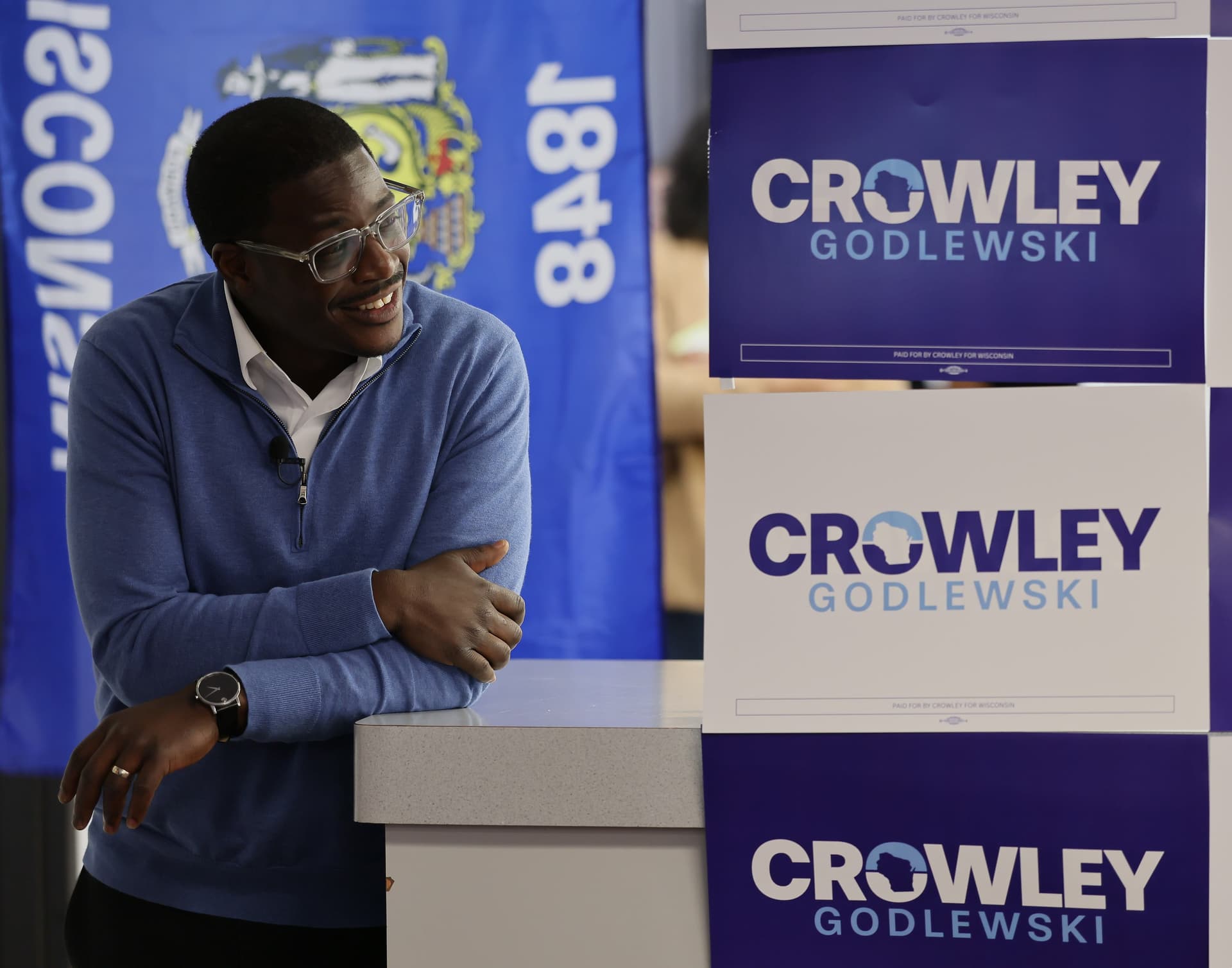
Former Vice President Kamala Harris and Democratic nominee for Wisconsin governor David Crowley launched canvassers from the party's office on the northwest side of Milwaukee.
Source: Pat A. Robinson / Milwaukee Courier
Q&A: Wisconsin Governor-elect David Crowley on election results and priorities, including education, healthcare, marijuana, Act 10, prisoner commutations

Governor-elect David Crowley proposed dozens of ideas while on the campaign trail, and after his historic election victory, the state’s first Black governor understands that the Wisconsin State Legislature is due for a busy year.
The election results were earth shattering for Republicans and provided the Democrats with a mandate for change and solutions. For Crowley, he saw historic election results around the state for a Milwaukee native, but especially in his own hometown.
Before the new administration and Legislature are sworn into office in January, Crowley has announced a transition team and the legislature picked their leaders. Things are moving fast.
But will it be fast enough for the public? Government is often a tedious, slow moving affair.
Crowley discussed the election results and his priorities, including education and healthcare funding and marijuana legalization, in an interview with the Milwaukee Courier on Nov. 16.
Here is a Q&A with Crowley which has been lightly edited for clarity.
It’s been about two weeks since a historic midterm election in America. Similarly seen around the country, Democrats had a great night in Wisconsin. If prior elections are an indication, your election result was a blow out as you won by more than 200,000 votes or more than eight percentage points. Did you anticipate winning by that big of a margin?
Absolutely not, Drake. I mean, when we think about it historically this is the largest win that we have seen in almost 30 years. I think 1998 is when we've seen this large of a victory. But I think that this speaks to the fact that people are looking for some change, looking for someone who has the leadership capabilities and the experience of bringing people together to the table. And, while there may be folks who may try to say that this was a mandate, this was a blue wave or a blue tsunami. For me, it's about serving the state and I'm going to be focusing on making sure that we can tackle affordability, healthcare, childcare, property taxes, housing, all those different things. And that's really what my focus is on. While it was a historic night, I'm excited about it, but it's not a motivating factor about how we're going to govern.
It’s likely safe to say your Milwaukee election results are the best ever, at least in the modern era. You earned a higher percentage of voters than Barack Obama and Herb Kohl have ever received in Milwaukee. How does it feel to have your hometown turnout for you?
I did not know that. You know, I'm a child of Milwaukee. This entire city, this entire community raised me, and many folks have seen the work that I did as a young person, as a community organizer, as a staffer, and as a state representative, but also being able to deliver as a county executive. And I think that with the work that I have done, and the leadership that I have shown this entire community, it shows that I not only have their belief and faith, but I have the partnership we've been able to collaborate with one another in order to really move this community forward. And I really want to say thank you to all of the city of Milwaukee, everybody in Milwaukee County who showed out to make sure that we got over the hump and won this election in the general cycle. I'm just excited about the opportunities that we have ahead of us.
You recently announced a chief of staff and transition team to work through this period before you are sworn in on Jan. 4. How did you land on this group of people?
Well, I wanted to get a bunch of folks, one that represents the diversity of this state, making sure that they weren't just from southeastern Wisconsin, but making sure that we identify people who understand what the government needs to do to uplift communities. But also understands the importance of relationships. And so to have someone like Jeff Pertl, he's been a great person who was working for the state government for many years. He worked in DPI, worked within the governor's executive cabinet before, and he brings a ton of not just expertise but relationships that we're going to need in order to make sure that we move the state of Wisconsin forward. But when I think about this transition team, this transition team is going to help us identify cabinet level members, managers, as well as appointments for different boards, commissions, and councils who truly understand and value the state, who understand that we need to collaborate in order to move this state forward. I'm just so excited to be working with this team within the next few weeks to make sure that we're ready on day one once I'm sworn in on January 4th.
The governor is limited on what the position can accomplish unilaterally. Things will require working with the Legislature and most policies will start there. What has been your experience working with the legislative leaders and what are the priorities as governor?
I got some of my first government starts working in a legislative body, starting as a staffer on the Milwaukee County Board, a staffer in the state Senate and served in the Assembly. I understand the importance of the legislative body. And I know that as governor, this is going to be about partnership and how we work intentionally and strategically to make sure that we're tackling the issues that we heard in the campaign, specifically as it relates to affordability, as it relates to public schools and healthcare and things of that nature. I served with both the new majority leader Dianne Hesselbein as well as the speaker, Greta Neubauer, and we had great working relationships. And I look forward to building on that foundation in the next couple of weeks to make sure that we are going forward as a state. But this is about how we work with one another. As governor, I can't get anything done without the legislature and vice versa. And so I'm looking forward to working with one another to actually deliver real results.
You mentioned affordability. Specifically, how do you all go about lowering costs for the average Wisconsinites?
The first thing that we can do is repeal the minimum markup law on gas. I mean, we're talking about 40 cents a gallon that families are being charged every time they go to the pump and how this can actually be passed down to consumers as well because businesses have to pay for the inflated costs of gas as well because of this war that we have seen happening in Iran. And so, that's absolutely one thing that we can do. But it's also looking at what we can do related to property taxes. Making sure that we're investing more in public education to bring those costs down in healthcare and childcare. But as you can imagine, we’re getting those priorities together, we're going to be having those conversations, but we’re focusing on how we get this transition team in place to make sure that we can tackle those issues on day one.
President Donald Trump will be in office two more years, despite having a Democratic Congress. Do you see any areas that you can work with the president on in the next two years?
I think that there's always something that we can work with anybody on, it doesn't matter what side of the aisle that you are on. I think that we have a duty. We were elected to make sure that we are representing our constituents and working with those that we agree with or don't agree with in order to deliver those results. And so, whether it's the president or whether it's anybody in the state of Wisconsin, I'm always willing to sit down and have those conversations. Yes, I'm going to make sure that we're protecting the values of the state of Wisconsin, the values and the things that I ran on, and we have to fight back whenever we are being attacked on those things. But it doesn't stop us from pushing forward together. And so I'm willing to work with the current administration in any way possible, but as well as working with our congressional delegation to make sure that we're delivering for Wisconsin. Also, we've done this as county executive. I had to work through a Republican-controlled Legislature to bring resources back down from the state government. We worked with Sean Duffy at the Department of Transportation to invest in our airport and other transportation projects here in the state of Wisconsin. We recently just announced at the county, grant dollars coming from this federal administration to help with veteran homelessness. And so we have a track record of being able to work with anybody and I plan on doing that as governor.
You ran on Medicaid expansion. There were some reports out last week that it's basically impossible. It's dead on arrival. Is that your position now as well?
Look, we know that due to the decisions that were made under the Trump administration, expanding Medicare and getting those federal matching dollars have become an uphill battle. But it doesn't mean that we shouldn't be trying to tackle healthcare here in the state of Wisconsin. And I want to be very clear. I look forward to working with the Assembly as well as the Senate to make sure that we can put healthcare on the table here in the state of Wisconsin. And there are many different ways that we're going to be able to tackle that or be strategic around that. And so I'm looking forward to hunkering down and working with them to see what is really possible. Because at the end of the day, we cannot wait for the federal government. We still have to make sure that we bridge the gap for families and individuals who are in need of healthcare whenever and wherever they are.
Do you think the ultimate solution here is the federal government reengaging on healthcare again and maybe moving to like a Medicare for All system as opposed to the states getting involved here?
Well, look, I think that every state is doing the best thing that they can at this moment in reaction to the decisions that this Trump administration has made. But if we're going to fix healthcare here in the state of Wisconsin and across this country, it needs to happen at the federal level. And this is where we're going to have to lean on our congressional members. I'm excited at the fact that we have Rebecca Cooke and Mitchell Berman, who are going to be joining both Mark Pocan and Gwen Moore in Congress, as well as Senator Tammy Baldwin. We're going to be pushing for more fixes as it relates to healthcare moving forward. And I look forward to partnering with them to not only figure out how we can strengthen what we have here in the state of Wisconsin, but how we can strengthen healthcare across this country. There's no way states are going to be able to fix healthcare completely on their own. This has to happen nationally. And I look forward to working with others to make sure that there's a federal push to do so.
Let's turn to public school funding. I'm not sure if you saw that report that at Milwaukee Public Schools, which you're obviously a graduate of, just barely less than half of the students in Milwaukee are attending MPS. What do you make of that finding?
I know that we definitely have declining birth rates all across the state of Wisconsin, and what we see happening, particularly to MPS, is affecting many school districts across the entire state. We want to make sure that none of our public schools have to dissolve, like we recently just saw happen in one of our communities here in the state of Wisconsin. And so we know that funding public schools is extremely important. And if I'm not mistaken, this particular year we've only had a little over 50% of the referendums that actually passed, which lets you know that communities are strained of resources. You can't continue to put everything on the back of our local property taxpayers and on our seniors who may be on fixed incomes. And so we need the state to step up, to help provide that relief, to make sure that our children have, and our teachers have access to the resources that they need. And so I'm looking forward to working with, again, our new Democratic majorities here in the state of Wisconsin to figure out what that looks like moving forward. But at the end of the day, we need a long-term permanent fix, not just as it relates to our funding formula for education, but also for shared revenue as a whole.
Dr. Jill Underly, head of the Department of Public Instruction, recently proposed using a good chunk of the state’s $3 billion surplus to address education. Do you support said proposal?
Yeah, well, I didn't know DPI was a part of the legislative body. But as you can imagine, we're gonna have to figure this out. With the many budget gaps that we're going to see in this budget moving forward, there's going to be a lot of competing priorities. But at the end of the day, we know that public education is going to be a top priority of not just the legislative bodies, but as well as mine. And so we're going to work together to make sure that we can find both short term and long term solutions to make sure that our public schools don't continue to get the short end of the stick.
What do you want to use the surplus on and are rebate checks an option?
As you can imagine, we're going to have to talk with the legislature, and I don't want to negotiate through any print media or anything like that. But at the end of the day, we're going to be focusing on what we heard from voters, and that's tackling the affordability crisis, whether that's through property taxes, public schools, healthcare, childcare, housing, you name it. We’re going to put all those things on the table and have a discussion about what this first budget looks like and decide the best way to spend the surplus dollars.
The legislative leaders have said that Act 10 and right to work, the repeal of those are a priority. It's also working its way through the courts. What kind of role do you have in seeing a reversal of Act 10 and right to work?
Well, I know that there's two lawsuits right now going through the state Supreme Court, and I'm very interested in seeing exactly how they rule in both of those cases. But let's just face it, unions, workers, they've definitely been on the menu ever since the Scott Walker era. And they haven't been able to come to the negotiating table to fight for better working conditions and benefits and wages, things of that nature. And so it's important for me that all of our union brothers and sisters, but all workers here in the state of Wisconsin have the opportunity to unionize, to negotiate for a better way of life for themselves and for their families. And so I look forward to working with our legislative body to really look to see what this really looks like because the devil is always in the details. But when it comes down to our union brothers and sisters, I will always stand with them like I have in solidarity to make sure that we continue to protect their rights.
Legislative leaders have also said in interviews that recreational marijuana legalization should happen quickly. This is a top issue for many who look around and see surrounding states with recreational marijuana and wonder what we could use the new revenue on. Voters want this and they want their leaders to do it. Has your position changed?
My position hasn't changed, but as someone who served in the Legislature, the devil's always in the details. And so, we’re missing out on tens of millions, if not hundreds of millions of dollars of revenue that could be funding many of the priorities that we ran on. But I truly believe that it is time for the state of Wisconsin to legalize marijuana, and I look forward to getting that passed. What does that timeline look like? I don't know. I know that a lot of people are high on passing marijuana legally. I want to make sure that we're doing it the right way, the best way for the state of Wisconsin, and we do that by talking to other states that did this by learning the dos and don’ts. I want to make sure that whatever we put in place works for everyone.
Gov. Tony Evers recently announced 14 sentence commutations the other day. He’s obviously done a lot of great work on criminal justice reform more than probably any other governor before. Is this something you anticipate continuing?
I commend the governor on bringing commutations back to the state of Wisconsin. I think it's extremely important how we give second chances and set up a lot of people to become better citizens, returning citizens into society. And it is something that I will continue as the next governor of this great state. I believe in criminal justice reform, and believe that we have to strengthen many of our laws as it relates to criminal justice. And look forward to working with the Legislature to do so in some capacity.
The Black caucus in the Legislature is probably the most powerful Black caucus the state's ever seen. Nothing can really get passed without the approval of the caucus. You're obviously the first Black governor in that position. Is there a Black agenda for you? I know you represent the entire state, but is there something that Black folks who really turned out to vote for you and put you in office can expect from you?
Well, I think it's important, one, to just say, congratulations to Senator LaTonya Johnson on her appointment as the co-chair of the Joint Finance Committee. And you think about our new majority leader, Kalan Haywood II and Senator Dora Drake becoming the speaker pro tempore. That's phenomenal, not just for the Black caucus, but for the state of Wisconsin. And I know that the Black caucus themselves are going to continue to have conversations about what their legislative agenda is going to be. But as you can imagine, Drake, the issues that we're going to tackle are not just going to tackle the African-American community, it’s going to tackle every single community across this state. And while recognizing that I am the first Black governor, I want to make sure that when the tides rise, all the boats rise. And so when we talk about investments into public education or public transit or healthcare or childcare or raising the minimum wage, these are things that's going to help out, not just Black people, but these are going to help out all communities across this entire state. And I just want to make sure that no matter what ZIP code you live in or what your last name may be, that you can continue to have access to opportunity. And I think that's the most important thing we can be focusing on while making sure that we push back against anything that's going to erode what we value as a state.
Drake Bentley is the general assignment reporter for the Milwaukee Courier, covering politics, sports and the community. He is an award-winning investigative journalist who has worked for the Milwaukee Journal Sentinel, Wisconsin State Journal, Newsweek, Heavy and The Sporting News. He is a northside Milwaukee native, former political staffer and graduate of the University of Wisconsin-Whitewater and the University of Nebraska.