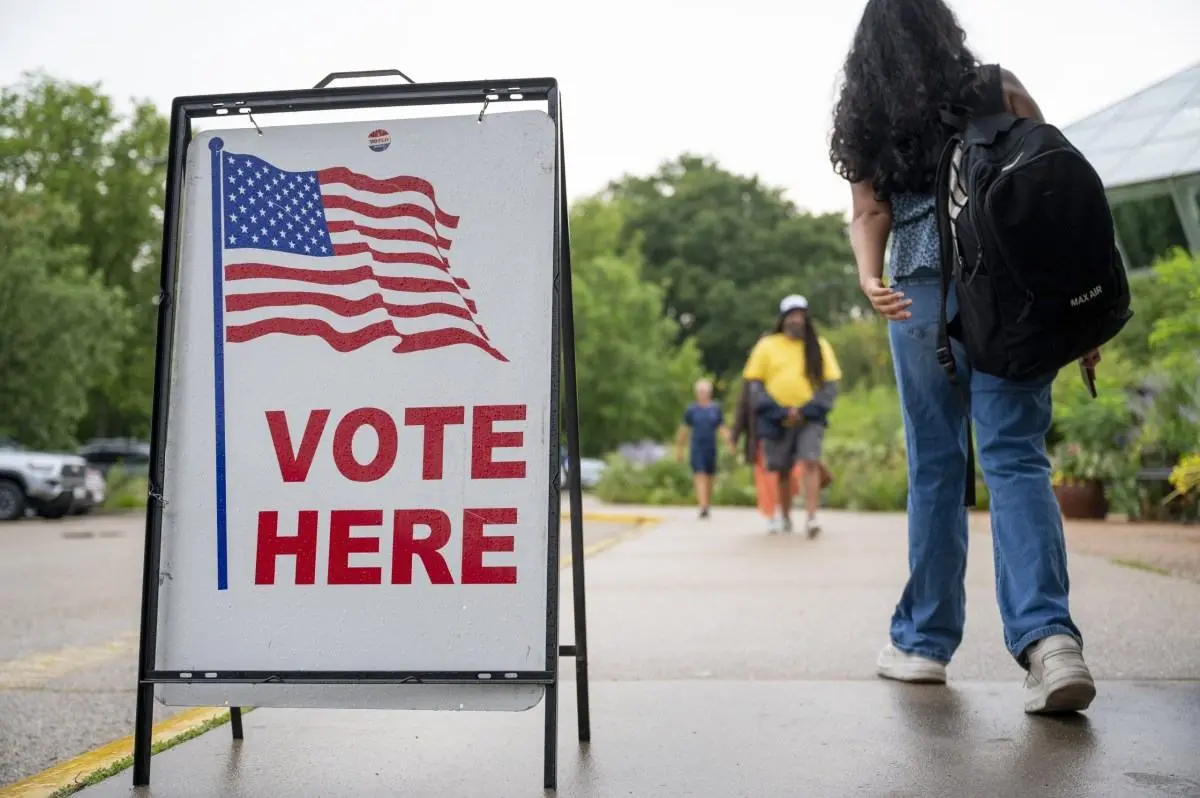
Voters walk past a “Vote Here” sign at a polling place at Olbrich Botanical Gardens during Wisconsin’s partisan primary in Madison, Wis., on Aug. 11, 2026
Source: Jake Piper for Wisconsin Watch
Election Day is Tuesday. Learn more about the candidates and questions on your ballot.
Voters get to decide control of the governor’s office, state Legislature, the House of Representatives and three constitutional amendments.
Tuesday is Election Day, and the votes Wisconsinites cast are expected to shape the Badger State for years to come.
Voters will choose between Democrat David Crowley and Republican Tom Tiffany for the state’s next governor after Democratic Gov. Tony Evers opted not to seek reelection after two terms.
Voters will select who to send to Congress and represent their corners of the state during the final two years of the Trump administration.
Elections for the state Assembly and Senate will determine which party holds power in the Legislature and whether there will be split government or one-party control in the Capitol in the coming years.
Four-year terms for attorney general, secretary of state and treasurer are also on everyone’s ballot in Wisconsin, as well as three constitutional amendment questions. County sheriffs, clerks of court and in some areas school funding referendums are also on the ballot.

The key question on Tuesday is to what extent the national midterm wave favoring Democrats hits races across Wisconsin’s ballot. The final Marquette University Law School poll before Election Day showed President Donald Trump’s approval rating at a record low of 37% among registered voters in Wisconsin. In the governor’s race, Crowley leads Tiffany 51% to 44% among likely voters with 4% undecided ahead of Tuesday. Crowley has a 30-point lead with likely independent voters at 56% to Tiffany’s 26%.
Wisconsinites have exceeded the number of people who voted early in 2022, when the governor’s race and the U.S. Senate race were the top contests on ballots that year. As of Friday, more than 693,000 people voted early in person or by mail, according to the Wisconsin Elections Commission. At the same time in 2022, more than 642,000 people cast a ballot prior to Election Day.
Polls are open from 7 a.m. until 8 p.m. on Tuesday. Learn what’s on your ballot, your polling place location and more at myvote.wi.gov. Voters must show a valid photo ID and can register at the polls on Election Day with proof of residency.
Before then, read more about the candidates for statewide, congressional and legislative races by visiting Wisconsin Watch’s 2026 voter guide.
Governor and lieutenant governor
It’s been 16 years since the last open race for governor in Wisconsin.
Candidates entered the race left and right after Evers announced his retirement in 2025. It’s now down to Crowley, the Democrat, and Tiffany, the Republican.
Both men are two very different candidates. Crowley, 40, is in his second term as Milwaukee County executive and previously was elected to two terms in the state Assembly. He narrowly won the Democratic nomination in August with Evers’ endorsement. If he is elected on Tuesday, he would become the state’s first Black governor.
Crowley’s campaign has focused on lowering costs for Wisconsinites with ideas like providing a public option for BadgerCare and capping child care costs at 7% of a household’s income for families with children under age 5. He also has promoted his ability to work across the aisle to pass bipartisan legislation, frequently highlighting the 2023 shared revenue law that allowed Milwaukee County, and the city of Milwaukee, to enact new sales taxes to offset the deficits caused by rising pension costs. Tiffany has used the sales tax increase to suggest Crowley would raise taxes as governor.
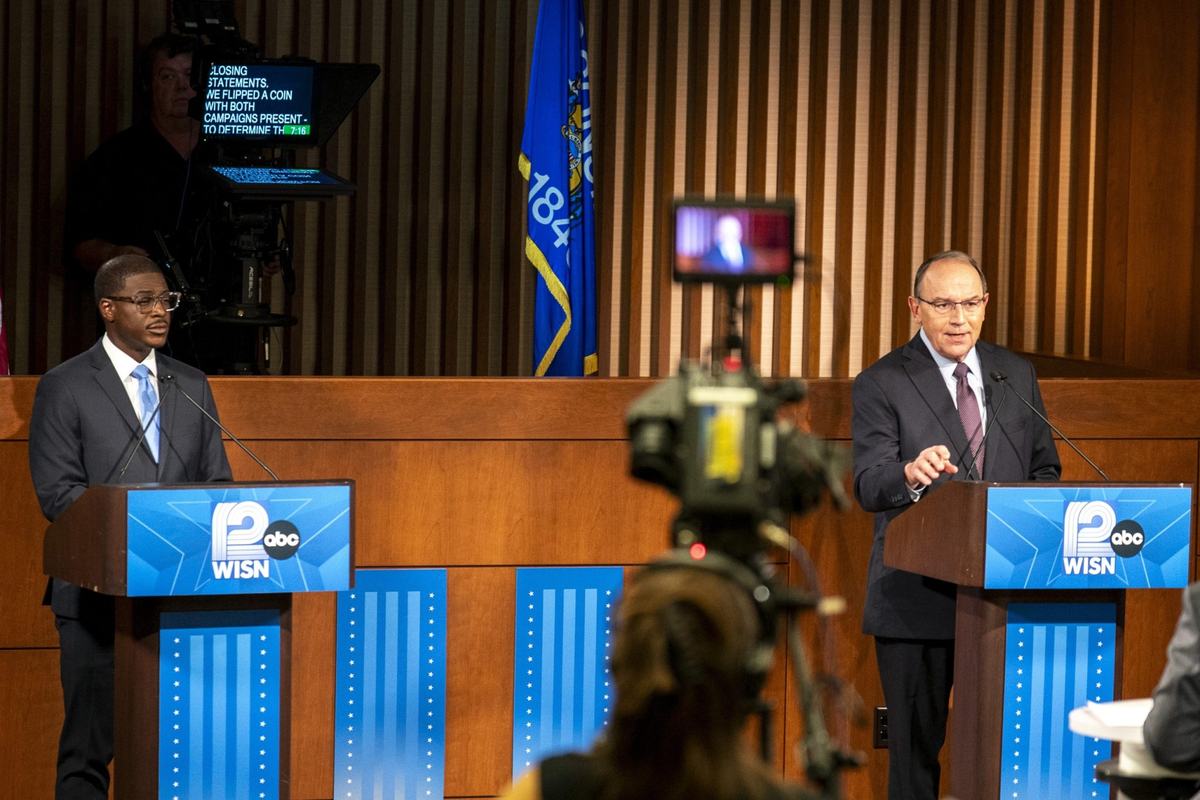
Tiffany, 68, has represented Wisconsin’s 7th Congressional District in the U.S. House of Representatives since he was first elected in 2020. He also served one term in the Assembly and was elected twice to the state Senate. He cleared the Republican primary field earlier this year after receiving Trump’s endorsement. Crowley has attacked Tiffany’s connection to Trump as the president’s approval ratings plummet.
Tiffany’s campaign has also focused on rising costs across the state, although his solutions have largely focused on lowering taxes, specifically freezing property taxes and providing a 10% income tax cut to families earning less than $150,000 a year.
Voters will see a second name on their ballot alongside Crowley and Tiffany. In Wisconsin, candidates for lieutenant governor form a joint ticket with the gubernatorial nominee after the state’s partisan primary.
The Democratic nominee for lieutenant governor is Secretary of State Sarah Godlewski, and the Republican nominee is David Varnam, a stay-at-home dad who previously served as mayor of Lancaster. Godlewski was unopposed in the Democratic primary, and Varnam defeated the Republican Party of Wisconsin-endorsed candidate in the party’s primary to join Tiffany’s ticket.
Voters will see the governor and lieutenant governor candidates as a joint ticket in the same section on the ballot. A vote for the Republican or Democratic candidate for governor is a vote for the same party’s candidate for lieutenant governor.
Attorney general
The 2026 race for attorney general is a rematch of the 2022 contest between two-term Democratic incumbent Josh Kaul and Republican Fond du Lac County District Attorney Eric Toney. Kaul defeated Toney four years ago by less than 2%.
In the rematch, Kaul has said he wants to continue progress he believes the state has made in protecting Wisconsinites, including securing settlements tied to the state’s environmental laws and responding to the opioid epidemic. Toney has criticized Kaul for “broken promises” tied to backlogs at the state’s crime labs and making politics part of leading the state’s Department of Justice through lawsuits against the Trump administration.
Congress
All eight congressional districts are up for reelection, but the 1st and 3rd districts are the key races to watch as Democrats set their sights on both.
Republican U.S. Rep. Bryan Steil faces a challenge from Democrat Mitchell Berman, an ER nurse and political newcomer, in Wisconsin’s 1st Congressional District. Berman is positioning himself as an outsider, looking to appeal to working-class voters who are unhappy with Steil’s record in Congress. He was added to the Democratic Congressional Campaign Committee’s “Red to Blue” program in September, which provides chosen candidates with campaign support. Steil, who has represented the district since 2019, has greater name recognition and financial resources.
Polling is close in this race. A Fox News Power Ranking listed the district as a “toss-up” and the nonpartisan Cook Political Report shifted its rating from “likely Republican” to “lean Republican.”
The 3rd Congressional District is one of the most targeted seats in the nation as Republican U.S. Rep. Derrick Van Orden faces a challenge from Democrat Rebecca Cooke, a rematch from 2024. National Democrats have also added this district to its “Red to Blue” program, and Sabato’s Crystal Ball, a nonpartisan organization forecasting election outcomes, recently labeled this district as “leans Democratic.”
Cooke is a waitress and former political consultant. Her top priorities include a $15-an-hour federal minimum wage, addressing teacher shortages with bonuses and raises, protecting abortion rights and expanding Medicare. Van Orden, who has held the seat since 2022, has focused much of his time in Congress on veteran-related legislation. He emphasizes working with Trump on issues such as the war in Iran.
This is the first year since 2020 — when Van Orden first ran and lost to the Democratic incumbent Ron Kind — when Republicans are not favored to win. Republicans may lose seats if this year follows a historical pattern of midterm voters punishing the president’s party.
Assembly and Senate
Republicans have controlled both chambers of the Legislature since they swept into power in 2010. This year, it’s a competitive landscape for the Assembly and the Senate, stemming from significant gains Democrats made in 2024 after new legislative maps were signed into law.
The moves Assembly and Senate Democrats made two years ago occurred the same year Trump won Wisconsin on the way back to the White House. In 2026, the national political environment supports Democrats. Wisconsin’s Assembly and Senate Democrats are eyeing potential majorities in both chambers if that national mood flows down-ballot to legislative races.
In the Senate, Democrats need to flip two of three Republican-held seats and hold onto a Democratic district in Eau Claire to win a majority in the chamber. Former Vice President Kamala Harris won in the districts for all four of those key races in 2024, according to an analysis by John Johnson, a research fellow at Marquette University Law School.
In the Assembly, Democrats need to maintain all 45 of their existing seats and flip another five Republican districts to win a majority. Republicans hold five seats in districts that Harris won in 2024, but Democrats also have to compete against strong incumbents in several of those districts.
Secretary of state
Three candidates are running for Wisconsin secretary of state, a role with limited responsibilities compared to officials with the title in other states across the country.
The candidates this year include Republican Jay Schroeder, Democrat JoCasta Zamarripa and Green Party candidate Pete Karas.
The debate in this race has focused on duties that the office does not currently have the power to control. Schroeder has campaigned on ending the Wisconsin Elections Commission and bringing the duties under the secretary of state, an action that would require approval from the governor and the Legislature. Zamarripa said she instead sees the office as a platform to protect voting rights. Karas said his campaign aims to break the state’s two-party system.
Treasurer
Republican State Treasurer John Leiber, the lone statewide GOP elected official, faces a challenge in 2026 from Democrat Yee Leng Xiong, the executive director of Wausau’s New Beginnings for Refugees who is also a Marathon County Board member and D.C. Everest School Board member.
Like the secretary of state, Wisconsin’s state treasurer has limited responsibilities. Republicans sought to entirely eliminate the office eight years ago, but the effort was rejected by voters. Leiber said he wants to provide continuity to the office, which hasn’t had a multiterm treasurer since Republican Jack C. Voight served from 1995 through 2007. Xiong said he sees an opportunity to grow the treasurer’s responsibilities, especially if Democrats control the Legislature and the governor’s office.
Three constitutional amendments
Three questions on ballots across the state are asking voters to determine whether to make changes to the state constitution.
Under the eight years of the Evers administration, Republican lawmakers have used the constitutional amendment process as a way to avoid the governor’s veto pen.
The questions on the ballot in 2026 attempt to address what Republicans have described as various aspects of government overreach and Democrats and other civic groups have said are unnecessary changes.
The constitutional amendments before voters include:
- Whether the governor should have the ability to raise taxes or fees through the use of the partial veto. The question stems from Evers’ 2023 veto that raised school district revenue limits for the next 400 years, which Republicans incorrectly describe as a property tax increase. Increased revenue limits allow districts to raise property taxes, but local school boards ultimately make those decisions. Under limits, the state can also lower property taxes with increased state funding for public schools.
- Whether the state government can close a place of worship during a public health emergency, such as during the COVID-19 pandemic.
- Whether various levels of government from education to state agencies should be prohibited from “discriminating against, or granting preferential treatment to, any individual or group on the basis of race, sex, color, ethnicity, or national origin.” Groups both opposed and in support of the amendment have described it as an anti-diversity, equity and inclusion measure that could limit programs and resources for minority communities across the state.
School district referendums
Another 71 school districts are asking voters in their communities to approve tax increases to either help districts pay expenses to operate their schools or borrow money for construction projects.
Fifty-four districts are seeking operational help from taxpayers while 10 districts are asking voters to sign off on capital expenses. Seven school districts are asking voters to sign off on both operating and construction referendums. They include: Brown Deer, Greenfield, Little Chute, Lodi, Princeton, Unity and Waunakee school districts.
Earlier this year, 72 school districts turned to voters to sign off on referendums. Just over 60% were approved during the April election.
Other local races
Voters will also make decisions in local elections, such as county sheriff and clerk of circuit court. For more information about specific local races on your ballot, visit myvote.wi.gov.

Originally published by Wisconsin Watch.