

Source: Getty Images
How Wisconsin’s gubernatorial candidates differ on election administration
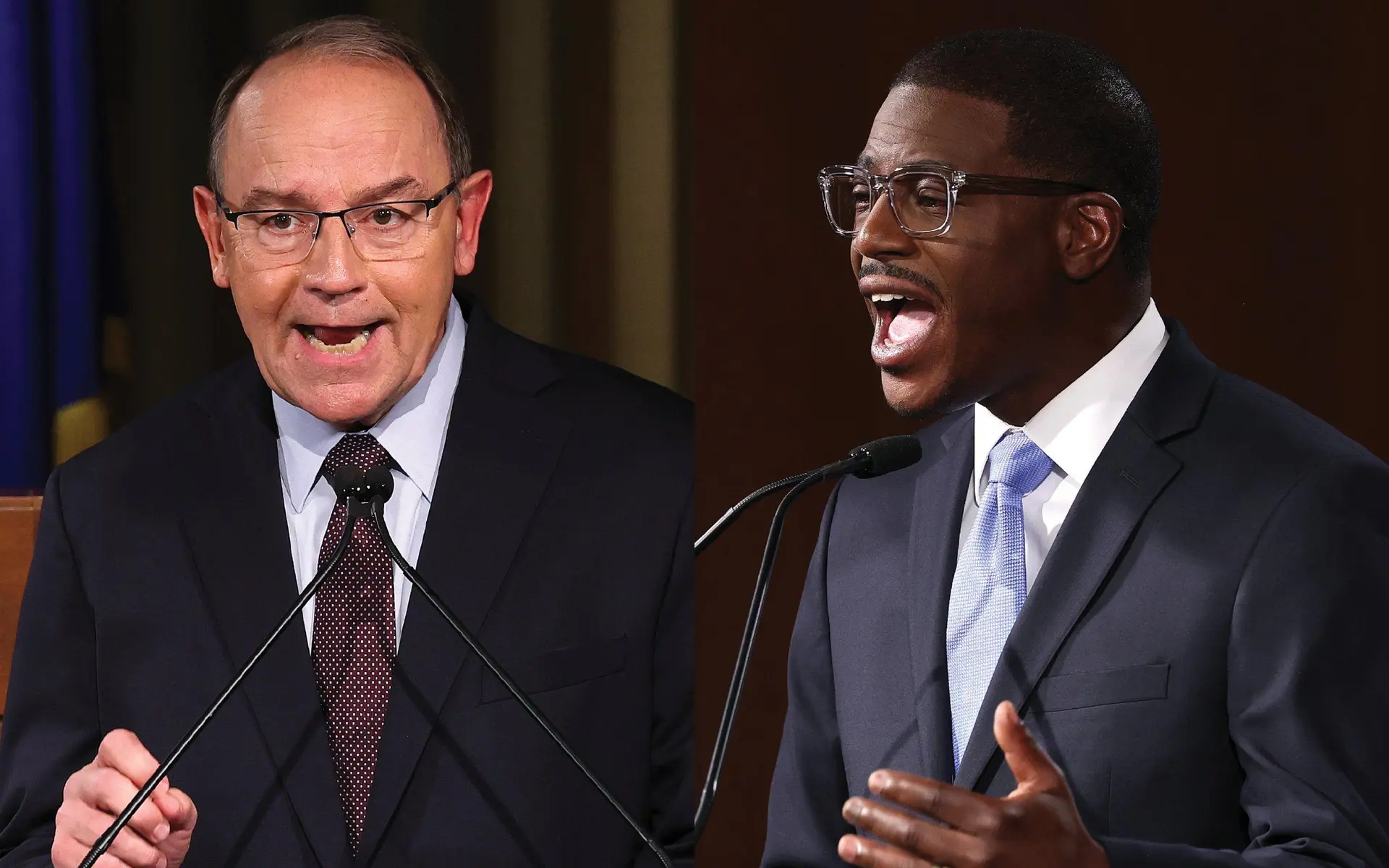
U.S. Rep. Tom Tiffany has largely supported President Donald Trump’s election agenda, which Milwaukee County Executive David Crowley has denounced.

This article was originally published by Votebeat, a nonprofit news organization covering local election administration and voting access.
The election is underway for Wisconsin’s first open gubernatorial race in over 15 years, as voters decide between two candidates who offer strikingly different views and rhetoric on election administration.
U.S. Rep. Tom Tiffany, a Republican, has supported many of President Donald Trump’s election goals, including efforts to overturn the 2020 election, while his opponent, Milwaukee County Executive David Crowley has backed many Democratic election priorities and denounced Trump’s efforts to undermine elections.
Here’s how the gubernatorial candidates’ views differ and — in one instance — align.
2020 election
Six years later, the 2020 election continues to be front and center in Wisconsin’s election discourse and a recurring topic on the campaign trail. The FBI this year probed Milwaukee officials about the election as an ongoing lawsuit seeks to obtain Milwaukee County’s 2020 Ballots. A criminal case against 2020 false electors is ongoing.
Tiffany in 2020 voted not to certify the 2020 election, and has expressed support for the FBI probe into how the election was conducted in Milwaukee. During his campaign, Tiffany dodged questions about the legitimate winner of the 2020 election, before conceding in August that “Joe Biden won.”
David Crowley, who currently serves as Milwaukee County Executive, has vehemently denounced the 2020 probe. He said the 2020 election was properly conducted, adding that “no amount of fear and intimidation from the Trump administration will change that truth.”
Voter registration and identification
Tiffany has been a consistent supporter of federal legislation that would require voter registrants to provide proof of citizenship. He also told Votebeat he would sign legislation comparing state transportation records with the voter registration database to identify ineligible voters.
In 2011, while serving in the State Assembly, Tiffany co-authored the legislation that established Wisconsin’s photo ID requirement for voting, one of the strictest in the nation.
Crowley has criticized Wisconsin’s voter ID law, which requires voters to present an acceptable form of photo identification when casting a ballot, rather than when registering. In 2020, Crowley called voter ID an “extreme barrier” in low-income communities and communities of color, likening it to “what was going on in Jim Crow days with the literacy test.”
During his time in the Wisconsin Legislature, Crowley was the lead author of a bill to establish automatic voter registration, which would allow eligible residents to be registered during interactions with state agencies. The bill never received a public hearing or floor vote.
Ballot processing
Unlike many states, Wisconsin election officials cannot begin processing absentee ballots until Election Day. It’s a restriction that can delay the reporting of results in communities with large numbers of mail ballots, particularly Milwaukee. A bipartisan proposal would allow clerks to begin processing absentee ballots on the Monday before an election, without counting or releasing results until Election Day.
Crowley’s team told Votebeat that he supports the proposal.
Tiffany didn’t respond to a request for comment. He acknowledged the Monday processing bill at an August press conference but didn’t say whether he supports it.
Wisconsin Elections Commission
In 2015, while serving in the state Senate, Tiffany voted to create the Wisconsin Elections Commission, which replaced the Government Accountability Board as the agency overseeing the state’s elections.
But, at a recent debate, Tiffany said he was open to dismantling or making significant changes to the agency, arguing that it needs greater accountability. He said he would only eliminate the agency if lawmakers could agree on a better replacement.
Crowley’s team told Votebeat that he wants to keep the Wisconsin Elections Commission in charge of elections. At the debate, Crowley acknowledged that the agency isn’t perfect but defended its resistance to the Trump administration’s efforts to obtain unredacted Wisconsin voter information.
Both would certify 2028 presidential winner
The next governor’s ability to reshape Wisconsin election laws will depend in part on who controls the Legislature. Both legislative chambers have been controlled by Republicans for over a decade, but Democrats hope to flip at least one chamber in November.
The governor can sign or veto election legislation, giving the office significant influence over which policies become law. The governor also plays a part in certifying presidential results. At an October debate, Crowley questioned whether Tiffany could be trusted to certify the 2028 election, citing his efforts to overturn the 2020 results.
But Tiffany said, “I will certify the election in 2028, regardless of who the winner is.”
Crowley, asked whether he would certify the results, answered: “Absolutely.”
Alexander Shur is a reporter for Votebeat based in Wisconsin. Contact Alexander at ashur@votebeat.org.
Votebeat is a nonprofit news organization covering local election integrity and voting access. Sign up for their newsletters here.

Alexander Shur is a reporter for Votebeat based in Wisconsin. Contact Alexander at ashur@votebeat.org.


