

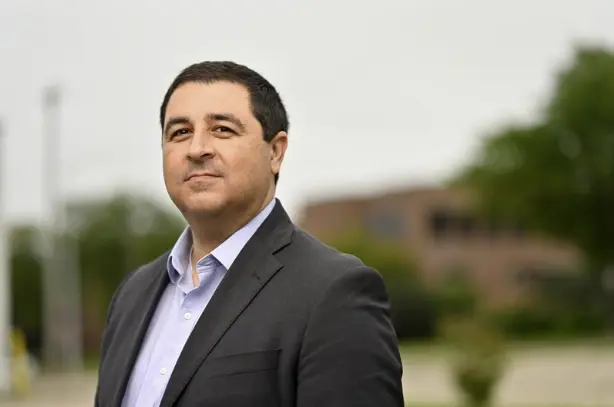
Wisconsin Attorney General Josh Kaul
Source: Provided by Kaul campaign
Josh Kaul is on the front lines in defense of Wisconsin against Trump

The race for Attorney General couldn’t be more important. A victory for the Republican and President Donald Trump has another tool to negatively impact the lives of Wisconsinites.
The race has been razor-thin in recent elections and running again is Democrat Josh Kaul and it is critical he be reelected in the era of Trump.
A 45-year-old Wisconsin native, Kaul is the son of Peg Lautenschlager, a former attorney general and longtime Democratic politician. Kaul grew up in the Oshkosh and Fond du Lac areas. He graduated from Yale and his law degree is from Stanford. Before returning to his home state, he was a federal prosecutor in Baltimore where he targeted drug traffickers.
Under his watch in Wisconsin, crime has steadily declined in recent years since historic highs during the pandemic.
The Milwaukee Courier, Wisconsin’s oldest Black-owned newspaper, is proud to endorse Kaul for attorney general for this midterm election.
Here is a Q&A with Kaul from earlier this month that has been lightly edited for clarity.
You’ve done a lot of work on school safety, but also child predators and you filed a lawsuit against Meta to address issues on social media. Can you summarize your goals on protecting children?
People should feel safe in communities around the state and certainly kids should feel safe in our schools and keeping our kids safe is of the utmost importance. And I'm proud of the work we've done on that during my time as AG, in a variety of ways. The Wisconsin Department of Justice leads the Wisconsin Internet Crimes Against Children Task Force. And my administration has helped put child predators behind bars. We also have done a lot of work around school safety. That office was launched in 2018 following the Parkland tragedy, so it was before I took office, but during my time as AG, we both launched some innovative programs there and I fought for funding for that office and helped to keep it funded. We continue to work to get long-term funding lined up. But one of the things that office did was launch a 24/7 tip line that anybody associated with a school or who was concerned about school safety issues can call, so folks who are trained to respond can get help to communities where it's needed and help keep kids safe. We also have provided guidance to schools on behavioral threat assessment and management. And the idea is teachers are trained in teaching our kids, they're not experts in public safety issues. This helps give schools some guidance as to how they can determine if a particular issue that comes up in class is just the kind of routine thing that happens and is not of major concern, or maybe the kind of thing that may be an indicator that there may be a safety concern associated with that. Those are just a couple examples of the work that office does, but it's helping to keep our schools safe. And we helped secure a settlement that requires Meta to pay billions of dollars and to make a number of changes that put kids safety ahead of its profits.
Crime is down in Milwaukee, including homicides. How has the DOJ played a role in these successes?
First I want to be clear that public safety and making communities safer is the result of the work of a lot of people. And a lot of people contribute to making our community safer. And I'm proud of the role that the Wisconsin Department of Justice plays in helping with public safety efforts around the state of Wisconsin. One thing that I think has been important to public safety throughout the state, is the work that's been done to fight the opioid epidemic. It's important because of all the lives that have been impacted by that epidemic. But there's also other crime that is often associated with addiction. And so by addressing the opioid epidemic, you're not only addressing its direct impacts but also the indirect impacts. And so my administration helped to secure the recovery of over $800 million from those who were alleged to have contributed to the opioid epidemic. Many of those dollars have begun going to communities around the state to help fight the epidemic. And from 2023 to 2024, there was a reduction of over 40% in opioid overdose deaths in Wisconsin. We don't have final numbers for 2025 yet, but it certainly looks like there's going to be another meaningful reduction from 2024 to 25. Then when it comes to crime, my administration has worked to keep kids safe. I fought to pass legislation that's going to help prevent Wisconsin from ever having another backlog of untested sexual assault kits. I fought for funding for crime victim services. Last year, we had the lowest number of violent crimes statewide that we've had since 2011.
You’re from Wisconsin but worked in Baltimore as a federal prosecutor. What lessons did you learn while there?
I was a federal prosecutor in Baltimore, and I worked in the narcotics section in the United States Attorney's Office. And I prosecuted murderers, gang members, and drug traffickers. First, I certainly saw the impact that crime can have through that work. And I also saw how important it was to build strong law enforcement community relations. One thing that was a challenge in Baltimore and can be a challenge for law enforcement in a lot of contexts is, even if somebody witnesses a crime, that doesn't mean they necessarily are going to come forward and provide that information to law enforcement. But it's critically important to get accountability for that to happen. And so when you build strong relationships between investigators and community members, that's not only important for building trust and for building a positive atmosphere, it's also important for solving crimes. And so one way you can see that reflected is originally back in 2021, I introduced a plan called Safer Wisconsin and there was an updated version that was put out later. The idea was to make investments that can help make communities safer. And so I proposed investing in officer recruitment and retention in community policing and violence prevention, reentry programs, treatment for substance use disorder and for mental health issues. Those are the kinds of investments that I think can help make communities safer. We haven't seen the Legislature take action on that, but I was encouraged in the last state budget that included additional funding for shared revenue because that then allows communities to have more resources to make the kind of investments that can help make communities safe. Continuing on the path that we are on right now, we're making progress, is important for the state.
You’re not shy about fighting back against the Trump administration. What have been some legal wins against Trump?
Yeah, there have been over 70-plus multi-state cases that we've joined challenging different Trump administration actions. A lot of them are cases where the Trump administration has either put illegal conditions or made illegal cuts or illegal freezes of federal funds. And those are really important to the state because it varies what they relate to. One case involved, just for Wisconsin, over $2 billion in public health funding. There were efforts to cut funding that supports medical research. There was a freeze of funds for education in Wisconsin. They tried to eliminate the America Corps program. So those cases where we've been challenging those and ensuring that resources that by law should be coming to Wisconsin. These are our tax dollars we're talking about. The abortion case, I think that's a critically important one. For about 15 months women in Wisconsin didn't have access to safe and legal abortion in the state. And that's a stark contrast in the AG’s race from that case, by the way, because when Eric Toney was running for AG against me when we were first litigating that case, he called the case a partisan stunt. He called it a farce. He said it should be dismissed. You know, ultimately last year, the state Supreme Court ruled on that case and they ruled in our favor. And then defending the results of the 2020 election. There was an effort to overturn the results. My administration defended against those legal challenges and we won every single case. And so the results of the election were upheld.
Do you ever see yourself arguing in court anymore?
These were both in my first term, but I argued two cases before the state Supreme Court. If I think the occasion calls for it, there may be time when that's appropriate, but running a large agency is obviously a full-time job. And so, being able to make the time you need to personally be involved in cases can be a challenge for sure. I loved working on trials when I was a federal prosecutor. I worked on voting rights cases, when I was in private practice. So, I do miss being able to be in court as often as I used to, but I'm certainly motivated by the impact we're able to have as an agency through the many different cases we're involved in.
You are also looking to crack down on sports betting in prediction markets, correct?
Yeah, there are a few things going on. We filed a suit seeking to stop what we allege is sports betting by prediction markets to the extent that the sports betting is taking place in Wisconsin. The federal government then also filed a suit against us, and then there's a private company that's filed a suit against us as well. Those cases are all pending right now. And so the legal process is ongoing. There’s not much of an update at this point. Our complaint is focused on enforcing Wisconsin law. And so, under Wisconsin law, there's prohibitions on gambling. There are certain exceptions that have been made in state law, and you just talked about one where there is legislation that was passed, although there will need to be compacts before the online gaming happens. Part of our responsibility at the Department of Justice is to enforce state law, and we've argued that what these prediction markets are doing is basically facilitating gambling, just calling it something different, and that you don't get to evade the gambling laws by changing what you call the activity that's happening. And we want to make sure that we are protecting Wisconsinites. Gambling around the country where it's allowed is highly regulated. The argument that's being made in these cases, these prediction cases, including by the Trump administration, by the way, is that the CFTC, this federal agency, should be able to make all these regulatory decisions, even though it doesn't have a background in this area. And that would take a lot of authority away from the states and move it to the federal government. I forget which companies, I believe it’s Kalshi, where Donald Trump Jr. is involved in the company. But, there's clearly an effort by the federal government here to seize regulatory authority over this area and to displace states. And one of the things that's pretty interesting about this actually is there's a bipartisan group of AGs that have been involved in advocating against the Trump administration's position. So it's not only Democratic states, but also Republican states that are opposing what the prediction markets have been arguing.
What does Eric Toney winning the race mean even if the Democrats win the governor’s office and the Legislature?
As I mentioned, we've joined 70 plus multi-state cases challenging different Trump administration actions. In all those cases, there is not a single one where a Republican AG has joined us in challenging what the Trump administration was doing. In the mail-in voting case, some Republican AGs came in on the other side of the case, but clearly you would not see an AG who's standing up to the Trump administration like I have been. In some cases where we get orders in these multi-state cases, the orders only apply in the states that have been part of these actions. And so, if Wisconsin's not part of some of these suits, we don't benefit from the order in these cases. It also means that essentially the Trump administration would have a lot more control over the lives of Wisconsinites, because in a lot of these cases, they put illegal conditions in place. They try to dictate what the state can do or what its role is. Now, there have been a few Democratic governors who have gotten involved, where they had Republican AGs, and I think that's the position that Governor Crowley would be in if that situation were to arise. But obviously having the full team at the Wisconsin Department of Justice working on these cases is a much better position to be in than to have a governor's office trying to litigate on behalf of the state. When it comes to legislation, there are a lot of areas where we can strengthen our laws. Consumer protection is one good example. We could do more on anti-trust enforcement, which is important for stopping companies from improperly raising costs, and having an AG's office that's working collaboratively with the Legislature to advance good legislation, I think is really valuable because it's folks at the AG's office who are enforcing consumer protection laws and anti-trust laws, and environmental laws and so can really provide good insight to the Legislature as to how they can be most effective with legislation that they're passing.
The DOJ investigates non-Milwaukee area police shootings, such as the fatal police shooting of Corey Ruiz in Madison. The Dane County District Attorney’s Office is set to make a charging decision any day. What goes into these DOJ investigations and why are officers often not held accountable?
Let me start with just what the DOJ's role is. There’s a law that was passed in Wisconsin that provides that if there's an officer-involved death, there needs to be an independent agency that leads the investigation. And what's happening around the state is that, in many cases, the outside agency that's brought in is the Wisconsin Department of Justice, which I lead. There is a team in the Milwaukee area, the Milwaukee Area Investigative Team. And so in that part of the state, a lot of the officer-involved shootings tend to be involved by that team and not by our office. But in many of these cases in the rest of the state, it's our office that's investigating these cases. A couple things I would say about that. First, it's important that these investigations be conducted even handedly, that they be conducted fully and comprehensively, and that the investigators follow the facts where they lead. I'm proud of the way that we do that at the Department of Justice. I also think it's really important that there be transparency. And so what you see at the end of our cases is if there's a criminal charge that's brought, then the case goes through the criminal process. If there's not, we make the records publicly available from that case and you can go online and get them. So folks can actually look online and see the investigative steps that were taken, see what happened during the course of the investigation and see the outcomes there. So, with the cases that we've worked on, the ones that I can speak to, I encourage folks to look and see what we've done because like I said, we're very committed to ensuring that the investigations are conducted objectively and fully. And then a charging decision is made by the DA in the county where that happens. So we're not the agency unless we were appointed as a special prosecutor. We wouldn't be the agency that made the charging decision. We just investigate the case and provide that information to the DA for the charging decision. I do think building strong law enforcement community relations helps reduce the likelihood of there being confrontations. The more that people who are having an interaction with people who know each other, the less likely there is to be either some sort of misunderstanding or lack of clear communication on anybody's part. The more that people have an understanding of the people they're dealing with, I think the less likely you are to have some kind of crisis event arise. And so having community policing is another thing that would be really helpful. Having crisis response teams where we've worked to get social workers or mental health professionals involved in responding to circumstances where somebody has a mental health crisis. Those are all steps that I think make our system fair and more equitable and also increase public safety.
What have you done to expand transparency at the AG’s office?
I think it's really important for the public to know what their Department of Justice is doing in a variety of ways, and that includes cases that we're acting as a law enforcement agency and enforcing the laws, being clear about what we're doing and why we're doing it, or to the extent we're talking about litigating cases against the federal government. I held a town hall in Green Bay, for example, where I talked about the multi-state cases that were involved in. And I think that's important because, first, it's important for people to know what's going on in this area of government. And secondly, I think the communities where there is open discussion and transparency, I think building community trust helps build safer and stronger communities. There's an important caveat, and I want to be clear about this, which is that when you have an ongoing investigation, it's of vital importance to protect the integrity of that investigation because if you don't, that can have all sorts of complications if there's a case that's ultimately brought. So there are times when because of the need to protect the integrity of investigation, there's limited information that can be provided. But like we do with the officer-involved shooting investigations, if there's not a charge brought, making sure that information is publicly available at the end of the process does help with transparency. I do think it's encouraging that Crowley is out there talking about transparency and how we can make government more accessible. It's important to note that the one area that I think is really critically in need of a change is the fact that the Legislature doesn't need to retain its records. So while agencies like mine have records retention rules, and respond when information is requested, the Legislature has exempted itself from that. And so I'm hopeful we will see a change on that issue early in the new administration.
Drake Bentley is the general assignment reporter for the Milwaukee Courier, covering politics, sports and the community. He is an award-winning investigative journalist who has worked for the Milwaukee Journal Sentinel, Wisconsin State Journal, Newsweek, Heavy and The Sporting News. He is a northside Milwaukee native, former political staffer and graduate of the University of Wisconsin-Whitewater and the University of Nebraska.


