

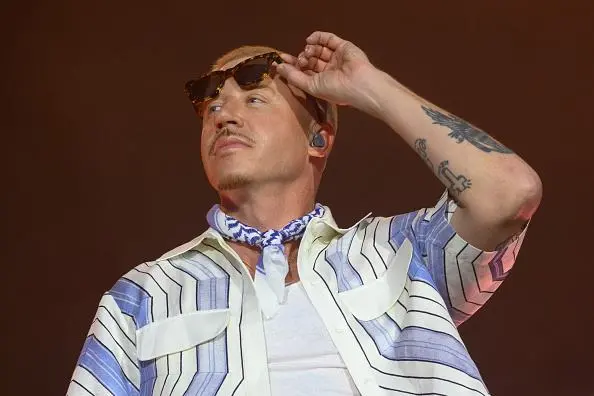
PARIS, FRANCE - JULY 19: American rapper Macklemore performs live on stage during the 5th Lollapalooza Paris Festival on July 19, 2025 in Paris, France. (Photo by Kristy Sparow/Getty Images)

Oct 5, 2026, 2:11 PM CT
Share


In the “Home of the Brave, Land of the Free,” can you really speak your mind without facing consequences?
It sounds like a simple question. It isn’t.
Social media has given almost everyone a platform. We tell stories, share experiences and create narratives about the world around us. But having the freedom to speak does not necessarily mean speaking comes without a price.
The more visible you become, the greater those consequences can be.
Entertainers, athletes, actors and musicians have some of the largest platforms in the world.
When they speak about social issues, race, politics or humanity, their words can reach millions.
And sometimes, those words come with a price.
Macklemore is an interesting example.
The Grammy Award-winning rapper has never been afraid to address social issues. Songs such as “Same Love” and “White Privilege II” tackled subjects ranging from marriage to race and privilege.
That makes his relationship with hip-hop particularly interesting. Hip-hop has long been a place where people could tell stories that weren’t always being told somewhere else. It gave people a microphone when traditional institutions didn’t necessarily give them one.
On Sept. 4, while performing as an opening act for Ed Sheeran, Macklemore said, “Free Palestine.”
Those two words became much bigger than a concert.
The statement generated controversy, and sponsorship concerns followed. The situation ultimately resulted in Macklemore being removed from future NFL-stadium performances, according to reports surrounding the incident.
So what does that say about free speech?
The First Amendment protects Americans from government restrictions on speech. But being free to speak does not mean being free from criticism, professional consequences or disagreement. It states:
“Congress shall make no law respecting an establishment of religion, or prohibiting the free exercise thereof; or abridging the freedom of speech, or of the press; or the right of the people peaceably to assemble, and to petition the Government for a redress of Grievances.”
You can be free to speak and still lose a job.
You can be free to speak and still lose a sponsorship.
You can be free to speak and still lose an audience.
Authors Marc Lamont Hill and Mitchell Plitnick write in their 2021 book, Except for Palestine: The Limits of Progressive Politics, that Palestinians “had been fed up with a quarter century of talks that always prioritized Israeli concerts over their own.”
We’ve become very comfortable celebrating free speech when we agree with the speech. The real test comes when we don’t.
We don’t have to agree with Macklemore. We don’t have to agree with his politics or his message.
Hill and Plitnick’s book states why Macklemore made his stand: “For decades, Israel has officially and publicly demanded that Palestine recognize its 'rights to exist.’”
But disagreement is not the same as silence.
Perhaps that is the part of free speech we sometimes forget.
The right to speak doesn’t promise that everyone will applaud. It simply gives us the opportunity to use our voice.
And sometimes the real question isn’t, “Can I say this?”
“Am I willing to say it knowing what might happen afterward?”
That’s the price of having a voice.
Zachary Collier is a graduate student at Temple University in Philadelphia, studying afrocology. He is writing stories about life.


