

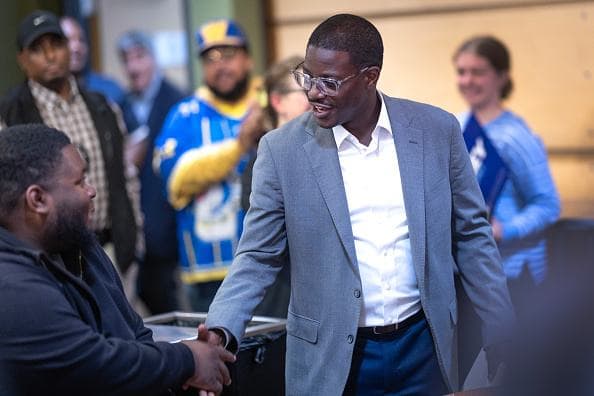
MILWAUKEE, WISCONSIN - OCTOBER 01: Wisconsin Democratic gubernatorial candidate David Crowley greets supporters as he arrives for a campaign event at the Milwaukee Public Market on October 01, 2026 in Milwaukee, Wisconsin. Crowley is running against U.S. Rep. Tom Tiffany (R-WI). (Photo by Scott Olson/Getty Images)
Crowley proposes Milwaukee County 2027 budget with property tax cut, no Flock funding, a new courthouse, and paid parking at beaches

Oct 1, 2026, 4:35 PM CT
Share


Milwaukee County Executive David Crowley presented his 2027 budget to board supervisors on Oct. 1, saying the county has strengthened its finances but “major challenges remain.”
Crowley, the Democratic candidate for Wisconsin governor, stepped off the campaign trail to deliver his remarks at the Milwaukee County Courthouse.
Including in this year’s budget, the property tax rate for Milwaukee County homeowners has decreased every year the 40-year-old has been in office, despite what his Republican opponent Tom Tiffany says.
The $1.5 billion budget closes a projected $50 million gap for 2027, Crowley said.
The budget prioritizes public transit, which Crowley said can open up commerce and job opportunities for workers. Other proposals include moving forward on a new Milwaukee County Courthouse complex and rehabilitation of the Mitchell Park Domes.
Despite funding for the domes, Milwaukee County Parks face a gloom reality in 2027. Crowley is proposing a pilot program of paid parking at high-demand locations, like the lakefront. Without this program, the parks face significant cuts, he said.
The budget also cuts all funding for Flock cameras on county property.
After mismanagement from prior administrations, the county has climbed back, increased reserves by five times, and remains in good standing, Crowley said.
“For years, Milwaukee County faced budget deficits, declining revenues, and a growing deferred maintenance backlog created by past county leadership,” he said. “Left unaddressed, that structural deficit was projected to balloon to $109 million by 2028.
“So, we’ve had to make hard decisions each year to get Milwaukee County back onto solid financial footing.
“We tackled long-standing fiscal problems head-on, secured new sources of revenue, cut waste, and identified more efficient and innovative ways to deliver services throughout the community.”
Crowley touts Wisconsin Act 12 — the shared revenue deal the county executive made with Republicans in Madison and the governor — as a successful bill that generated millions in new revenue. The bill allowed the county to increase the sales tax by 0.5% as a way to generate revenue, something it wasn’t allowed to do for 15 years.
Crowley proposes a one-time withdrawal from the county’s reserves to help an ailing Milwaukee County Transit System, which has been plagued by poor state funding and millions in projected deficits.
“This reserve exists precisely for moments like this one with MCTS: to provide one-time support to cover short- term gaps,” Crowley said.
“It is not a tool for permanent fixes, like sustaining a bus line indefinitely.
“Rather, it's being used to buy our transit leaders the time they need to put lasting solutions in place.”
If passed, Flock cameras will be no more on county property.
Crowley said he was concerned “about how Flock collects and uses data — often without sufficient oversight” and that it was “enough to give me pause.”
“I will not continue to fund a program that carries the risk of misusing information about our residents. Period,” he added.
Crowley wants to redirect the funds to sustain the Eviction Free MKE program, the county’s right to counsel program that assists residents facing eviction.
“This issue is personal to me. I grew up in unstable housing and know firsthand the devastation that eviction can bring to a family,” Crowley said.
The budget also includes a 2% raise for all county employees and a large commitment to a new courthouse as the current one is decrepit and gets so warm and humid it could affect legal outcomes.

Drake Bentley is the general assignment reporter for the Milwaukee Courier, covering politics, sports and the community. He is an award-winning investigative journalist who has worked for the Milwaukee Journal Sentinel, Wisconsin State Journal, Newsweek, Heavy and The Sporting News. He is a northside Milwaukee native, former political staffer and graduate of the University of Wisconsin-Whitewater and the University of Nebraska.


