

The Wisconsin Department of Justice (DOJ) has joined 19 other states, including the commonwealths of Massachusetts and Virginia, in a lawsuit pushing back against the Trump administration’s attempts to attach immigration enforcement requirements to federal grants supporting state and local public safety efforts.
“Threatening to cut funding that supports law enforcement if states don’t agree to unlawful conditions is an abuse of the Trump administration’s authority,” Attorney General Josh Kaul said in a statement. “This funding should be distributed to the states, not improperly used as a bargaining chip.”
The lawsuit states that the grant programs, which have been active for decades, “provide more than a billion dollars to States annually to address some of the most serious threats to the safety of their residents: from gang violence to drug trafficking to sexual assault to all kinds of violent crimes.” The funds, which are enacted by Congress, are used “to assist more than 8.5 million crime victims; pay more than 200,000 claims for losses suffered by crime victims; and fund ongoing criminal justice and public safety operations, such as drug task forces, crisis intervention programs, and youth recidivism reduction efforts, in all 50 states and over 1,000 local government units nationwide,” the lawsuit states.
Under President Donald Trump, states which depend on these funds have been advised to either cooperate with Trump’s immigration priorities or face losing access to those funds. Calling this a “brazen attempt to manipulate critical funding for law enforcement and crime victims to strong-arm States into supporting the Administration’s civil immigration policies,” the lawsuit asserts that the Trump administration is running afoul with governing principles of the United States: that a federal agency “has no power to act … unless and until Congress confers power upon it.” Since Congress has the power of the purse, it decides what criteria executive branch agencies — like the Justice Department — must use when awarding grants, the suit argues.
The lawsuit also accuses the Trump administration of not considering how denying these grants would undermine public safety across the country. “Action by this Court is urgently needed,” the lawsuit states, asserting that it is illegal for the administration to impose these conditions on the public safety grants.
In a press release, the Wisconsin DOJ said Monday that last year the Trump administration declared that states wouldn’t be able to access Victims Crime Act funds unless they cooperated with the administration’s hardline deportation agenda, affecting $1.3 billion in grants.. A coalition of states sued and the administration reversed its action and released the money.
This year, however, the immigration conditions have been applied funding for juvenile justice and law enforcement, and amount to over $6 million in Wisconsin alone — a loss of $3.2 million in grant assistance, $2.1 million for a crisis intervention program, and $800,000 for juvenile justice and delinquency prevention, according to DOJ.
Although 20 sheriff offices across Wisconsin partner with Immigration and Customs Enforcement (ICE) through the 287(g) program, many communities have mixed relationships with the controversial federal agency. Some police departments may still cooperate with immigration enforcement even without an official 287(g) program. Others have policies prohibiting officers and jails from participating in immigration enforcement.
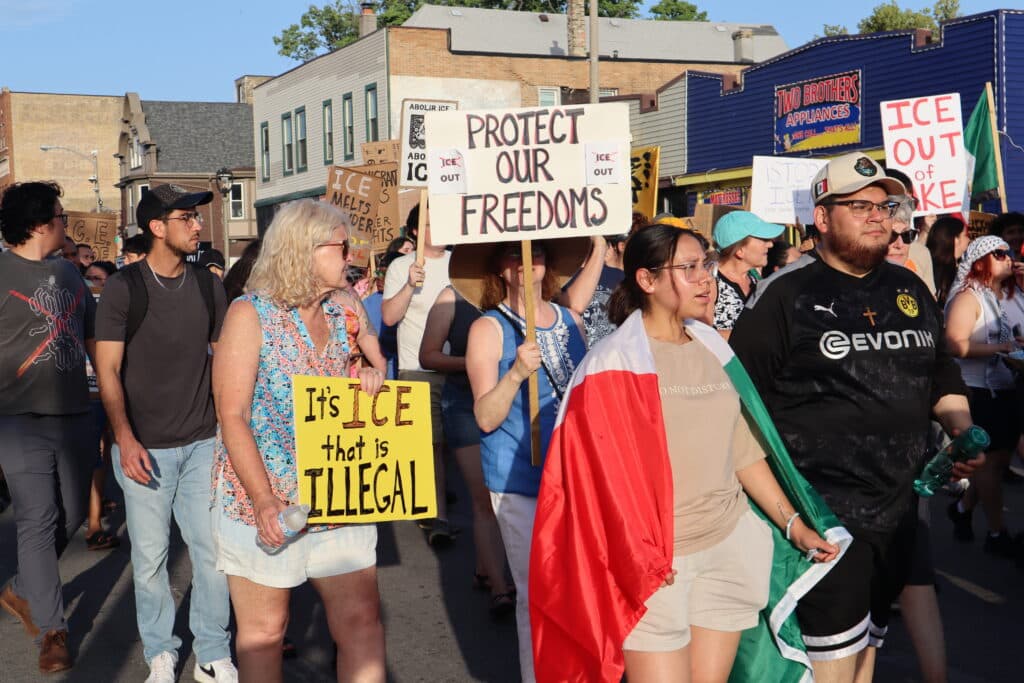
Despite public pushback, immigration agents have conducted surges and arrests in neighborhoods, courthouses, and elsewhere since Trump returned to office. In Milwaukee County, where some of these enforcement efforts have played out, local elected officials have enacted local ordinances and policies to curb the effect ICE operations have on public safety in the city. These, however, have invited further confrontation with the Trump administration.