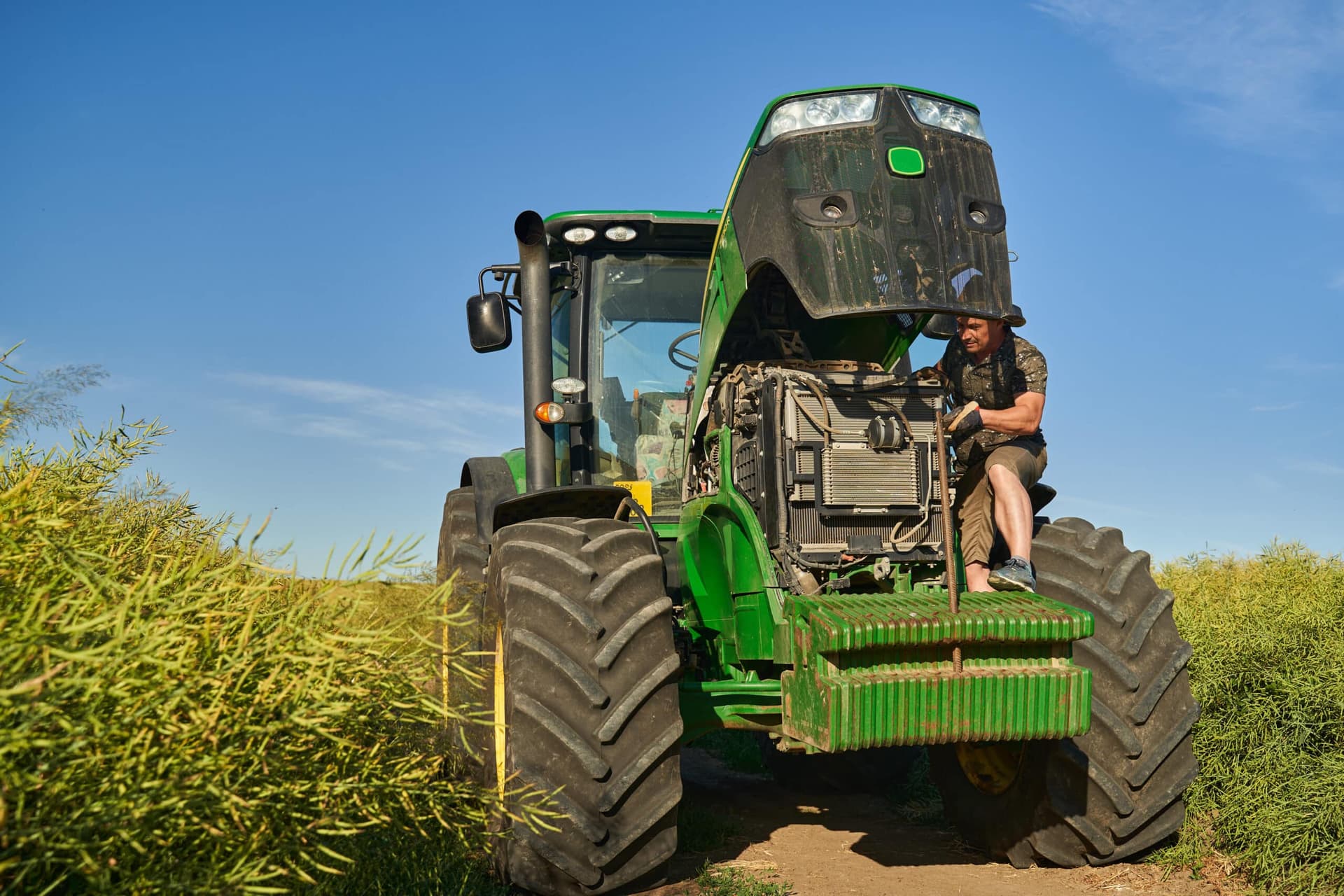
After years of pressure from farmers, independent repair shops and right-to-repair advocates, John Deere has agreed to a proposed $99 million settlement with the Federal Trade Commission (FTC) and five state attorneys general that would require the company to make many of its repair tools, software and documentation available beyond its authorized dealer network.
The July 8 agreement marks a federal victory for the right-to-repair movement, as it promises to lower repair costs and reduce downtime for farmers. Deere’s restrictions have long made farmers dependent on dealers during critical planting and harvest windows.
The proposed settlement requires Deere to provide equipment owners and independent repair providers with access to diagnostic software, repair tools, manuals and other resources on fair terms. It gives Deere a deadline of this calendar year to implement the terms and also establishes a 10-year compliance period to ensure Deere follows through on its obligations.
All electronic repairs on Deere equipment require a diagnostic software that only Deere makes. By licensing its software only to authorized dealers, according to the suit, Deere unlawfully built monopoly power for its repair services, forcing farmers to rely on its authorized dealers, leading to service delays and higher costs. The settlement resolves an FTC lawsuit brought by former chair Lina Khan in January 2025 under the Biden administration, which was joined by Illinois, Minnesota, Arizona, Wisconsin and Michigan.
But even among advocates who endorse the settlement, there is broad consensus that the fight is far from over. While the proposed order will undoubtedly both expand access to repair and establish a mechanism for accountability, it fails to outline how compliance will be monitored in practice and whether that oversight will be robust enough to prevent Deere from exploiting potential loopholes.
Claire Kelloway, a researcher at Open Markets Institute, says those details distinguish the FTC agreement from Deere’s previous voluntary commitments.
“If you look at the appendix of this settlement and where it outlines all the resources that Deere has to make available on ‘fair terms,’ it is a very detailed list that includes some key things that advocates have been asking for in other settlements,” Kelloway says.
Kelloway says those provisions, such as the access to repair tools and the compliance period, give advocates a stronger legal tool than Deere’s earlier agreement with the American Farm Bureau Federation, which many repair advocates argued was insufficient.
The settlement has raised questions about why the Trump administration chose to resolve the case instead of pursuing a trial.
“We know that the Trump administration, on the whole, has been moving to settle antitrust litigation,” Kelloway says. “As much as they’ve talked about challenging [food] monopolies in particular, they’ve shown an unwillingness to bring cases to trial—and have had a general posture of settling.”
While trials carry risk, she says that a court victory could have established “stronger precedent than you can with a settlement,” while potentially imposing “a stronger penalty” than the one Deere voluntarily accepted.
Though the case could have been pushed further, Kelloway points to the involvement of state attorneys general, including Minnesota Attorney General Keith Ellison, as evidence that negotiations likely strengthened the final settlement terms.
“If this was an egregious, huge giveaway to Deere, we might not expect someone like Keith Ellison to sign on to it,” she says. “Because presumably the states were negotiating to get a settlement that they could, in good conscience, feel they could sign on to.”
That doesn’t, however, signify the end of the road.
Ellison wrote in a statement, “This settlement is a win for the right to repair that farmers and small, independent businesses have fought so hard for and richly deserve … There’s more to do and we’re going to do it.”
Similarly for Willie Cade, a board member of Repair.org and longtime right-to-repair advocate, the proposed settlement represents progress, but nowhere near a resolution.
“As I read the settlement, it’s a positive, but it’s not sufficient,” Cade says. “It leaves so many loopholes that John Deere could drive a tractor through it. It really won’t encourage John Deere to change their behavior.”
Cade’s concerns are rooted in accountability and the potential difficulties for independent repair providers to access what they’ll need to make repairs in a timely and reasonable manner.
The settlement specifies the functions that Deere must make available through its repair software, but Cade is not convinced that these are the full scope of the resources authorized dealers can access.
“I don’t know if it’s a complete list of the functionality that the dealers have,” he says. “It would be important, I think, for a third-party evaluation of the software to say: these are the ones that are included, these are the ones that are excluded, and why. Because frankly I don’t believe that the FTC has the expertise to say that this is everything that could and should be included.”
He notes that software-based repair systems present a unique enforcement challenge, as the tools are housed in a digital cloud rather than in, say, a physical repair closet.
“When they first brought out PRO Service, the new owner tool, we did some testing [and got results],” says Cade. “When we re-tested the exact same questions this year, the software returned a response that indicated that they had withdrawn some capabilities from the software.”
This is the underlying reason that Cade argues “a third party needs to constantly review what is and isn’t being granted.” Without that oversight, he warns, changes could occur “very stealthily.”
Kelloway says advocates will continue pushing for state legislation and broader reforms that require equipment to be repairable by design rather than relying on case-by-case settlements.
“I don’t think anyone expects this settlement to solve everything,” she says. “They’re still going to be pushing for policy changes.”
For Cade, the next phase is ensuring Deere complies with what it has agreed to. Whether it ultimately changes the balance of power between Deere and farmers may depend less on the language of the agreement itself than on how rigorously it is enforced in the years ahead.
Have thoughts or reactions to this or any other piece that you’d like to share? Send us a note with the Letter to the Editor form.