

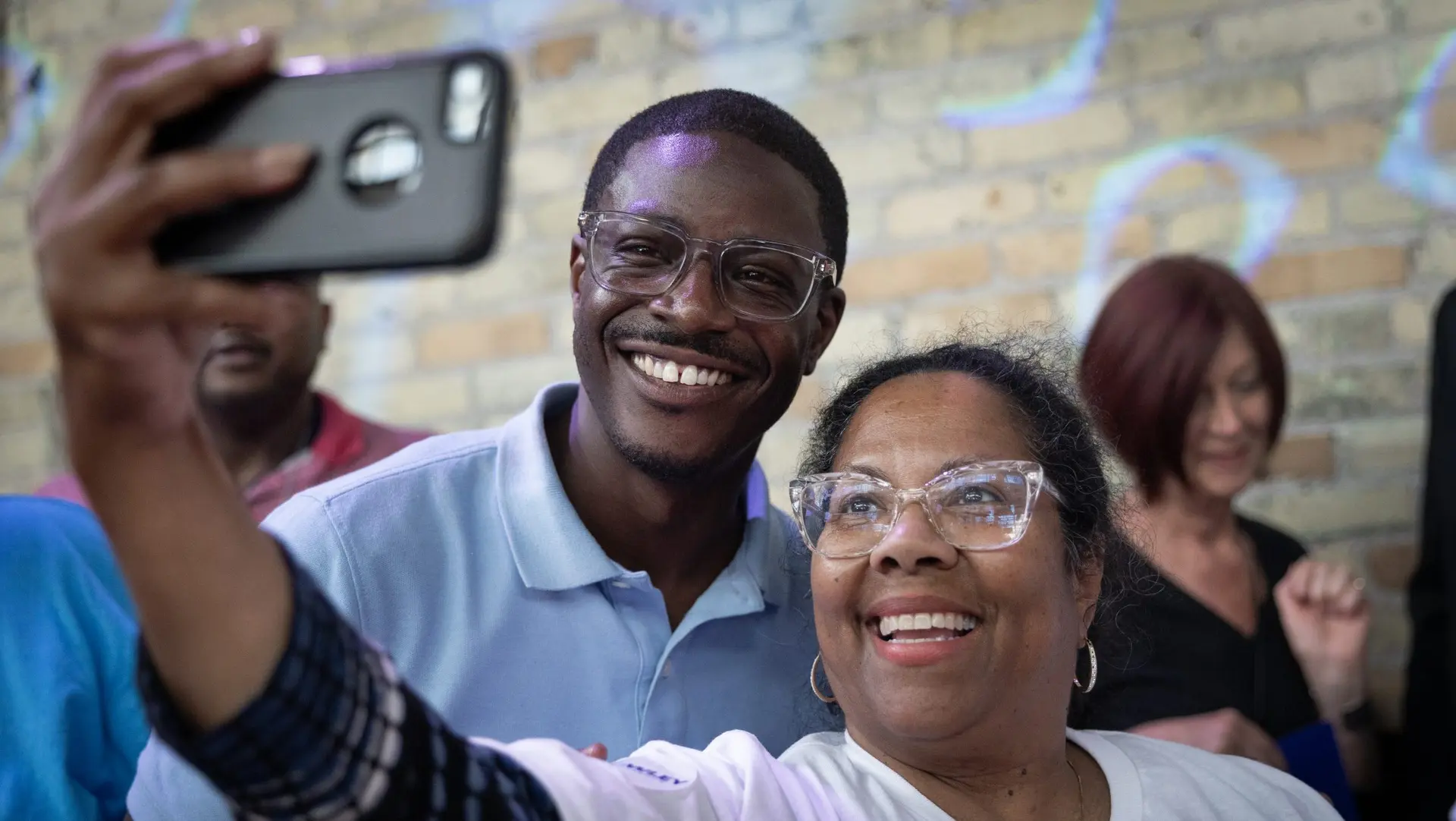
MILWAUKEE, WISCONSIN – AUGUST 10: Democratic Wisconsin gubernatorial candidate David Crowley greets supporters at a campaign rally on August 10, 2026 in Milwaukee, Wisconsin.(Photo by Scott Olson/Getty Images)
Q&A: David Crowley talks Francesca Hong, data centers, healthcare, Milwaukee’s north side for the first time since becoming Democratic nominee for Wisconsin governor

Aug 12, 2026, 8:31 PM CT
Share


It’s been a whirlwind campaign for Milwaukee County Executive David Crowley.
When the 40-year-old sought the Wisconsin governor’s office, he didn’t think this would be the path. Initially polling low, dropping out, reentering, and then pulling off an upset on election night that resulted in the north side native becoming the first Black person to be the Democratic nominee.
Crowley defeated state Rep. Francesca Hong on Tuesday by under 4,000 votes, in a race that was called in the early morning hours following mistakes by Milwaukee election officials.
Crowley was trailing significantly in polling headed into Tuesday, but there were also many undecided voters remaining. The razor-thin margin leaves most of the Democratic base split and it is now on Crowley to win over Hong supporters ahead of the November showdown with Republican Tom Tiffany.
The Democratic Party of Wisconsin is holding a “unity tour” in hopes of bringing voters together. Crowley and Hong both met for a “unity breakfast” on Wednesday alongside other prominent Democratic officials, including U.S. Sen. Tammy Baldwin, U.S. Rep. Mark Pocan and Attorney General Josh Kaul.
“This is about how we bring people together,” Crowley told the Milwaukee Courier on Wednesday. “We want everybody to be up under this big tent and focused on the ultimate goal.”
If elected, Crowley would become the first Black governor in Wisconsin history and only the fourth-ever Black person elected governor in U.S. history.
Crowley discussed election night, his conversations with Hong, data centers, growing up on the north side and more. Here are his responses.
David Crowley answers Milwaukee Courier’s questions
What was your reaction to the results last night? Were you surprised by anything? When did you think you could win this?
No one had a clue what was going to happen. When you take in account the polls we’ve all seen, but we know the polls have been wrong during the Michigan Senate primary. We didn’t know what to expect. But as those returns came in and it got later and later, I got more hopeful.
But we’re focused on moving forward. How do we make sure that everybody has a place within the Democratic Party, finding unity and making sure we ultimately win in November.
I have to give kudos to (Hong). She ran a strong campaign. She got a lot of people engaged who have never been involved in politics before and it is our duty to make sure that they continue to have a seat at the table.
What time did you go to bed last night?
About 3:30 a.m. maybe. I’ve been running on seven hours of sleep the last two days, probably three hours of sleep last night. But when you’re running on these types of fumes or adrenaline, you’ll be ready.
What have the conversations been about the unity events and directly with Hong?
We talked early this morning when she gave me a call to congratulate me. And I wanted to congratulate her on running a very strong race and thank her for her leadership.
We have people running statewide and in the Senate and Assembly. So we want to make sure that we can bring everybody to this table to not just win this governorship but make sure that we can get that trifecta that is needed to pass good policies.
This was a really contentious race. A lot of national personalities and big networks swooped in to put their own narratives on the race. What did you make of national figures applying narratives to a state government race?
It’s frustrating because it sounds like sometimes we are using clickbait language and divisive language when it comes down to our primaries. And I think that plays into the hand of (President) Donald Trump and Republicans wanting to continuously divide and distract.
But we can’t continue to look into the rear view mirror. Now it’s about moving forward. It’s about making sure that we can bring communities together from urban, suburban and rural communities alike.
Let’s reject bringing Washington’s politics into Wisconsin and focus on what we need to focus on.
Although many similarities, you and Hong had different policy platforms. How are you going to engage these voters to get on board with you?
It’s having a conversation and meeting people where they are. It’s giving them a seat at the table. It’s understanding that we all have the same goals when it comes down to making sure (Tiffany) is not the next governor.
But it’s also about making sure we speak directly to the issues that matter most to folks, like tackling the affordability crisis, so people can afford to put groceries on their table. Utility bills, the floor, the roof over their head and being able to plan for a child because childcare is accessible and affordable.
We need to fully fund our public schools and make sure we are responsible for our most vulnerable populations, people with disabilities, our seniors, undocumented immigrants.
It’s about listening and building those authentic relationships because people are tired of transactional leadership.
We want to be not constantly responding and reacting to (Trump) and Republicans because they’re gonna define us if we continue to do that. And so, we want to empower communities. We want to empower people to be part of the Democratic Party, but in order to do so, we have to start delivering for them.
Data centers appear to be a 75/25 issue in public polling with the vast majority of people, across the political spectrum, completely opposed to them. Hong ran on a moratorium. Tiffany also opposes them. Are you concerned in any way of being known as the “pro data center” candidate?
Well I think there’s a lot of people that talked about this because they wanted a certain person to win. I’ve been very clear on where I stand — we have to do everything we can to protect ourselves.
The Republican-controlled Legislature left session and created a political football without protecting our natural resources, without protecting our people.
And so, we have to hold (data center builders) accountable. They need to pay their own way. They need to pay for their infrastructure and grid upgrades. They need to bring their own new clean energy when it comes down to building more solar, building more wind and battery storage so we don’t see the burden shifted onto Wisconsin taxpayers.
We need to continue to have clean air, clean water and make sure we are protecting jobs in the future at the exact same time.
To be clear, you don’t support ending new construction or the building of new data centers?
You can’t end the construction of new data centers being built. These are contracts that are already in place.
For example what happened during Talgo, when you had Gov. (Jim) Doyle spend money to try and build a train and Governor (Scott) Walker ended that. That means that we had to use taxpayer dollars to actually pay that back.
And so, you can’t put a moratorium on what’s already here and what’s already been built or currently being built.
What are your education plans?
We need to make sure that we get back to the ⅔ funding formula and increase the reimbursement rates. The state of Wisconsin has really broken its promise to all our public schools across the state. We need to give every child a chance to succeed.
So, it’s about working with the Legislature and delivering a trifecta to make sure our schools are in the best position possible.
What are your healthcare plans?
We need to expand BadgerCare and create it to be one of the best alternatives to for-profit insurance. We can create sliding scale premiums, allowing gig workers, entrepreneurs, farmers, or anyone who wants to pay into this particular network.
We need to find ways to incentivize providers to be part of the network, especially in communities that have seen clinics leaving and hospitals leaving because they’re not getting enough in the reimbursement rate.
And we want to make sure that we’re taking care of our home healthcare workers, our family care workers, increasing their reimbursement rates gives them the ability to take care of themselves and vulnerable populations.
Is marijuana legalization something you can see getting down immediately if there is a trifecta?
Absolutely. It’s extremely important for us to legalize marijuana.
Illinois Gov. J.B. Pritzker loves Wisconsin residents because of how much money they’re making from the revenue. We are the donut hole. This is revenue that can pay for childcare, healthcare and public safety.
And so, we have to make sure that we’re not only legalizing it but we’re actually putting guard rails in place to make sure that we’re protecting our young people.
As you talk about legalization, it’s also important to couple that with decriminalization to make sure people aren’t being criminalized for a legal product.
Do you think there is any truth to the rumor that the Tavern League and Wisconsin’s drinking culture deters legalization here?
I am not familiar with that to be honest, but we always know that there’s always big and special interests that stop things from happening.
You have taken corporate PAC money and have been supported by private equity interests. How can voters be confident that you aren’t beholden to big money interests?
I was the only candidate with a real record of getting things done, and so people can always check my record as far as how I continue to fight on behalf of people of Wisconsin and not big corporations.
What we’re focused on is tackling those issues at heart. And so you can check my record. We have to compete with the Republicans. And I’m going to make sure we do everything to not have MAGA extremists or any Republicans who are buddy, buddy with Trump in office.
You grew up on the north side of Milwaukee. Turnout might have been down on the north side in the primary, but overwhelmingly Black wards supported you. It could be argued Black voters decided this razor-thin race. You are now the first Black person to be a major party’s nominee. What do you tell every little Black kid about achieving your goals and overcoming adversity?
The things that you’ve been through don’t necessarily define what your future is going to be.
I grew up in 53206 zip code and we’ve always been told what this zip code lacks than what it actually has. I think it’s important to think about the assets, the strength of these different communities.
The historic moment isn’t lost on me, but my job is to make sure that no matter where a kid lives, whether it’s in Milwaukee, or in Vilas County, or in Wausau, or La Crosse, that we continue to provide opportunities no matter your zip code or last name.
It’s really about making sure that you can control your own destiny. You can control your own future but you have to continue to work hard and value resilience.
I want to make sure that I’m not the last one and we only do that by strengthening opportunities for our young people.
What are your plans for the north side?
Well, I got to win first. I still have 83 days to get through.
But the plan is about making sure they have a seat at the table. To make sure we are uplifting, encouraging and empowering them. But truly giving them an opportunity to craft the agenda that we need for communities like the north side.
I understand where I come from. I understand where my foundation is and never leave from that and so I want to make sure we are tackling many issues, like home ownership.
I want to make sure that we are increasing the household income, increasing educational opportunities, reducing overdoses and drug uses, and getting people better access to mental health and reducing incarceration.
Some prominent leftist leaders refer to 2020 and 2021, the weeks and months after George Floyd’s murder, as “Woke 1” and have publicly taken back remarks and comments about that time period despite the generational issues of law enforcement’s relationship with the Black community persisting and have never been solved. What do you make of this?
We can’t just dismiss people’s lived experiences. You can’t dismiss a period that people went through.
And so at the end of the day, we have to own that this country has done a lot of different things and we have to focus on how we move forward. I never want to dismiss people’s feelings, especially during that period, which included COVID. There was a lot of hurt. There was a lot of trauma.
We know that the greatest enemy that we’re fighting against is MAGA extremism. It’s not the time to dismiss people’s experiences.
Who are some of your political inspirations?
The first real politician that I heard of was (former President) Barack Obama. When I was a kid, I wasn’t really involved in politics.
But I also think about people locally — Vel Phillips, Lloyd Barbee, Annette Polly Williams.
I also think about people like Raphael Warnock, (Pritzker), Andy Beshear, Josh Shapiro.
And of course Wes Moore, who I spoke to earlier today.
Drake Bentley is an award-winning investigative journalist who has worked for the Milwaukee Journal Sentinel, Wisconsin State Journal, Newsweek, Heavy and The Sporting News. He is a northside Milwaukee native, former political staffer and graduate of the University of Wisconsin-Whitewater and the University of Nebraska.


