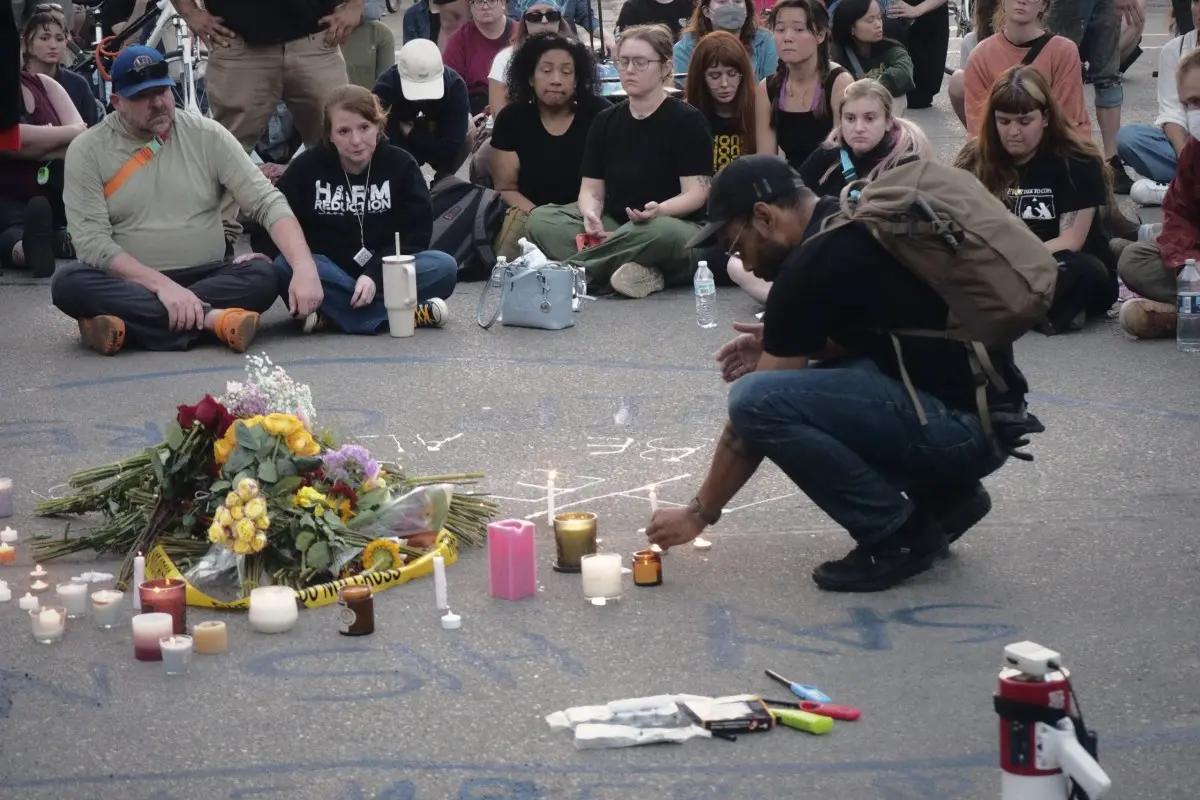


When a Madison police officer fatally shot Corey Ruiz on July 22, his death sparked outrage — and questions.
Among them: Why was Ruiz killed, and what kind of training or rules could have prevented his death?
Ion Meyn, an associate professor at the University of Wisconsin Law School, has studied exactly that. For a 2021 paper, he and his team interviewed police officers across the country and watched dozens of training videos to understand how police think about use of force and what guidelines they learn — even as departments argue that such situations can never be governed by hard and fast rules.
In this case, police say Ruiz pulled a knife when officers were trying to detain him. Meyn predicts authorities will conclude that the officer who shot Ruiz acted in line with his training, and thus that they won’t issue criminal charges or disciplinary action.
“I’ve seen so many of these shootings, so I see the justifications that are going to be provided,” Meyn said.
That, Meyn argues, is why communities should create enforceable rules for police. He spoke with Wisconsin Watch about how police training can make interactions with civilians more dangerous and why officers aren’t the only experts who should shape policing policy.
The following interview has been edited for length and clarity.
According to your research, what rules are police officers following when they’re making decisions about when to use deadly force?
This is a really contested space. If we say “What rules does the Madison Police Department follow?” the first assumption would be that officers only follow the training they hear from Madison Police Department trainers. I don’t believe that. We have officers who are keyed into officer networks. We have supplementary sources of information for training. We have the training that occurs in squad cars after the official training.
There’s a much larger ecosystem of input officers are receiving.
If you look at some of the biggest national providers of training, the videos that are available to officers are very aggressive. From my perspective, many trainers use language that is dehumanizing, that is part of this culture of “us” and “them” that the officer’s duty is to identify criminal elements and to protect good people from these bad people.
I haven’t been privy to the training rooms in the Madison Police Department, so I don’t know exactly what’s being trained, but the (common) general principles include things like “Always retain a tactical advantage,” “Reaction is slower than action,” and “The only person that can deescalate is the civilian.”
Now, there is a Madison Police Department protocol that says when you approach a situation, you should try to build in time in order to allow dialogue between the officer and the suspect. But then it says only do that within what you’ve been reasonably taught about tactics and these other principles, and so those other principles are in so many ways, in conflict with this protocol, and so it’s almost like the exception that swallows the rule.
You can see that playing out in many incidents in the way that the officer interprets the likelihood that they’re going to be subject to some kind of major bodily injury or death. They’re going to imagine the worst-case scenario because they don’t want to give the bad guy the first shot, right?
One of the takeaways from your article is that people without police training often seem to act less violently than police do around some of the same potentially threatening people.

That is the conclusion I draw. Take Tamir Rice (the 12-year-old Cleveland boy who was shot and killed by a police officer who mistook his toy gun for a real gun). If you watch the video of Tamir Rice with his fake gun that looked like a gun, he’s kind of waving it around. People walk by him before the police get there, and they wave him away, or they say, “What are you doing?” They’re assessing risk and they’re not seeing an imminent threat, or if they’re seeing a threat, they’re deescalating it and seeing what they can do.
This also happens in situations where someone has a knife and (other civilians) are trying to talk to the person with the knife, but they’re scared. They’re keeping their distance, and it’s been going on like this for a while. Then they call the cops, and the guy’s dead in 10 seconds. Why is that?
The reason is their training. The training makes this person with a knife (appear) much more dangerous than they are to a person who might be trying to assess the situation without that training. Another thing that you see in training is a constant flow of videos that show officers getting hurt, and that’s just not empirically a representation of what happens in these situations.
Criminologist Franklin Zimring argues that police departments should write rules that tell officers when to refrain from shooting or stop shooting. What kind of rules do you think police should be following?
To me, (the question is), what kind of conversation are we going to have about the rules we want, and who’s an expert on what force should be used? Who is the Madison City Council going to invite into police reform, and how significant a voice are they going to give to, say, sociologists and social workers? The best way forward is inviting those voices in and giving them a significant role.
I am not the person to come up with the best set of rules, but I am the person that’s going to say, “It’s clear that you’re not bringing in other voices. It’s clear that you’re not bringing in empirical data to appropriately assess risk.”
Another point you make in your article is that community members should trust their own reactions to these kinds of events, and that local governments can actually set their own standards for how they want police to operate.
They can. Police departments will say, “We’re in compliance with the law and national standards and the Constitution and all those things, and therefore your attempt to change things is unreasonable.” That is absolutely wrong.
What the Supreme Court actually said is, “It’s not our job to regulate training or use of force. Our job is to say if a police department uses a tactic that is so egregious, that it’s unreasonable under the Fourth Amendment.” That’s regulating an outer boundary of minimally acceptable conduct. The court said, “We leave it to communities to determine how they want to be policed.”
So communities have a lot of power to regulate it. They’re going to be up against a police union. They’re going to be up against powerful political players. They’re going to be up against an organized campaign that will tell people who are trying to change it that they have no right to speak in this space.
So that’s the political aspect of it, but it’s certainly not a legal one. There’s no legal constraint to changing the way that we train police.
You predict there won’t be any criminal or administrative sanctions regarding Corey Ruiz’s death. Given that, what do you hope might come out of this incident?
My hope every time with these things is that it increases the number of people talking about it in a way that is open and curious. They want to learn how police are trained. They want to learn what rules officers are subject to. By the way, it’s very dangerous for civilians if they don’t know what police training is.
(I also hope) people start feeling like they have a voice. I’ve just seen people get stepped on left and right, told that they just don’t have the right to speak, that they don’t know anything about policing, that they don’t know what it’s like to face a bad guy. That’s the constant refrain you hear.
And I really hope that this community in Madison works with dispatch and comes up with a program that really is serious about directing a good portion of calls away from police into folks with a different set of expertise that’s much more based on getting social support for people.