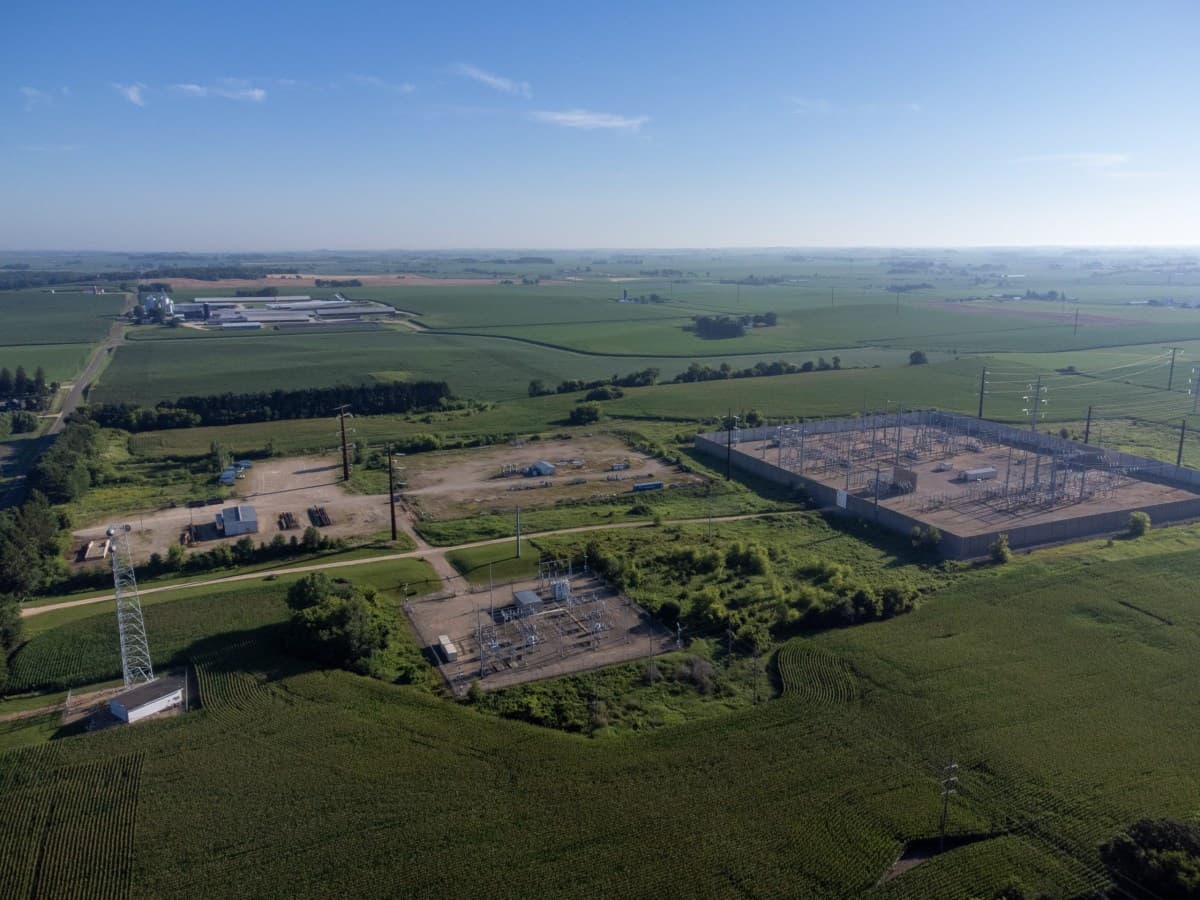


Earlier this year, the Madison suburb of DeForest abruptly rejected a $12 billion, 1,600-acre data center amid mounting public opposition.
In doing so, the village of 12,000 also turned down wide-ranging public benefits that some experts say could be a model for what communities can demand from hyperscale data center projects.
Wisconsin Watch reported in January that DeForest and other communities around the state had, for months, secretly worked on proposals for billion-dollar data centers before informing the public.
The day after the report, DeForest officials announced the project was “no longer viable.”
The retreat was a response to a swell of opposition fueled by outright objections to data centers, misinformation about their impact and anger over the proposal being kept quiet.
Amid the controversy, little attention was paid to an agreement the village had negotiated with Virginia-based QTS Data Centers.
Here’s some of what the community could have received if the data center had come to fruition:
- A guaranteed amount of property tax value for the data center of $1.2 billion, which would be worth an estimated $12 million annually in property tax payments to the village, schools and other taxing bodies.
- Tens of millions of dollars in payments toward the village’s signature natural feature, the Yahara River, as well as for affordable housing and other needs.
- Protections for nearby property owners and electricity ratepayers.
“You’re not seeing these in other development agreements,” said Tyler Byrnes, a researcher at the nonpartisan Wisconsin Policy Forum.
Local governments throughout Wisconsin, even where data centers have not been proposed, are adopting data center moratoriums. At the same time, data center development proposals are being considered in communities such as Kenosha, Menomonie, Wisconsin Rapids and Rock County.
Even though no data center was built in DeForest, the village’s agreement could offer guidance for future data center deals in Wisconsin.
‘Best package’
QTS’ proposal drew opposition because data centers have become inherently controversial, but also because DeForest would have had to annex 1,600 acres from the neighboring town of Vienna. Moreover, there was backlash to the news that DeForest staff were meeting with QTS representatives and Alliant Energy as early as March 2025 — seven months before announcing the proposal.
Three weeks before dropping the project, DeForest announced it had reached a pre-annexation agreement with QTS that put more than a dozen requirements on the developer.
“It’s our job to provide the best package that we can get from our development, to benefit the population and the village,” village Administrator Bill Chang recently told Wisconsin Watch.


The provisions are wide-ranging. Here’s an overview:
Guaranteed assessed value of at least $1.2 billion for 15 years
QTS would have had to pay property taxes based on at least that amount, even if the actual valuation were lower. The village estimated that QTS would pay $12 million annually to local jurisdictions by 2031 and that over 15 years, a home with an assessed value of $400,000 would save $1,772 per year in property taxes.
“The tax benefits are big,” said professor Ross Milton, a local government tax expert at the University of Wisconsin-Madison.
Milton said the guarantee means that even if the data center’s property valuation didn’t reach $1.2 billion, the village would still receive the amount of property tax revenue as if it did, though other local taxing bodies would not.
Pay $50 million for community infrastructure
That funding would have included $100,000 annually for 15 years for preservation, restoration and other improvements for the Yahara River; paying $1.5 million toward a planned $15 million interstate interchange; contributing $200,000 annually for five years to the village’s affordable housing program; and creating a community solar energy project to help homeowners.
Pay for public infrastructure
QTS would have paid for all public infrastructure improvements serving the data center, including water, sewer lines and roads.
The deal included on top of that a $1 million payment for a sewer main extension, completed in 2024, that would have served the data center.
Another provision would have paid for any police, fire and EMS vehicles and equipment necessary to address needs caused by the development. The developer also offered to provide emergency services, including an ambulance, to the development site for five years after signing of the agreement so as not to draw away from existing community services.

Also covered were planning and design of a public transit connection from DeForest to Madison and operation of the transit line during construction, as well as an alternative snowmobile trail through the property.
The developer also would have had to reimburse the village for water, sewer and stormwater expenses that would otherwise cause general rate increases. And QTS would have paid to install a wastewater monitoring station to measure effluent discharged from the data center.
“QTS wanted to work with us,” Chang said. “They were willing to play ball, per se, to get into a position where it would make sense for the village to approve an annexation.”
Pay for power infrastructure
QTS would have paid for all improvements to electric power infrastructure needed to serve the data center without — subject to state regulation — affecting existing ratepayers.
The agreement included a commitment that the data center would draw 45% of its energy from solar, wind or other renewable resources. The agreement noted the developer had bought 750 megawatts of renewable energy credits for the project.

Protecting neighbors
The agreement would have committed the developer to repairing or replacing private wells, or connecting a home to municipal water, within a quarter-mile of the data center if the data center construction or operation contaminated the wells.
QTS also would have committed to buying residential properties within a quarter-mile of the data center if the property “is materially adversely affected by noise, vibration, private water supply contamination or other negative impacts” from the data center.
The purchase price would have been no less than 110% of the property’s assessed value.
Democratic candidates for governor have called for gaining benefits in data center deals. One of them, state Sen. Kelda Roys of Madison, supports creating a state team of experts to help communities negotiate with data center developers.

Reclaiming the site
If the DeForest center had been built but later stopped operating, the deal would have allowed the village to reclaim the site. Then the village would have been able to sell or lease the property or demolish the buildings on it.
QTS “did communicate that they are long-term-involved in their facilities and that they have, as one of their priorities, to be a good community partner,” said village Community Development Director Alex Allon.
One of the proposal’s opponents, former Vienna town board member Shawn Haney, said he had urged village staff to be more precise on some requirements of QTS, but that the staff “were definitely doing their homework and they had some good ideas in there. The concept behind it was good.”
No tax incremental financing
The agreement doesn’t include a tax incremental district, a common tax break that commits future property taxes from a land parcel’s anticipated increase in value to finance a proposed development.
That “makes the proposal abundantly better” for residents, said Prescott Balch, who is sought out as an expert by data center opponents around Wisconsin.
The difference is that while a property is in a TID, it isn’t counted in the total value of the village’s property for tax purposes and therefore doesn’t lower taxes on other property owners until the TID is closed, Byrnes said.
Nevertheless, the sheer opposition to the data center far overshadowed what was in the pre-annexation agreement. The village never took a vote on annexation, which would have required support from a supermajority of the board.
“The politics got too loud too fast,” Chang said.
Looking ahead
In contrast, the local government agreements covering the three data centers under construction in Wisconsin, in Beaver Dam, Mount Pleasant and Port Washington, use tax incremental districts.
None of them includes the wide-ranging community investments and protections that DeForest negotiated.
Other communities around the U.S. are negotiating deals similar to DeForest’s. In Pennsylvania, for example, a developer seeking local approval of a data center has offered $165 million, including $10,000 payments to homeowners.
UW-Madison professor Anna Haensch, who researches data center policy, said DeForest’s agreement contains some elements in what are typically contained in more formal “community benefit agreements” — provisions that local governments seek as part of the process of approving a data center.
She and UW colleagues are working on a framework that local governments could use for negotiations.
“Community benefit agreements are not yet the norm, but I think they should be and I think they will be,” Haensch said.
“When you’re in a tough position in life, knowing what you can ask for is half the battle.”