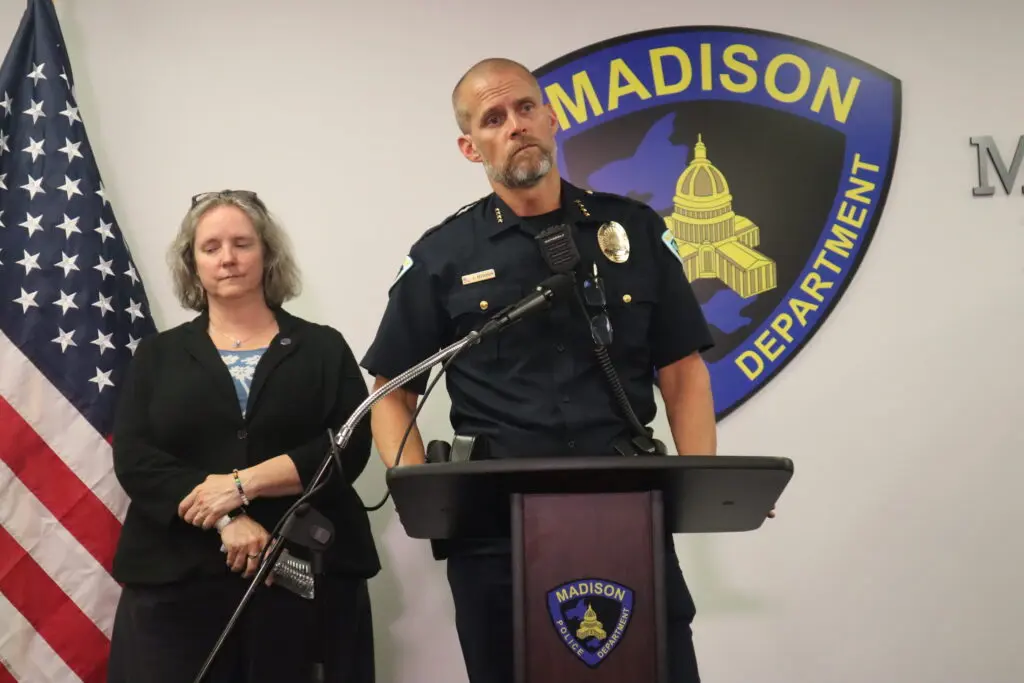


Madison city officials attempted to hold a press conference Thursday after a police officer shot and killed a man, identified as Corey Ruiz, at a busy intersection on Williamson and Baldwin streets Wednesday. The briefing was derailed by a group of protesters who arrived and took over the podium, sparking a verbal altercation with Madison residents who also wanted to express their discontent and question Mayor Satya Rhodes-Conway, Police Chief John Patterson, and Common Council President Sabrina Madison.
“My immediate concern, right now, is for the well-being of our community,” Rhodes-Conway said at the beginning of the press conference, speaking to reporters while local residents began taking seats in the small room. “I want to make sure that everyone who needs it has access to resources and mental health support. Those resources exist, and are available if you need them.”

Rhodes-Conway urged residents to use the 9-8-8 hotline for urgent mental health support, or to text either “home” or “hola” to 741-741 to reach volunteer crisis counselors, or to contact the Dane County crisis hotline at 608-280-2609.
The shooting triggered outrage, anger and grief among residents, especially those who witnessed it directly.
Video taken by bystanders shows several officers wrestling Ruiz to the ground. While he is on the ground, one of the officers appears to fire several shots into Ruiz’s head at close range. The Madison Police Department does not have a universal body camera program, and Chief Patterson has pushed local elected officials to implement a body camera program in the 2027 budget. During the press conference Thursday, Patterson said a criminal homicide investigation has been opened in the shooting.
The shooting is being investigated by the Wisconsin Department of Justice Division of Criminal Investigation. Patterson said Wednesday that the officer who fired was injured by a fixed-blade knife Ruiz brandished. Patterson also said that officers had confronted Ruiz after responding to a call from someone in the neighborhood who said he was checking cars, but that Ruiz fled before they chased him to the intersection.

State law requires that officer-involved shootings be investigated by an outside agency in order to maintain objectivity and public trust. The investigations can take months, after which the case is handed over to a local district attorney who then determines whether an officer will be charged for the shooting. Madison residents, impatient for more information and still angry about the 2015 police shooting of Tony Robinson in the same neighborhood, are demanding a response from city officials.
“This is an incredibly difficult moment for the Madison community,” Rhodes-Conway said. “And I understand the very difficult emotions that people are feeling. I am feeling them too. As a city, as a community, as a society, we have to do better.” She added that “it does not matter who you are, or what your past is, you should not lose your life as a result of an encounter with law enforcement. That should not happen.”
“Like many in our community today, I have a lot of questions and concerns about what happened yesterday,” Rhodes Conway said, “what decisions were made by officers that led to escalation instead of de-escalation; what different choices could have been made to prevent harm; what needs to change — police policy, or training, or anything else — to prevent more deaths.”
Madison, the city council president, said Ruiz could have been any number of people, including people she knows and loves. She added that she has family members who have struggled with mental illness, homelessness, and that Black and brown children are taught by their parents how to interact with police in order to survive the encounter, something Madison said her white friends with children have no need to discuss with their own sons. Madison said that Ruiz “is a person, he’s a human being, he has a family, he has parents who loved him, you know, who brought him home, who cared for him, who poured into him.”

Watching the videos Madison said she could hear the sounds, she could hear officers yelling “taser,” and she can also hear the shots fired. Madison said she asked herself, “When the officer’s walking away, why isn’t he walking away in cuffs?” She said her thoughts are with Ruiz’s family because “his death is final, there is no coming back from death.”
Madison, the mayor, and the police chief all called for a full, fair and transparent investigation. Madison also said that “we should be pushing and advocating for our district attorney to charge folks” and that people should engage with the district attorney, the Division of Criminal Investigation, the city’s independent police monitor, and the Police and Fire Commission. Madison encouraged residents to file complaints with those organizations, as well as the police department. “I think you should take every route for justice for Corey; I don’t think you should limit yourself.”
Patterson said that he didn’t want to “rush past” the fact that Ruiz’s family and the community are grieving. He said that the Madison Police Department requested a full, independent criminal investigation. Patterson said that the Division of Criminal Investigation will release the name of the officer on its own timeline, and that the Madison Police Department has limited information about and involvement in the investigation. Recalling the words of retired former Madison Police Chief David Couper, Patterson said that police “cannot do the job unless you have the support of the community.” He added that Couper once wrote that “use of physical force by police is a sacred public trust…The more force a department uses, the less trust and support it has from the people it serves. The more force we use, the less trust we have.”

As Patterson spoke about the need to recognize the trauma the community has experienced from past shootings, Carlos LeMar Dixon of Milwaukee entered the room with a small entourage. Dixon yelled, “We can shut this down, you can stop talking!”
“You’re going to say the same thing you all say every time a Black body gets shot down in this city,” Dixon yelled, adding, “Have no fear, the anti-Zionist is here!”
Dixon continued yelling over the chief while walking to the podium, about imperialism and Zionism, asserting that he would not allow any public officials to speak or answer questions. Dixon also scolded reporters in the room to hear the briefing from public officials for not asking him questions instead.
Some of Dixon’s supporters also yelled, helping him drown out the mayor, chief and common council president. Meanwhile some Madison residents in the room argued with Dixon, sparking a tense verbal confrontation as Dixon and members of his group hurled insults and threats at various people. Some of the Madison residents, while critical of the public officials at the briefing, demanded that Dixon either calm down or leave so that relevant questions could be asked.
At one point after the chaotic exchange, Mayor Rhodes-Conway left and Patterson held the podium to answer questions.
Patterson answered a question from the Examiner about whether officers are trained under Defense and Arrest Tactics to use the least amount of force necessary to overcome a threat, and whether officers who use deadly force must evaluate whether the threat is still present after each shot is fired. “There is a standard of a threat of great bodily harm or death that must be articulated to one’s self or someone else,” Patterson began. “And so that is a standard that [Division of Criminal Investigation] will be evaluating when they start, that is a standard that we use when we use our use of force review.”

Under Defense and Arrest Tactics, there are several levels of force available to police officers including their mere presence, which can discourage criminal activity, less lethal force such as tasers and deadly force. The standard for use of force is evaluated through the perspective of a hypothetical “reasonable officer” faced with the same situation, and questions whether such an officer would have used deadly force. Prior to shooting Ruiz, one of the four officers involved deployed a taser, which Patterson said was ineffective.
The Examiner asked Patterson how the reasonable officer standard would apply when four officers are involved in a situation and only one officer chooses to use deadly force. Patterson declined to respond to that question citing the ongoing investigation. Patterson also said that the officer who fired was not a supervisor — such as a sergeant or lieutenant — but that he was a veteran officer with 11 years experience. He added that he did not have information about whether the officer who fired had a history of discipline or citizen complaints, but he did say that he’d never been involved in a deadly force incident before.
Evening vigil
More than 24 hours after the shooting, protesters still controlled the intersection where Ruiz was killed. Initial barricades of garbage bins and mattresses were reinforced by police blockades and Madison city snow plows.
Activists and community members held a vigil Thursday evening in the intersection with hundreds of people somberly listening as pained members of Madison’s Black community spoke, with chants of Ruiz’s name interspersed like the response in a prayer.

Juliana Bennett, a former Madison alder who is now running in the Democratic primary for the 76th Assembly District — which includes Willy Street — noted in a speech to the crowd that the killing of Ruiz took place six years after the police protests of 2020, which themselves took place six years after Madison police killed Tony Robinson, a few blocks west of the spot where the vigil was held, in 2015.
Bennett said that police killings are policy decisions and noted that in a liberal community such as Madison, police violence and racism are often met with “committee after committee, meeting after meeting,” and implored community members to continue pressing local officials for change.