

The weekend before one April election, I got a text from a friend about the upcoming county board of supervisors race. Our district had one candidate on the ballot. A last-minute write-in campaign was starting for someone else – someone I would have voted for. Unfortunately, the deadline for filing as a “registered write-in candidate” was the day before the would-be candidate decided to stand for office. Election rules in Wisconsin are specific about when write-in votes are eligible to be counted and when they are not. In this case (with ballot candidate(s) equal to or greater than the number of seats to be filled), write-in votes for an unregistered write-in candidate would not be counted.
If you know more about the rules in football than about running for office, you are not alone. But there are rules. They vary from state to state, but rules provide a framework for fairness. Candidates for local government offices in rural counties, townships, villages and school boards are bound by many of the same rules as candidates for state and federal offices. So it’s helpful for local candidates and potential candidates and their families and friends (a.k.a. unpaid staffers) to know there are rules and how to comply with them.
It’s important, too, for voters to know how to make a write-in vote count.
Local races. Top-of-ticket races get their share of write-ins, like the fictional presidential candidate Alfred E. Newman. Up and down the ballot, voters express dissatisfaction with ballot choices by writing in Donald Duck or Mickey Mouse. But where they are allowed, bona fide write-in candidates are more commonly associated with local races.
A local race can be won with surprisingly few votes. That’s true especially where no one made the decision to stand, registered their campaign committee, collected nomination signatures, submitted a declaration of candidacy, filed a statement of economic interests, and met any other requirements for getting their name on the ballot. In a local race with no ballot candidate, a write-in has a good shot. And when there’s no high-profile federal or state office being contested and voter turnout for local races is light, the odds are even better. But it doesn’t necessarily mean a write-in candidate can dodge all the paperwork.
What paperwork? According to the U.S. Election Assistance Commission, a dozen states have no registration requirement for write-in candidates to be “official”. But 31 states that permit write-ins have some filing requirement. That may be for a registration document or letter of intent asserting residency or qualifications for office.
In Wisconsin, the paperwork a would-be registered write-in candidate would file is the CF-1L Local Candidate Registration Statement. That form is a public record in which a candidate or their authorized representative certifies:
- that the registration information is true, complete and correct.
- that the candidate/campaign will amend the registration statement within 10 days of any change, including any change in eligibility for exemption from campaign finance reporting.
- that the candidate/campaign acknowledges the requirement to maintain records in an organized and legible manner for three years from the close of the most recent contribution limit period.
- and acknowledgement of the requirement to continue to comply with all applicable requirements under Chapter 11 of the Wisconsin Statutes until the registration is terminated. Further, that the candidate is not released from any liability simply because the election date has passed.
That second bullet point should be of particular interest to rural candidates for local government offices in Wisconsin. A candidate may affirm exemption from campaign finance reporting because they don’t anticipate meeting the threshold for aggregate financial activity. But we’re seeing more money being spent on local races that used to be non-partisan. So this paperwork clearly states the obligations of a candidate, whether they’re on the ballot or a registered write-in, and provides a public record of their accountability.
Who’s registered? Before heading to the polls, take time to review a sample ballot to see what candidates are listed and what format is used for writing in a candidate who is not already on the ballot. You can do that on Ballotpedia. But it won’t tell if there are registered write-in choices or who they might be. For that information, ask local election officials like a county or municipal clerk (after the deadline for registering as a write-in). Or check the website for your state’s Secretary of State. Or ask a would-be write-in candidate if they are, in fact, registered.
Some states may post those names at polling places. But not in Wisconsin, where I’m a poll worker in a rural voting district. Before the polls open, we review the Registered Write-In Candidate List provided by our county clerk. Election rules state that the list “may be given to any elector who inquires about the list but may not be posted.”
Poll workers are not to offer information about write-ins, only to respond to questions from electors. I don’t love the prohibition on posting, but I understand it: It’s rare that electors read any of the notices we’re required to post anyway. But I support the guidance that poll workers not offer information about write-ins. In small communities where poll worker relationships are well-known, it helps prevent any subtle encouragement (conscious or otherwise) about who to vote for.
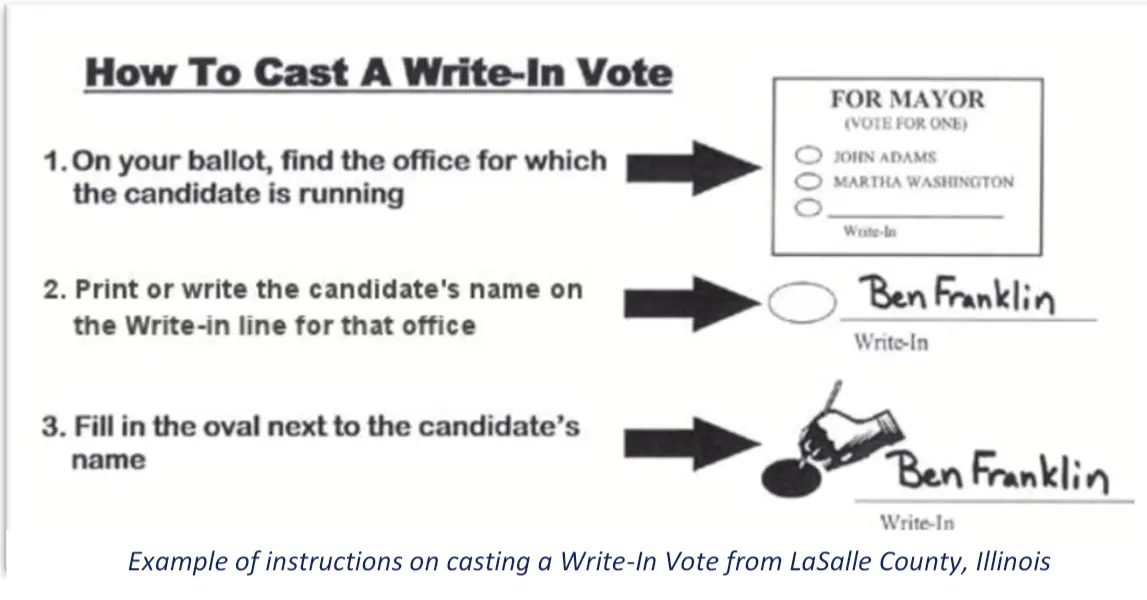
Follow directions. Ballot tabulators operate on a logic based on expectations set out in the instructions. So in the voting booth, re-read the instructions on the ballot. If the instructions say you may vote for only one (1) candidate, don’t fill in the bubble for a ballot candidate and also add a write-in. If there’s a bubble next to the space for a write-in, fill in that bubble. Try to spell your candidate’s name correctly, or at least close enough that the board of canvass can reasonably assume voter intent.
When voting absentee or by mail, take extra care to follow instructions. If you make an error at the polling place, a tabulator may eject the ballot to give you a chance to correct it. With absentee ballots, if voter intent cannot be clearly determined by poll workers, your vote in that race may not count at all. Again, there are rules for how those ballots are handled. Those rules probably require consensus or agreement by a majority of poll workers, and documentation of the incident by the chief election official. They want each ballot to count. But it’s the voter’s responsibility to make their intentions clear. Read the instructions.
Be prepared. As with most things in election administration, rules regarding write-in votes in your state probably cover a number of possible scenarios. What if there are not enough ballot candidates to fill available seats? What if there are no candidates on the ballot? What if one or more candidates on the ballot die before the election?
Stuff happens, and some of it is unusual enough that poll workers need a minute to check the rules. Questions may be best addressed before you check in at the polls and receive your ballot. Once a ballot is issued, ballot security rules may not allow you to take it out of the polling place to make a call or have a discussion about how to make your vote count the way you want it to. So be prepared before you go into the voting booth.
And if you’re thinking about running for office in your rural area, please don’t wait until it’s too late.
Donna Kallner writes from Langlade County in rural northern Wisconsin.