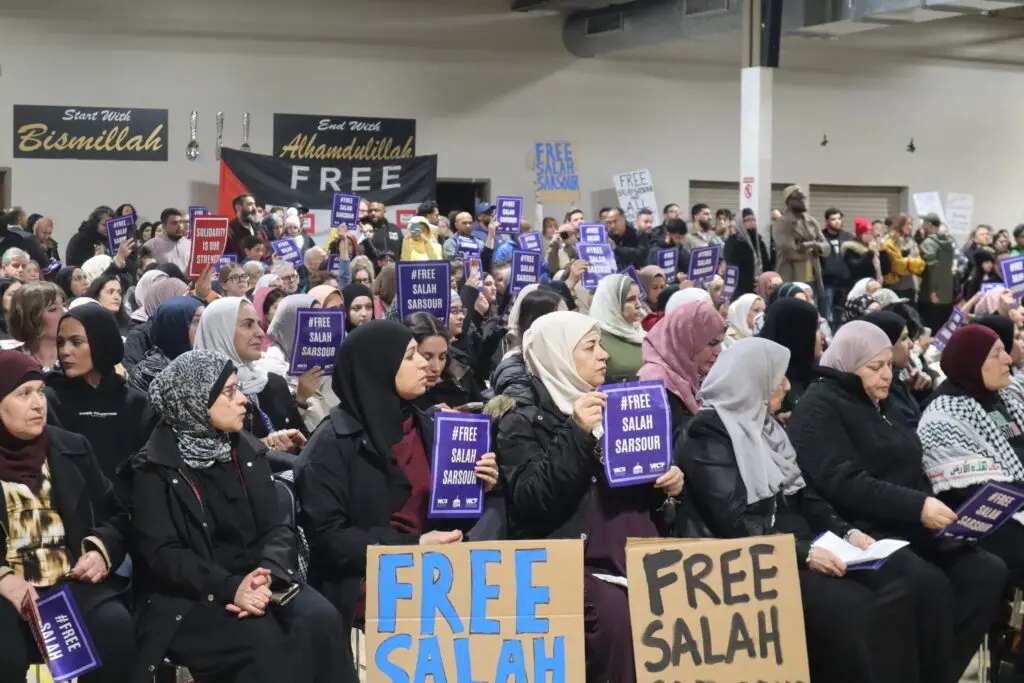


A federal immigration judge heard arguments Wednesday from attorneys in a deportation hearing for Salah Sarsour, the president of Milwaukee’s Islamic Society. Earlier this year, Sarsour was arrested by Immigration and Customs Enforcement (ICE) agents and then detained in an Indiana facility for months. Sarsour was released in June following a federal judge’s ruling that his arrest constituted First Amendment retaliation due to his advocacy for Palestinians and his criticism of the Israeli government.
The Wednesday hearing, which ran all day before being adjourned until next week, was to determine whether Sarsour’s deportation order can be upheld. Sarsour has lived in the U.S. with no criminal record for decades, and is considered a local community leader. Sarsor became a lawful permanent resident in 1998, and his naturalization application was approved under Republican president George W. Bush in 2002.

After his arrest, the Department of Homeland Security (DHS) accused Sarsour of lying on his 1993 green card application, asserting that Sarsour was convicted in Israeli military courts of throwing Molotov cocktails at the homes of Israeli soldiers. The department also cites other accusations by Israeli authorities that Sarsour “illegally attempted to possess” weapons and ammunition. Sarsour’s family members have said that he would tell stories of being tortured to confess while in Israeli detention. Prosecutors repeatedly referenced detentions and accusations from Israeli authorities against Sarsour during 1988 and 1995.
Those accusations, and the context of what living under Israeli military occupation means for Palestinians in the West Bank, were examined in court Wednesday. Defense attorneys first called Sarsour’s older brother Mohammad, a U.S. citizen who is married and lives in Oak Creek. Mohammad testified that he helped his brother retain a well-known lawyer in the West Bank when Sarsour was arrested. He denied ever seeing Sarsour ever provide support to terrorists of any kind, and recalled that Sarsour went through three or four Israeli military court hearings.
“Every time I saw him, I noticed weight loss and also discoloration in his eyes, redness, yellowish,” said Mohammad Sarsour, speaking through an Arabic translator, although he also understood English. “And had a discolored, faded face color. He looked like he was unable to take showers so his hair was sticking on his head.” There were other signs that his brother was not being provided proper hygiene access, and that he “complained to the court of pain in his knee and back.” Mohammad said that the Israeli authorities would not allow them to talk to Sarsour, but that at one point a member of the Israeli secret service told Mohammad and Sarsour’s wife to persuade him to plead guilty.
Prosecutors raised questions about Mohammad’s ability to remember those events from decades ago. Mohammad couldn’t remember the exact dates of the hearings. Prosecutors questioned why an Israeli military official would tell them to get Sarsour to plead guilty if they generally weren’t allowed to talk to him. “They [Israeli authorities] can do whatever they want,” he said on the stand. Mohammad was also asked by prosecutors whether he loved his brother and didn’t want to see him be deported, which Mohammad affirmed.
Defense attorneys also called Alan Hirsch, an expert in false confessions and chair of the Justice & Law Studies Program at Williams College. Prosecutors spent an extended period of time trying to convince the judge, unsuccessfully, that Hirsch was not qualified to testify as an expert in false interrogations, particularly as his direct knowledge of Israeli interrogation practices would be limited. Hirsch testified that Israeli authorities, based on his own studies, were “using aggressive interrogation tactics” during the time when Sarsour was detained. He said that there’s no evidence that Sarsour’s confession either generated new evidence or corroborated existing evidence, and that when Sarsour was initially detained in 1988 he was a juvenile, one of the groups most vulnerable to giving false confessions.

Another defense witness had a much more extensive knowledge of Israeli treatment of Palestinians. Sari Bashi, an Israeli lawyer and human rights investigator, testified remotely, from Israel, where it was late at night when she was called to give her testimony. Bashi has an extensive knowledge of what Palestinian prisoners go through in Israeli detention and military courts. She pointed out that Sarsour’s 1988 arrest occurred shortly after the First Intifada, a sustained period of uprising and protest by Palestinians in the occupied West Bank and the Gaza Strip. Prosecutors attempted to undermine her credibility as an expert, casting her as overly sympathetic to Palestinians, and saying she was too young to have known first-hand what Israeli practices in 1988 were.
Bashi said that Israel holds the West Bank under “belligerent occupation,” where the local military commander serves as the executive, lawmaker, judge and executor of law. Military orders dictate what is considered a crime in the West Bank, and Palestinians can be detained without charge for long periods of time. Sometimes evidence against the accused is considered secret, and proceedings and documentation are in Hebrew, which few Palestinians speak and even fewer can read. “The system lacks very basic due process standards,” said Bashi. “So arrests are the norm, even for children.” Conviction rates in Israeli military courts against Palestinian civilians are over 90 percent.
Under this regime, Palestinian people often receive very vague charges for organizing community activities, public disorder, association, or writing a liberation slogan on a wall, Bashi testified. “There can be almost no limit to what that association can look like,” she said. This was especially true during the First Intifada, a period during which Bashi said that hundreds of thousands of people were detained by Israeli authorities.
Bashi said that Israeli forces used euphemisms such as “moderate physical pressure,” “threats,” and “severe psychological pressure” to describe tactics which she and other international experts would simply call “torture.” During testimony she listed a variety of interrogation tactics including violent shaking; prolonged stress positions, beatings, sexual violence such as forced nudity, hitting of genitals, or rape threats, temperature torture, exposure to foul smells and human bodily fluids, being forced to hear the screaming of other tortured detaines, sleep deprivation, the targeted arrest and threating of loved ones and choking.

“People will do whatever they think will get them out, released, as quickly as possible,” said Bashi. “They just want to make that stop.” Reviewing the Israeli records provided for the hearing, Bashi said that she can only see pending charges for membership in unlawful associations and helping wanted people as of 1995 for Sarsour. Based on the records she reviewed, it wasn’t clear to Bashi whether Sarsour had ever been convicted of weapons charges. She also pointed out that he was kept in detention for a matter of months, which is “pretty short” compared with a typical Israeli detention experience. “It would seem inconsistent with somebody who they truly believed was providing assistance” to terrorists, Bashi said.
Prosecutors asked Bashi whether she was aware of accusations as described in Sarsour’s immigration records. She said she was not. Bashi only reviewed Israeli records. Prosecutors also targeted Bashi’s statements that high conviction rates may indicate some sort of problem like torture, citing high conviction rates in America. Bashi said that whenever there are exceedingly high conviction rates, it’s worth asking why that is. She said that while she doesn’t know Sarsour, everything he described in terms of being tortured by Israeli forces to produce a confession is “extremely common” among Palestinians.