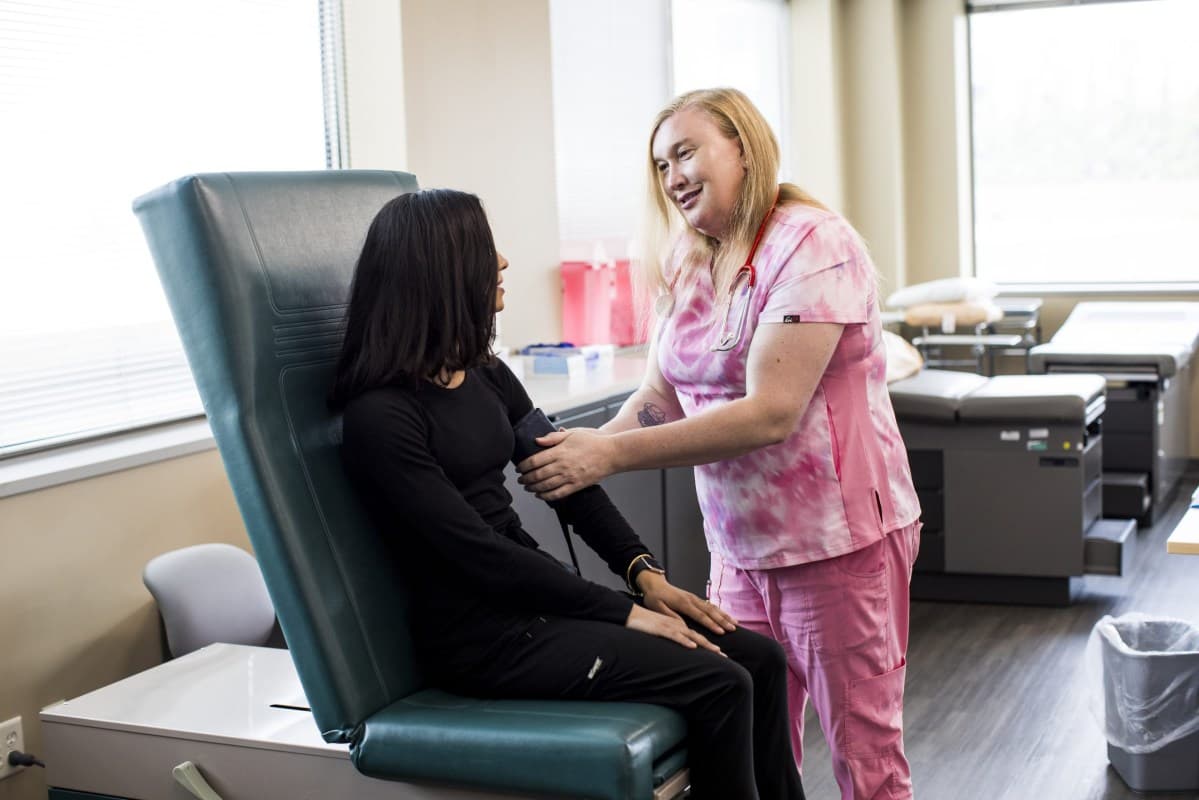


Violet LaClair was ready to leave her job.
As a certified nursing assistant at UW Health in Madison, she used the skills she developed while caring for her dying grandmother for nine years. Her co-workers had supported her through her gender transition. She’d even won an award for providing “extraordinary” care.
She loved her workplace, but after four years, she wanted a change.
“I felt like I’d done it all,” LaClair said. “I felt like at some point I needed to challenge myself more.”
She thought about going back to school, but that didn’t seem doable. She was already in her 40s and didn’t have time or money to spend.
Then she learned she could get trained to be a medical assistant for free, while working, through an apprenticeship program UW Health started in 2018. She pays no school costs, and she gets paid for the time she spends in class.
Three days a week, she works at the company’s Union Corners clinic, where she gets patients situated, takes blood pressure, flushes ears and more.
“I can pretty much do anything the doctor asked me to,” LaClair said. Two days a week, she takes classes on pharmacology, laboratory procedures, and law and ethics.
“I think the program is great,” LaClair said. “It’s given me a whole new chapter in my life, and something to be excited about.”
Opportunities like these are novel, but increasingly common. The idea is simple: Maybe the country’s next nurses, surgical technologists and medical assistants are already working in hospitals and clinics. The people who’ve spent years booking appointments or drawing blood might jump at the chance to train for new careers — if their employers will help them do it.
UW Health now offers apprenticeship options for 17 professions, including surgical techs, pharmacy technicians, respiratory therapists and registered nurses. Apprentices pay nothing for their course work, and they get paid to be in class.
To date, more than 1,000 apprentices have graduated.
Bridgett Willey, who oversaw the launch of those apprenticeships, said they’ve helped fill a critical gap. Wisconsin colleges alone just aren’t graduating enough students to meet the needs of the three major health systems in southern Wisconsin, Willey said.
The popular programs, which attract far more applicants than they can accommodate, have helped the company fill entry-level roles and hold onto existing staff. Before it began offering apprenticeships, as many as 3 in 10 positions for medical assistants, nursing assistants and pharmacy technicians were unfilled, Willey said. Today, it’s around 1 in 10.
“We’ve increased our supply by growing our own and training our own folks,” Willey said.
UW Health isn’t the only health system trying this model. Apprenticeships, once a rarity in health care, have become increasingly common at hospitals and clinics nationwide.
But offering this kind of on-the-job training isn’t always easy. Now, UW Health plans to use what it’s learned to help other states overcome the financial and bureaucratic barriers that can stand in the way. In May, the health system announced it created a separate company called WorkForward to help health systems and state agencies elsewhere set up apprenticeships. Willey, who directs that new project, thinks it’s the first such initiative by a U.S. health care company.
The health care apprenticeship surge
Historically, apprenticeships have been a key on-ramp to technical trades like plumbing and carpentry, allowing trainees to earn as they learn.
Now, apprenticeships are flourishing in U.S. hospitals and clinics, too. In just five years, the number of registered apprentices in the health care field has grown by more than 40%, according to the U.S. Department of Labor, as employers have expanded existing programs and others have started new ones.

The boom comes as demand for health care workers has shot up across the country, triggered by the growing needs of an aging population and a wave of longtime health care workers retiring. By 2038, the country will be short about 109,000 registered nurses, 61,000 physical therapists, 33,000 pharmacy technicians and 13,000 respiratory therapists, according to projections by the National Center for Health Workforce Analysis.
Meanwhile, vocational and on-the-job training is becoming increasingly popular across the board, said Susan Skillman, senior principal research scientist at the University of Washington Center for Health Workforce Studies.
“Apprenticeships in general are growing,” Skillman said. “We’re kind of in that place in the nation where the pendulum is moving away from four-year college degrees.”
Staff seize opportunity to advance
Some health apprenticeships last months while others last years. At UW Health, apprentices training to become medical assistants finish in 10 months while future registered nurses train for four years.
No matter the length or industry, all apprenticeships involve a combination of on-the-job training and classroom instruction. In the case of Wisconsin’s registered apprentices, who are approved through the state’s Department of Workforce Development, employers must pay apprentices for the time they spend in class. In some cases, the employer pays for the apprentices’ school costs, too.
At UW Health, the employer covers tuition. The health system’s staff also coordinate the apprentices’ work and school schedules to avoid conflicts.

Those were big selling points for Brianna Matheson, 35, who had worked as a medical assistant for 12 years when she learned last spring that UW Health was starting a three-year surgical tech apprenticeship. She’d spent time in the operating room before, and she liked helping with clinical procedures.
“I was just ready for something more,” Matheson said. “I was in clinics for so long, doing the same thing for so long. I wanted to learn again, be a student again, and be a novice.”
When the application opened, she was the first to apply.
“I had kind of given up on the idea of going back to school because I, like so many others, need full-time income, and I didn’t really want to give up all of my free time to work full time and go to school in the evenings and weekends,” said Matheson, who now processes and delivers supplies to the operating room at Madison’s University Hospital.
Not only does she not pay tuition, but the Department of Workforce Development offers a stipend for scrubs, reimburses mileage to and from school, and even covers some daycare costs for apprentices with kids, Matheson said.
The position also let Matheson keep her prior $25 hourly wage, reflecting the raises she’d earned during more than a decade on the job. When Matheson graduates in May 2028, she’ll earn surgical tech wages, which range from around $30 to $44 an hour, according to current UW Health job listings.
“I would not have been going back to school at this point in life to pursue this without the support of specifically the apprenticeship program that UW Health is offering,” Matheson said. “I wouldn’t have done it on my own.”
Apprenticeships attract new job applicants
Offering apprenticeships could help health systems draw entry-level job applicants like 25-year-old DeForest native Alex Lippman.
Lippman trained as a certified nursing assistant in high school, then worked at a skilled nursing facility in Madison. He started college at Arizona State University with plans to become a doctor, but moved back to Wisconsin when his grandmother fell ill in his sophomore year. He wanted to continue his education but figured he’d missed his chance.
Then, in 2023, UW Health announced it was starting the state’s first apprenticeship for registered nurses. That apprenticeship, like all of UW Health’s multiyear apprenticeships that lead to degrees, are open only to employees who’ve worked for the system for at least six months.
“I had a plan of trying to get into this program because going back to school on my own was no longer feasible,” Lippman said. He got a job as a certified nursing assistant and began the apprenticeship the next year.
Today he takes classes at Madison College and works three night shifts a week caring for patients with brain and spine injuries in University Hospital’s neuro intensive care unit. He’s on track to graduate in 2028.

UW Health’s shorter training programs, meanwhile, are open to new applicants as well as current employees. Already, some have finished one and moved onto another, looking to advance their careers, Willey said.
“What we’re seeing is that people come in through one of our entry-level (apprenticeship) programs like medical assistant or nursing assistant, get their feet under them working in that capacity, and then now they’re applying for our degreed registered apprenticeship programs,” Willey said.
This isn’t the first time the company has built its own pipeline of health care workers. In 2013, Willey started a program called Health Occupations and Professions Exploration, or HOPE, where high school students spend a Saturday learning to do CPR, place a breathing tube in a mannequin, and more. The goal, Willey said, is to show students the range of careers available in health care. The program has trained about 6,500 students.
How much can the model grow?
Apprenticeships offer a unique way to address workforce shortages and help employees move up on the job, said Andy MacCracken, who coordinates health workforce planning for North Carolina at the NC Center on the Workforce for Health. That, he said, is one reason the number of apprentices and apprenticeships in the health care field has soared in recent years.
Still, he said, it’s not clear exactly how much of the health worker shortage can be solved through apprenticeships.
“We need to have a realistic view about what we’re actually aiming for when deploying apprenticeships as a solution,” MacCracken said. “I think apprenticeships are a really helpful tool in the toolbox. They’re not the only one.”
One challenge: It’s expensive to pay the clinical staff needed to supervise apprentices, so it can be hard for health system leaders to make the business case to their boards. Even health systems that embrace apprenticeships may not be able to accept as many apprentices as they’d like.
UW Health pays for its apprenticeship program with a mix of its own funds, private donations and public funds, though Willey said the latter is usually only available for starting up a new program.

Still, there are always far more applicants than openings. When the registered nursing apprenticeship launched in 2023, 200 employees applied for 16 slots. Last year, 70 people applied for 40 medical assistant apprenticeships.
Another challenge: Each state has its own laws about what counts as an apprenticeship and what standards an employer must meet when offering one. Likewise, the regulations for each profession may vary from state to state too. And then there are the accrediting agencies that approve educational programs, which are still getting used to the idea that students might get paid for their clinical training hours.
Willey said WorkForward will publish research on apprenticeship approaches that work, lobby for resources to support such programs and help other states identify potential funding sources. The company is a nonprofit, she said, which will apply for private and public grants. It will not receive direct funding from UW Health.
Currently, she said, WorkForward is working in Massachusetts with Tufts Medicine and Mass General Brigham — the state’s largest health care employer — and 12 of the state’s community and technical colleges.
“It would be great if we could take the solutions that we’ve built and spread (them at) scale across the U.S. … Health care continues to be a driver of new jobs for the U.S. economy,” Willey said, “and we have an aging population who needs more care, and so we need to be addressing these things now.”
MacCracken said he hasn’t heard of another health care employer taking on this role, but he thinks it makes sense, as employers may be more willing to listen to other employers.
In North Carolina, he said, he’s already seen how a few model programs can pave the way for others.
“I think because of the successes of some of the early adopters who have put these programs in action, we’re seeing great results, and so that’s helping inspire more action and scalability and replication.” MacCracken said.
Natalie Yahr reports on pathways to success statewide for Wisconsin Watch, working in partnership with Open Campus. Email her at nyahr@wisconsinwatch.org.