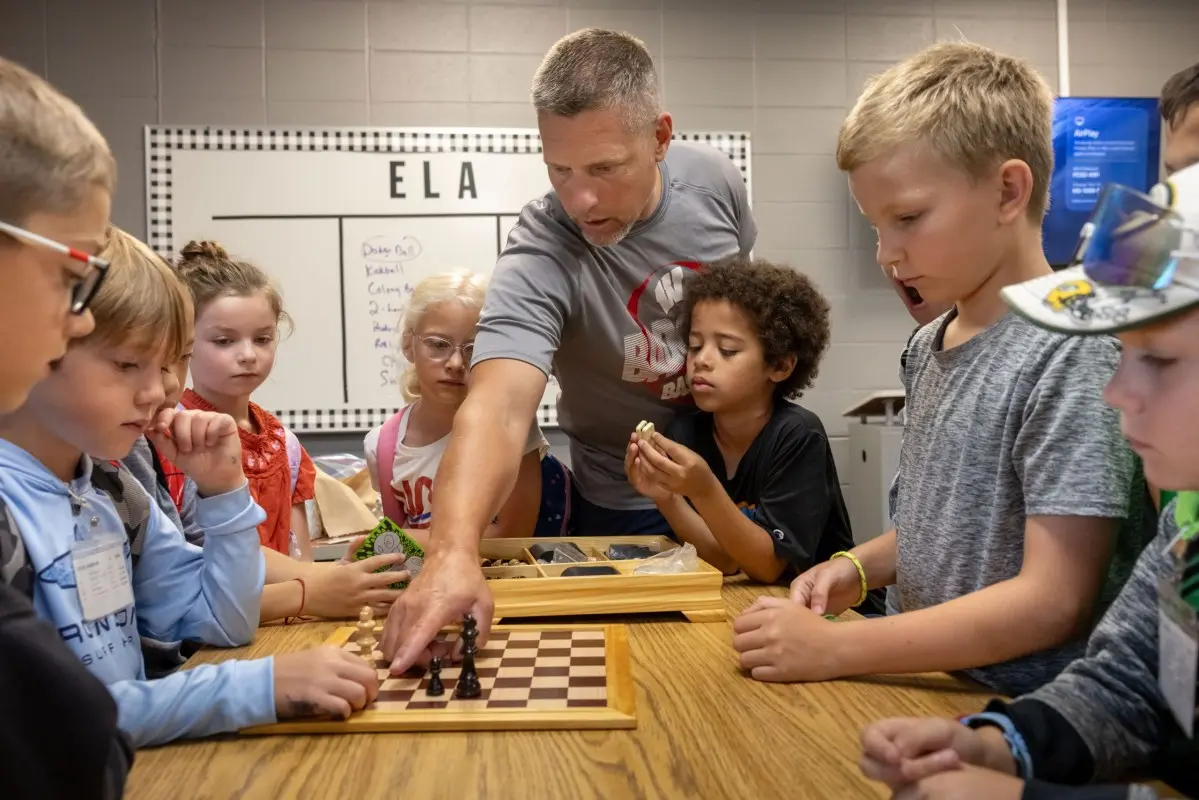


On a Thursday in early July, more than 1,000 children flooded the halls of Pulaski Community Middle School. Heaps of backpacks were piled in corners of classrooms and hallways. Bikes crowded the racks outside. At lunchtime, lines of children snaked around the building as they waited for hamburgers.
Summer school: a phrase usually wielded as a threat to keep students on task in the classroom.
Not in Pulaski.
For six weeks each summer, the northeast Wisconsin village’s middle school transforms into the “place to be,” instead of a punishment.
More than 2,600 kids — 68% of the school district’s enrollment — sign up for summer classes ranging from knitting and cooking to swimming lessons and science experiments. Students who need extra academic help get it, but the focus is on exploring new interests, spending less time on screens and nurturing kids’ creative sides in a way classwork doesn’t always encourage.
At a time when affordable child care can be hard to find, the free program has become a lifeline for the community. Signing up for classes is as competitive as queuing to buy Bruno Mars tickets, staff said — the most popular classes fill up in minutes.
“You get to see a lot of kids from other schools that you don’t get to see normally,” sixth grader Xiomara Lloyd said as she strung beads to add to the stack of bracelets on her wrist, each adorned with her nickname, “Xio.” “I love it.”
The classes help students build a positive association with school, explore new hobbies, get offline and into the real world — and, of course, learn.
“There’s a lot of anxiety and different things as soon as they get close to those (school) doors because now they’re asked to do a lot of things that are difficult for them to do,” said Pulaski Area Community Education Director Mark Heck, who leads the summer school. “But when we can have them come in and have great success and really enjoy it, that’s a win.”

‘A little different type of learning’
Walking through the halls is like stepping between different worlds.
In one classroom, students dressed in Halloween costumes have a dance party. In another, students take turns using American Sign Language to describe emotions. Upstairs, students cook pizza from scratch in a home economics classroom. And in the gymnasium, shrieks and shouts echo as kids play an intense game of dodgeball.
But the chaos is organized — every classroom has at least two adults, and kids wear a badge printed with their name and their schedule, so adults know where they belong if they get lost.
“Summer school is stuff that you learn new, like swimming floats, or you learn how to make diamond art, or even make hearts made out of clay … Summer school lets you have fun in the summer, if you don’t know what to do at your house,” said elementary student Ava Lentz.
And it’s not all fun and games. Kids who need the extra academic help get it. Those behind in classes or on tests take reading and math classes designed to catch them up. Several teachers also host tutoring sessions.
But generally, the classes take a more creative approach. That includes a science class where kids gleefully partake in a series of science experiments — on that Thursday, they combined soda and Pop Rocks and watched the fizzy reaction.

“It’s really great learning, but it might not be exactly what they’re learning during the school year, where (educators are) worried about standards, and worried about the tests that they’re going to be getting kids ready for, and things like that,” Heck said.
“All of those things are very important, but during the summertime we can do a little different type of learning.”
That philosophy has guided the program for two decades.
When Pulaski leaders launched the summer school 22 years ago, it was a small program consisting of one or two classes at several schools because the state would only fund a few hours a day.
Busy parents begged for a full-day program. Not long after Pulaski schools started offering afternoon programming at a cost, the state’s rules changed. Now, schools can get funding for eligible programs all day, all summer long. So Heck dreamed of something bigger.
“I just had this idea in my head that was going, ‘I think we could do something a lot better than this.’ … I want to make a program where your kids say, ‘No, I want to go to summer school,’” he said.
Nowadays, they do.

Kids beg to sign up to be where their friends are. About 68% of the district’s 3,800 students will enroll in at least one summer school course. Signing up for classes is “an Olympic sport,” staff say. Parents take off work to refresh the computer. They post to Facebook the night before registration, wishing each other luck. The best classes fill up in minutes.
It takes a village
Keeping such a behemoth summer school running smoothly takes a village. But in the tight-knit community, it works.
The district employs roughly 130 teachers, 25 classroom aides, various high school and college students and other community members to keep over 2,500 students busy.
“When we hire our teachers … The first thing I say is, if you weren’t here right now, what would you be doing?” Heck said.
Those answers often become classes. For example: A local farmer teaches kids about horses, even bringing in equestrians as guest speakers and taking kids to visit the farm animals. Two food service workers teach students how to cook. A hobby fisherman took students to different ponds in the area during a previously offered course.
Running such a major operation has also brought challenges. It was tough getting all of the departments — transportation, food, academics — on board. But that’s much easier to do in a small district like Pulaski, Heck said.
Ironically, another major challenge: child care.
Many educators have young children who are too young to attend summer school but still need care during the workday. Without viable child care, they couldn’t commit to working in the warmer months.
The district’s solution: One classroom is transformed into a “babysitting room,” where fellow teachers and aspiring early childhood educators change diapers, make bottles and keep a handful of babies entertained.

For aspiring educators like Cori Adelman, who studies early childhood education at Northeast Wisconsin Technical College, the room offers hands-on experience working with young children.
The program has become a workforce pipeline, too. Heck estimates about 15 young adults who first worked summer school have since returned as full-time educators either in Pulaski or in neighboring districts.
‘A lifesaver’
Affordable child care has become increasingly difficult to find, and securing spots in summer camps is notoriously competitive. For that reason, the free summer school that turns away no one has become a lifeline for local families.
Parent and Pulaski Area Chamber of Commerce Executive Director Stacey Von Busch said her kids have participated in the camp for years, calling its affordability a “lifesaver.”
“To have something like this in our community, where we don’t have to drive 30 minutes to get our kids to (other camps), is huge,” she said.
The district provides bus transportation for students who need it, and thanks to a federal grant, children can eat breakfast and lunch at school.
While by law the school must be tuition-free, the district may charge modest fees for supplies, such as beads for making bracelets or yarn for knitting and crocheting. Course fees range between $0 and $40 for each two-week term.

The school is funded by the state — Wisconsin schools can receive funding for summer school classes that meet certain academic requirements. Rather than paying schools a flat amount for each student, the state bases funding on the total instructional time students attend. Therefore, Heck is on a mission to keep enrollment high: More students involved equals more funding.
That includes everyone. Parents of children with disabilities often struggle more to find summer schools and camps that serve them, Heck said. He didn’t want that to be the case in Pulaski.
Many of the district’s special education employees staff a classroom dedicated to children with disabilities. That includes those who require federally mandated “extended school year instruction,” an individualized academic program meant to stop students from regressing over break.
“I look forward to this every year,” said special education teacher Tessa Badtke. “You just get to know them in such a different way because there’s not this academic pressure like at school, so you can just build these relationships.”
And then, Badtke said, students have a better school year. Heck agreed.
“What’s the win out of it for us? We got our kids to walk through the school doors and actually not be angry and upset when they came in,” Heck said. “They’re coming in and they’re happy. Our hope is maybe next year, when they come back in the fall, they’re coming in and they’re saying, ‘I’ll give it a chance.’”
Miranda Dunlap reports on pathways to success in northeast Wisconsin, working in partnership with Open Campus. Find her on Instagram and Twitter, or send her an email at mdunlap@wisconsinwatch.org.
This story was updated to correct the number of students who attend summer school. Wisconsin Watch regrets the error.