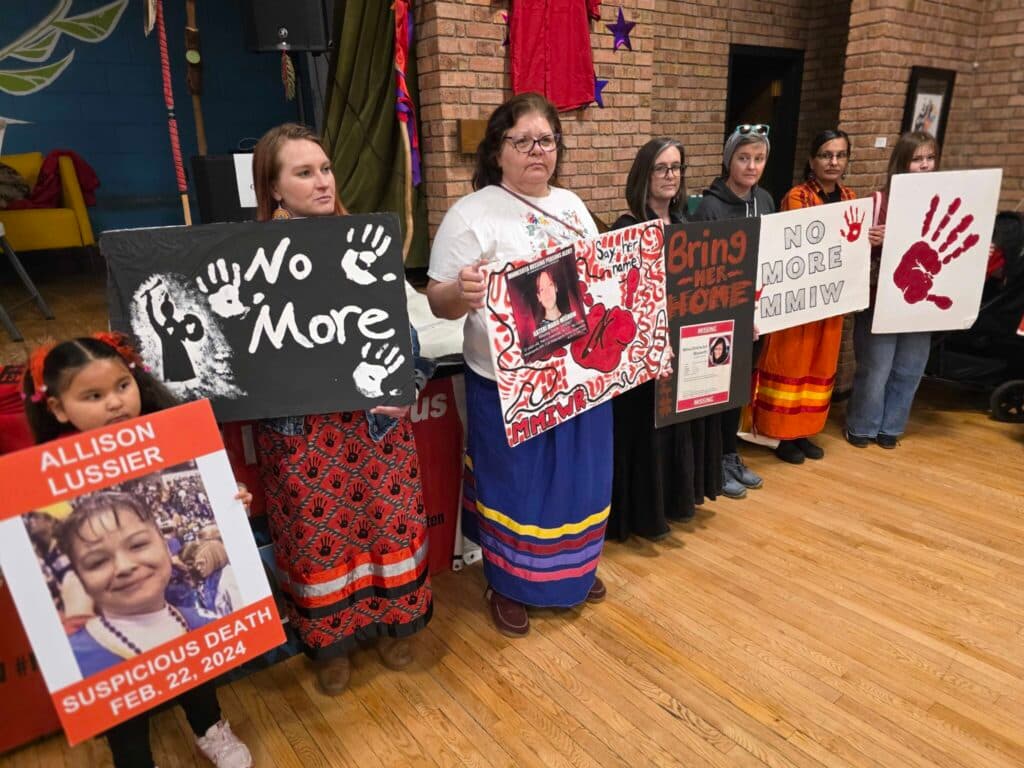


Organizations serving American Indian and Alaska Native survivors of violence say reductions in federal funding have led to over 1,000 unmet requests for help, according to a new report.
The Urban Indian Health Institute, an Indigenous health research group, surveyed 201 tribes, tribal organizations and urban Indian organizations and nonprofits about how funding cuts are affecting the survivor support and safety services they offer. These include safe housing, counseling, transportation, direct cash assistance, and court accompaniment for survivors of crime and violence. Other services include advocacy for victims of elder abuse, people with disabilities or people who had been trafficked.
Democratic U.S. Rep. Adelita Grijalva of Arizona discussed the report at a congressional hearing Tuesday.
Amid cuts under the Trump administration, tribal organizations reported being unable to fulfill 690 safe housing-related requests and 466 requests related to other services. Almost a quarter of those were for children, according to the survey, which collected responses between May and June 28 of last year.
Between 36% and 41% of various services provided by the surveyed groups, ranging from healthcare to legal assistance, “have been or will be reduced due to funding cuts,” according to the report. About 20% of services for active duty or veterans were reduced, according to the survey.
The Trump administration cut millions of dollars from and rescinded grants across multiple federal agencies, including the departments of Justice and of Health and Human Services. Following backlash, some grants were restored, but many, including domestic violence and victim services funds, remain slashed. While some of the funds may have been reinstated since the survey was conducted, the uncertainty and reductions have resulted in staff layoffs or hesitancy to reinstate programs.
For the majority of organizations and tribes surveyed, federal funding covered over half of their program budgets, with the U.S. Department of Justice funding 46%, followed by the U.S. Department of Health and Human Services at 36%. Stateline didn’t receive a response from either agency by publication time.
Congressional testimony
During a U.S. House Committee on Natural Resources hearing Tuesday, the Urban Indian Health Institute’s director, Abigail Echo-Hawk, testified about violence disparities Native communities face, as well as how organizations surveyed in the report are worried about rehiring laid-off staff due to financial uncertainty. Echo-Hawk, a member of the Pawnee Nation, also spoke about her group’s work helping trafficking survivors and other victims of violence. The hearing was focused on resources to address the crisis of missing and murdered Indigenous people, or MMIP.
Grijalva asked whether the Bureau of Indian Affairs’ public safety and justice budget request of $560 million, a decrease of $9.7 million from the prior fiscal year, was enough. She pointed to a 2024 report that showed the BIA estimated that in 2021, $3.5 billion would have been needed to meet Indian Country’s public safety and justice needs. The agency spent $446.7 million that year, the report shows.
Cherokee Nation member Charles Addington, principal director of justice services and law enforcement for Indian affairs at the U.S. Department of the Interior, said the federal government is doing the best it can with limited resources.
“We are trying to take in all of our resources and make sure that we are meeting the needs the best we can with what we are provided,” Addington said in response. “We’re looking at ways of streamlining our resources and working smarter with what we have.”
During the hearing, Echo-Hawk also shared her own story of surviving sexual assault as a child. When the assault was reported, “Law enforcement made the decision to not prosecute as a result of what they said was ‘lack of resources,’” she said during her testimony.
In the institute’s report, nearly half of surveyed organizations said they struggle to recruit tribal law enforcement officers, and 43% said they struggle with keeping them after training.
“I hope that every single one of you recognizes that my rape was not partisan,” Echo-Hawk testified. “And you all now have a responsibility to stand with us. This is in your hands to uphold treaty and trust obligations.”
Violence against Native women
Violence is a public health issue across Native communities, and Native women and girls suffer disproportionately higher rates than other racial groups.
A federal Centers for Disease Control and Prevention report showed over half of American Indian and Alaska Native women and men experienced intimate partner violence during their lifetimes. Violence inflicted by an intimate partner was a factor in 38% of homicides among Native women, and 44% of Native women reported being raped.
Native sexual assault victims were most often girls, aged 12 to 17, according to an FBI analysis of crime victim data between 2021 and 2023.
According to the Urban Indian Health Institute survey, more than 25,000 Native survivors received services over the course of a year. Over a quarter — 28% — were Native children, while 8% were women who were pregnant or postpartum.
The Arizona-based Southwest Indigenous Women’s Coalition works with tribes serving domestic violence and sexual assault survivors. Director of Policy Rose Quilt, of the Yakama Nation, noted that under treaty and trust responsibilities, the federal government has a debt to tribes. “This was already prepaid by the blood of our ancestors, and through the strength of their negotiation for treaties,” she said.
“Programs today are stretching everything,” she continued. “They are delaying hiring, cutting travel, reducing their hours, and trying to prioritize emergency needs in order to fill these gaps.”
Echo-Hawk told Stateline that recently, an 80-year-old sexual assault victim came to her team for help.
The frail, petite woman had needed a change of clean clothes, but Echo-Hawk’s team only had 5X-sized sweatpants to give the frail, petite woman.
“We simply don’t have what we need to provide the basic dignity that these people deserve,” Echo-Hawk said. “She deserved clothes that fit her in one of the most horrifying times in her life.”
Stateline reporter Nada Hassanein can be reached at nhassanein@stateline.org.