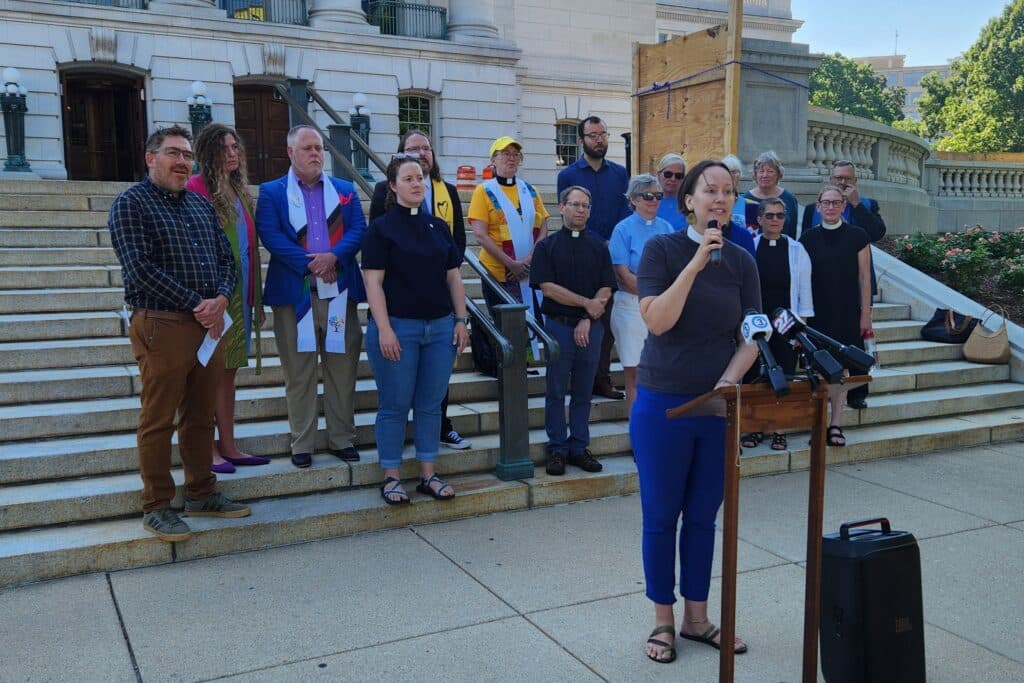


A multifaith group of clergy gathered at the state Capitol Tuesday to call for protecting voting rights and ensuring all votes are counted.

“Our theology teaches us and tells us that God created all of us in God’s image,” said Rev. David Hart, pastor of Sherman United Methodist Church in Madison, at a press conference on the Capitol steps, adding that all people “have this voice that deserves to be heard in the public square.”
The event Tuesday was one of three across Wisconsin, organizers said, and one of 15 similar actions held in nine states.
“We have seen the attacks on our election process,” said Rev. Breanna Illéné, director of Ecumenical Innovation and Justice Initiatives at the Wisconsin Council of Churches. “We are here today to celebrate our local poll workers, the city and county clerks who administer elections here in Wisconsin” — who she added, “are helping make our democracy function.”
The event took place as worries have grown about the possibility that President Donald Trump could deploy armed federal agents to polling places, and as Wisconsin Gov. Tony Evers joined other governors in demanding that the Trump administration immediately withdraw a rule restricting the mailing of absentee ballots in states, including Wisconsin, that have refused to turn over sensitive voter data to the federal government.

On Election Day in November, clergy will show up at local polling places as poll chaplains — “a peaceful presence” to ensure voters’ rights are protected, and to bring “calm to the site,” Illéné said in an interview. “They are just another layer of trust that we hope to add to the election process.”
Rev. Christopher Ross of First Congregational United Church of Christ in Watertown cited biblical readings that support an egalitarian view of society, and with it, democratic participation.
Early Christians built a community that they viewed as “an alternative to the ways of empire,” Ross said. Alluding to attempts to make voting harder, however, he added, “But not everyone these days seems to want such a community.”
Other leaders pointed to democracy as a key tenet of their faiths.
“Jewish tradition teaches us that the process of choosing leaders is not a privilege but a collective responsibility,” said Rabbi Jonathan Prosnit of Temple Beth El in Madison.
“It comes down to a core yet simple belief. Democracy is strongest when every vote is counted,” Prosnit said. “Democracy suffers when voters are suppressed.”
For Unitarian Universalists, democracy is “a religious imperative” said Rev. Kelly Asprooth-Jackson, a UU minister. “It’s one of our core values and principles that people who are affected by decisions must be involved in the making of those decisions.”
Raising barriers to voting and reducing the power of some people’s votes “diminishes all of us because it diminishes the practice of democracy upon which all of us depend for our most fundamental rights,” Asprooth-Jackson said.
The participants also promoted a national letter, drawn up and sponsored by Faith in Us, a national multifaith group, opposing federal and state actions organizers say threaten voting rights. The letter calls on elected officials to safeguard voting rights and assure access to the ballot box for all voters.
It also criticizes President Donald Trump’s executive order restricting voting by mail — which a federal judge blocked late last month — and expresses outrage at redistricting actions that produced “rapid gerrymandering of racially discriminatory election maps in many states” after the U.S. Supreme Court struck down key key provisions in the Voting Rights Act.