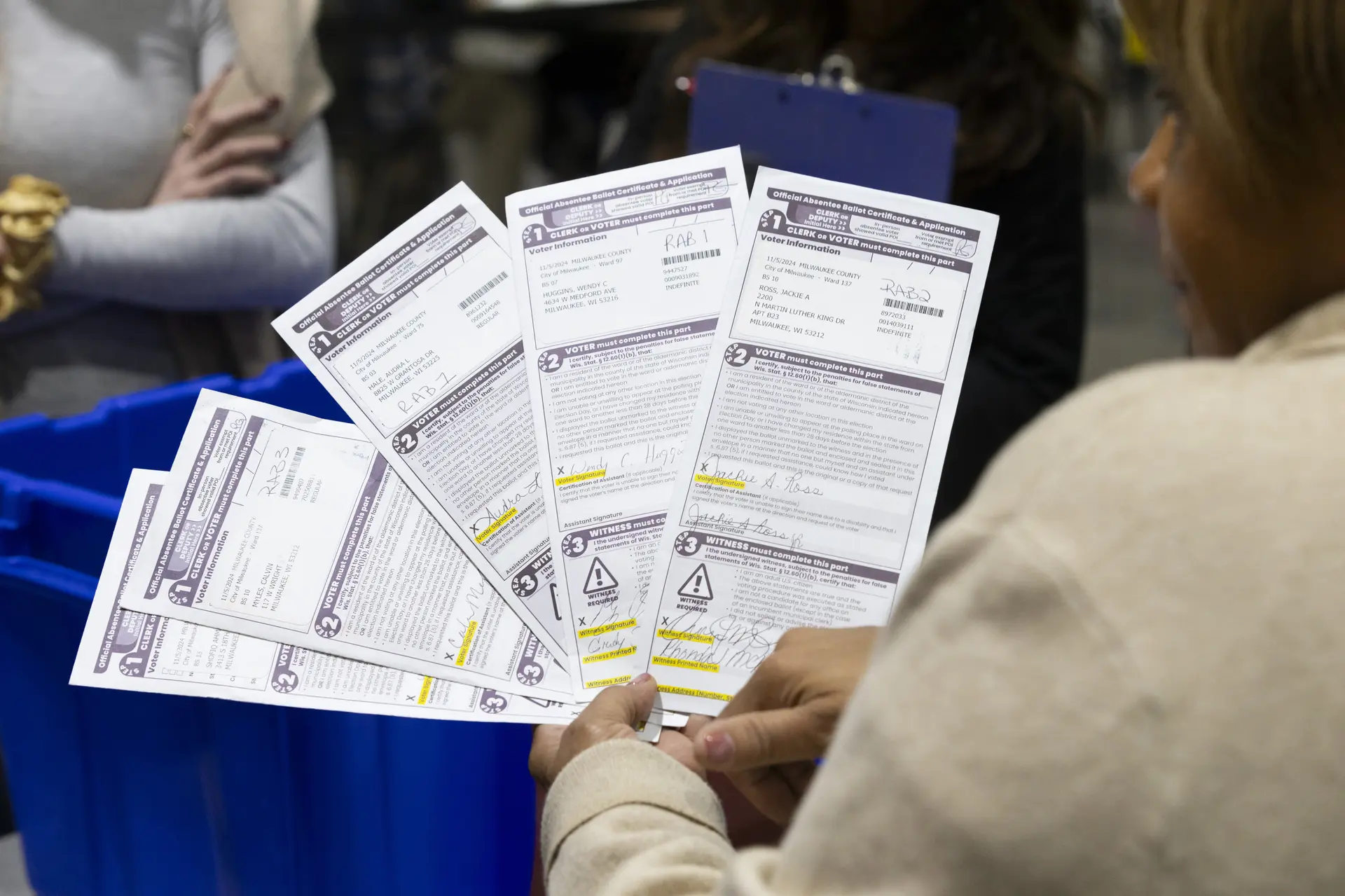


For years, Mequon election workers employed an unusually strict standard for judging the validity of witness addresses on absentee ballot envelopes — a standard not apparently used elsewhere in Wisconsin and that the Wisconsin Elections Commission has now said is illegal.
Under that standard, Mequon officials rejected absentee ballots if the witness address did not include a state or ZIP code and the municipality name was not unique nationwide. That’s despite the fact that Wisconsin’s absentee ballot envelope no longer specifically asks witnesses to provide the information Mequon treated as essential: a state or ZIP code.
But a Votebeat review of hundreds of April 2026 absentee ballot envelopes, the dozens of ballots Mequon at least initially rejected since 2024, and scores of city records found that the city’s strict standard was applied unevenly — and, in some cases, resulted in the initial rejection of ballots that did not appear ambiguous at all.
In April, election workers accepted several ballots with the same missing witness-address information as ballots they moved to the reject pile. In one case, poll workers appeared to override the city’s own recommendation to reject a ballot. And of the ballots Mequon rejected because officials said the witness address listed a municipality name shared by other places in the country, about a third were actually from uniquely named municipalities. All the rest had unique combinations of street number, street name and municipality, even without a state or ZIP code.
Across several recent elections between 2024 and 2026, the city rejected at least 27 absentee ballots while allowing others with the same missing witness-address information to count. In the Wisconsin Supreme Court election this April, Mequon initially intended to reject five more ballots before the commission ordered city officials to count them — and to stop applying the unusual standard in elections moving forward.
Mequon followed the commission’s order to count the votes in April. But when Votebeat asked whether the city would abandon its practice in future elections, the city attorney was less definitive, leaving open the possibility that it could return.
Mequon officials have defended the rejections by saying voters are responsible for following the rules. Nancy Martin, a chief inspector at a Mequon polling place, said that she is unequivocally supportive of the city’s witness-address policy. She invoked a state law calling absentee voting a privilege, not a right.
Because of that law, she said, “you need to make sure that you’re doing your job as a voter, and I don’t think that sending incomplete information is doing a complete job as a voter.”
How Mequon’s standard clashed with state practice
Wisconsin law requires absentee voters to have a witness sign the ballot envelope and provide an address. But state law does not define how complete that address must be. In a lawsuit filed by Rise, Inc., a nonprofit advocacy organization, a court in 2024 sided with the group’s more lenient view, ruling that an address is sufficient as long as a clerk can reasonably discern where the witness lives.
The Wisconsin Elections Commission has since said that means clerks should not reject ballots simply because the witness address does not include a state or ZIP code. In fact, the WEC-approved state absentee ballot envelope doesn’t specifically designate spaces for a witness to provide a state or ZIP code. Mequon has taken a stricter view than WEC in rejecting ballots that do not provide that information.
Around August 2024, Mequon officials discussed the state commission’s witness-address standard at a training for chief inspectors. City records pertaining to that meeting show that City Attorney Brian Sajdak expressed that he disagreed with the commission on what constitutes a valid address. Since then, the city has repeatedly rejected ballots the commission deemed properly witnessed.
Sam Liebert, the Wisconsin state director of All Voting is Local and a former municipal clerk, said it’s normal for city attorneys to be in touch with clerks to decide or interpret election policies.
“But in Mequon, it is pretty alarming and jarring that an attorney would so blatantly not be in agreement with WEC’s interpretation of the Rise ruling,” he said.
Sajdak and Mequon City Clerk Caroline Fochs didn’t respond to multiple requests for comment about who came up with the controversial policy, though a letter from a chief inspector endorsing the policy says they both played a part.
Inconsistencies within polling places that rejected ballots
The unevenness showed up even within the same polling places.
Mequon officials at the same polling places who initially rejected the five ballots from the April election counted six others in that same election — three from Cedarburg, one from Waukesha, one from Rib Lake, and another from Shorewood — even though their witness addresses were also missing ZIP codes and states, and the municipality names were not unique nationwide.
In one instance, poll workers even appeared to override a city official’s instructions to reject a ballot from Shorewood that didn’t list a ZIP code or state. It arrived at the precinct with a handwritten note affixed to it saying “Reject — multiple ‘Shorewoods’ in US.” There is a Shorewood near Mequon and others in Illinois and Minnesota.
In different handwriting, an election worker wrote that the street name listed on the address, Farwell Avenue, was in the nearby Shorewood, and accepted the ballot.
Mequon’s controversial practice came to light in April 2026 as a result of a letter to Fochs from Law Forward, a liberal law firm, warning that the city’s policy may be wrongfully disenfranchising absentee voters.
In response, Sajdak said the city’s ballot rejection practice is a “policy of last resort utilized only when all other reasonable attempts have failed.”
But it appears that city officials did not use simple techniques that would have shown that the witness address provided on each of the rejected ballots was unique.
All rejected ballots did have unique address
Of the 32 ballots Mequon initially rejected in recent elections, about a third did not meet even the city’s own standard for rejection: They came from uniquely named municipalities, like Fox Point and Chicago.
All the rest were also traceable to unique addresses. Even without a state or ZIP code: The street number and street name on those ballot envelopes pointed to only one location in the United States, even though the municipality name wasn’t unique.
Votebeat sought to better understand the process by which Mequon officials rejected those ballots, which the city has described as extensive. But the city has provided little transparency about what specific steps are actually taken to verify witness addresses.
In response to a records request for election workers’ online searches, Mequon initially said it had no responsive records. After Votebeat explained how to export browser history, the city produced records showing that Mequon officials searched Google on April 6 and 7 — Election Day and the day before it — for whether there were multiple cities in the United States named Baltimore and Verona.
The records do not show that the searches went further. Had city officials entered the complete street names and numbers, they would have found that both addresses were unique to just one of those cities. Ballots from both cities were rejected before the commission ordered Mequon to count them.
Fochs did not answer follow-up questions about whether she took other steps to determine whether the addresses were sufficient.
“I do what I can, and we do go through a lot of hoops,” Fochs said in an earlier April interview, saying the clerk’s office contacts voters with insufficient witness addresses when time allows.
But Liebert, from All Voting Is Local, saw it differently: “It does seem sort of just like a lack of due diligence.”
Mequon election workers appear split on city policy
Alisha Campbell, who was an assistant chief inspector at a Mequon polling place in April, said that every absentee ballot went through the clerk’s office before being delivered to an individual ward. The general instruction from her chief inspector, Campbell said, was to reject the ballots that the clerk’s office suggested rejecting.
She also said she was told by her chief inspector that ZIP codes were paramount, and that if a ballot is missing a ZIP and the municipality name isn’t unique, poll workers could not count it. While Votebeat found instances in which poll workers overrode a decision by the central election offices, Campbell said most were generally just following the instructions of the city clerk’s office rather than making decisions on the fly, she said.
Campbell would not say whether she agreed with the city policy.
“What you think independently isn’t always what you are told to do,” Campbell said. “I will leave that at that.”
Martin, the Mequon chief inspector who defended the city’s policy, took a different view. In her letter supporting the policy, which five other Mequon chief inspectors signed, Martin expressed hope that the election commission would “correct their position” by calling for a state and ZIP code in the witness address field.
Instead, the commission did the opposite. In its new manual, published in June, the commission said using the same witness address standard that Mequon employed would constitute “an abuse of discretion.”
Martin said she was disappointed in the commission’s new language and plans to write to her local legislators asking them to change the law to require ZIP and state. She was noncommittal on how she would handle the address standard moving forward, but said she will largely rely on the clerk’s office’s guidance.
Liebert questioned whether other cities and towns in Wisconsin were implementing policies that don’t follow state law or court decisions. Wisconsin has the most decentralized election system in the nation, with 1,850 municipalities each running elections at the local level.
But he said the commission’s intervention in Mequon this year shows a silver lining. While Mequon had rejected ballots against WEC guidance in several recent elections, the commission went further by ordering the city to count the initially rejected ballots from the April election. All five were included in the final results.
“It’s disappointing what happened in Mequon, but I think also at the end of the day, the system shows that it works,” Liebert said, adding that the commission vote to count those ballots was bipartisan. “That should give voters confidence in the system and that people are looking out for them.”
Alexander Shur is a reporter for Votebeat based in Wisconsin. Contact Shur at ashur@votebeat.org.
Votebeat is a nonprofit news organization reporting on voting access and election administration across the U.S. Sign up for Votebeat Wisconsin’s free newsletter here.