

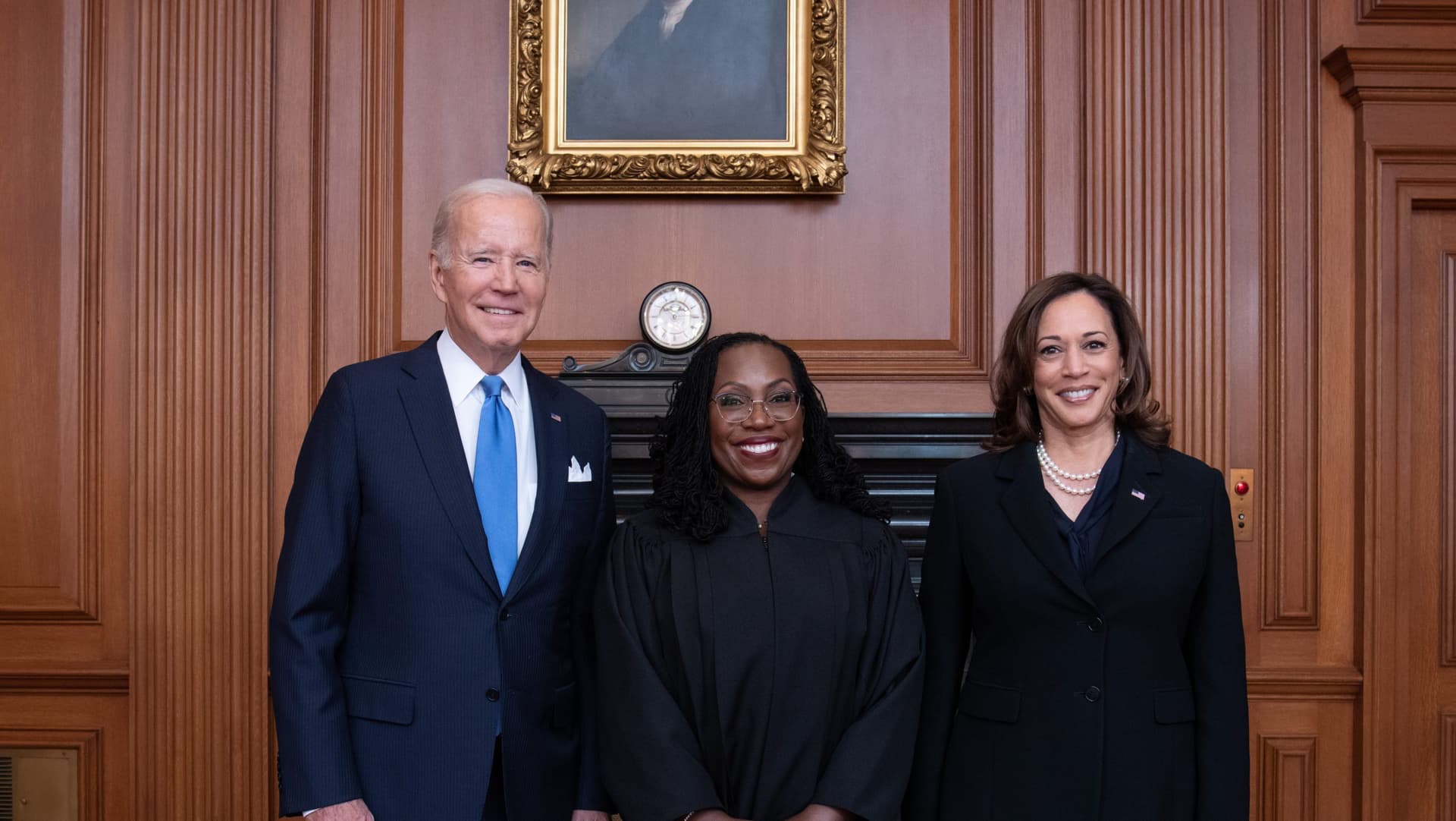
Source: Collection of the Supreme Court of the United States

Jul 2, 2026, 10:59 AM CT


Share
I am Fannie Lou Hamer “sick and tired” of Clarence Thomas. While I believe in respecting titles, the word “Justice” and his contempt for policies, protections, and legal principles that have historically benefited Black Americans just don’t align for me. With opinions that are routinely packaged as principled constitutional jurisprudence, Thomas’ selective legal philosophy of a “colorblind Constitution” is only used when it advances a particular political agenda. Can you hear me chanting “No justice, no peace”?
Justice Ketanji Brown Jackson exposed that contradiction in her dissent addressing the Trump administration’s effort to limit birthright citizenship. She highlighted what others have said for years about Thomas: when race-conscious remedies designed to address centuries of discrimination are before the Court, he insists that the government must pretend race does not exist. Yet when legal doctrines or historical interpretations can be used to diminish the rights of marginalized communities and elevate causes championed by those that are “white supremacy adjacent,” history suddenly becomes essential, nuanced, and worthy of consideration. That is not judicial consistency. It is judicial convenience.
The irony is impossible to ignore. Thomas has repeatedly argued that affirmative action stigmatizes Black Americans, helping provide the decisive votes to dismantle race-conscious admissions in higher education. He joined decisions that weakened the protections of the Voting Rights Act of 1965 by invalidating key enforcement mechanisms, making it easier for states to implement voting laws that disproportionately burden communities of color. He has supported narrowing the ability of federal agencies to combat discrimination and has consistently favored interpretations that make civil rights litigation more difficult.
While each decision may stand on its own legal reasoning, collectively, they tell a story. That story has too often resulted in fewer protections for Black voters, fewer opportunities for Black students, and fewer legal tools to challenge discrimination.
Nowhere is this more apparent than in the debate over birthright citizenship. Donald Trump never presented his argument as a neutral exercise in constitutional scholarship. It was always rooted in a political movement that casts immigrants, particularly immigrants of color, as threats to the nation’s identity. The target was never merely the words of the Fourteenth Amendment to the United States Constitution. The target was who gets to belong in America.
As a reminder, the Fourteenth Amendment was adopted after the American Civil War to overturn the disgusting legacy of Dred Scott v. Sandford, which declared that Black people could never be citizens of the United States. Birthright citizenship was not an accident, but an explicit rejection of white supremacy embedded in law.
Thomas may insist he is merely applying the Constitution as written. But his jurisprudence repeatedly aligns with outcomes that have attempted to provide intellectual cover for efforts that threaten one of Reconstruction’s greatest achievements, Americans have every right to ask whether the Court is applying neutral principles or advancing a broader political vision.
The slogan “Make America Great Again,” and let’s just say the not-so-quiet part out loud, for white people, should lead the syllabus of every opinion that Thomas issues. He appears committed to the movement that is seeking to dismantle gains of Black Americans, immigrants, and other communities of color. Hamer’s words capture Thomas’ tenure well: “Law and order is a very frightening word for every Black person I ever knew…We’ve got the order – but there is no law.”

Michelle Bryant is host of “Say Something Real with Michelle Bryant,” a morning drive political talk program on WNOV 860AM/106.5FM. She is a political strategist, president of CMB Consulting & Associates, and a weekly columnist for the Milwaukee Courier Newspaper. A former Chief of Staff in the Wisconsin State Legislature—where she also served as Budget and Policy Director and Clerk of the Senate Committee on Judiciary and Public Safety—Bryant brings decades of experience in legislative leadership, campaign management, and public policy. She is a graduate of the University of Wisconsin–Milwaukee and a longtime advocate for civic engagement and equity.
Want More Local News?

Civic Media
Civic Media Inc.
The Civic Media App
Put us in your pocket.


