

Recent polling from the Democracy Defense Project found that three out of every 10 Wisconsin voters aren’t confident this year’s elections will be conducted accurately.
U.S. Rep. Tom Tiffany, the presumptive Republican nominee for governor, has often been a vocal election conspiracy theorist — including voting against the certification of the 2020 presidential election on Jan. 6, 2021 and appearing at events with people who insist that election was stolen.
Republicans in control of Congress have spent months debating bills to add restrictions to voting while President Donald Trump has signed executive orders demanding states turn over voter data, sent FBI agents to Democratic cities across the country — including Milwaukee — to investigate the 2020 election and uses the bully pulpit of the White House to rehash the debunked theories that the 2020 presidential election was stolen from him and that Democrats are unfairly winning elections because large numbers of immigrants who are ineligible to vote are illegally casting ballots.
Since Trump’s return to office last year, fears that he will send armed federal agents to polling places have percolated across the country.
With less than 50 days until Wisconsin’s primaries for governor, congressional and state legislative seat and four months until the Nov. 3 midterm election, the past six years of Republican efforts to reduce faith in the country’s election systems have created a whirlwind of headlines, social media rumors, court rulings and fearmongering.
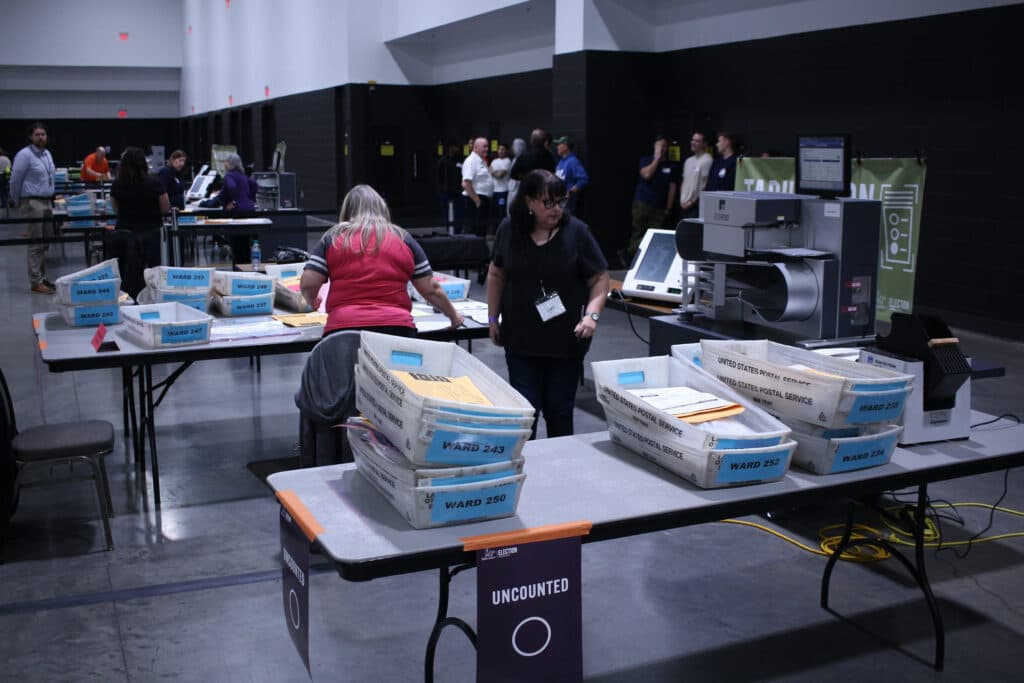
All of that is set to collide this summer with Wisconsin’s actual election administration system — which involves thousands of clerks, volunteers and state officials managing the polls, counting ballots and certifying the results.
Ann Jacobs, a Democrat on the Wisconsin Elections Commission, said that getting too worked up about the potential risks can turn people off from voting, even if they wouldn’t have been affected.
“There’s a lot we can prepare for, and scaring people in advance of the election is the worst thing we can do, because we don’t need to depress our own turnout,” she said.
TR Edwards, staff counsel at the voting rights focused firm Law Forward, told the Wisconsin Examiner that people’s fears often don’t exactly match with what happens on the ground.
“A lot of it is just fear-based and not necessarily rooted in what’s possible, but that being said, I am understanding of that,” he said. “I recognize why people are concerned, and I do think, particularly with some of the actions the administration has taken over the last six months, that they have every right to be concerned. I just don’t know if the level of concern matches either the level of preparation or the reality on the ground.”
Edwards said that he and Law Forward are focused on three areas ahead of the elections: the threat of the federal government seizing 2020 election ballots, building trust between election clerks and local law enforcement and working to prevent Trump’s election-related executive orders from taking effect.
Ballot seizures
The FBI over the last year has been re-investigating long debunked claims of fraud in the 2020 election. Agents have already seized ballots and documents in Fulton County, Georgia and Maricopa County, Arizona. They’ve also been conducting interviews in the Milwaukee area, raising worries that ballots there will also be seized.
In Milwaukee County, nearly 180,000 absentee ballots from the 2020 election have yet to be destroyed because of ongoing efforts from election deniers to obtain the ballots through the state’s open records law.
Under normal Wisconsin election law, ballots and other election materials are destroyed 22 months after an election is held. But because of the ongoing litigation, the county’s ballots still exist.
State officials have raised concerns that the federal government could seize those ballots, revealing how thousands of Milwaukee residents voted up and down the ballot in 2020.
Don Millis, a Republican member of the Wisconsin Elections Commission, told WISN’s UpFront on Sunday that the ballots need to be destroyed as soon as possible.
“Those ballots should have been destroyed. No one’s entitled to see those,” he said. “Our Constitution was built on the idea of a secret ballot, and I’m just frustrated that this hasn’t happened. I just wish the decision makers who are in charge of this would see that and move more quickly.”
But the discussion of the 2020 ballots has raised fears that the administration will attempt to do the same with this year’s ballots.
Jacobs told the Examiner there isn’t much an individual voter can do if that’s what happens — but that local elections officials and voting rights advocates are preparing for the possibility and planning to head off any attempts in the courts.
“I am thoughtful and cautious about how I talk about things that might affect an election, right, and in part it’s because there’s only certain things we can or cannot affect going into an election,” she said. “You know, ‘Donald Trump’s going to come in and steal all our ballots.’ Well, there’s absolutely nothing a voter can do about that if that’s in fact what’s going to happen, right? An individual voter has nothing they can do about that, so I don’t want them to not vote, thinking that that’s going to happen with me, and so I’m concerned that there’s a certain amount of fearmongering around what might or might not happen in a fall election.”
She added that with proper planning — having court documents pre-written, knowing which local judge will be on duty to hear a case right away — challenges to these kinds of actions can be made “in minutes instead of hours.”
Cops and feds
Edwards pointed to Riverside County, California, where the local sheriff — a Republican candidate for governor — seized ballots and opened an investigation into the state’s recent primary election, as an example of the risk posed by law enforcement intrusion into elections. In Wisconsin, Racine County Sheriff Christopher Schmaling has often been at the center of the state’s election skeptic circles.
Edwards said that the goal this summer is to build trust between cops, outside groups and local clerks ahead of the election so everyone knows what the law says and where it’s appropriate for law enforcement officers, local, state or federal, to be.
“We are less concerned about law enforcement being present, as long as they are in compliance with applicable law,” Edwards said. “But I am more concerned with ensuring that voters can cast ballots free from intimidation. Our goal is to make sure clerks and voters understand their rights and that any conduct that violates state or federal law, or could reasonably be viewed as voter intimidation, is identified and addressed appropriately.”
If law enforcement is entering areas of polling places that they shouldn’t be, the remedy would be filing lawsuits to get a judge to remove them.
Jacobs said this threat again comes down to planning.
“Certainly I can contemplate the possibility that a goal would be to go into a minority community and essentially stand around with guns and try to intimidate voters,” she said. “Unfortunately, our nation has a history of that, and it wouldn’t be the first time that has happened. That said, we can also plan ahead for that. … if that is something where a person is like, ‘Boy, if that happens, I would be really scared to go to a voting place.’ That person should be encouraged to vote absentee, right?”
In addition to voting by mail, voters can cast absentee ballots in person at drop boxes or at their local clerk’s office.
Executive Orders
Trump has signed executive orders that aim to require additional proof of citizenship to register to vote, restrict absentee ballot use and more tightly manage how the U.S. Postal Service handles absentee ballots. All of the orders have been hung up in the federal court system.
At a Senate hearing Wednesday, U.S. Postmaster General David Steiner said that under his agency’s proposed rule, the post office won’t deliver mail-in absentee ballots in states, including Wisconsin, that have refused to comply with Trump’s order to turn over voter data to the federal government.
Since Trump returned to office, his administration has been working to obtain voter registration lists in a number of states, including Wisconsin. So far, the state elections commission has resisted these efforts, arguing the administration is trying to gain access to personal voter data that can’t be released.
Jacobs said that the executive orders and any proposed rules from the USPS are going to be challenged in the court and are unlikely to be in effect by the fall election.
Edwards said that Law Forward has filed amicus briefs in the lawsuits against the orders and is working to help overworked local election officials digest information about potential changes.
“There’s no way [clerks] can keep up with the velocity of everything that’s going on, so we’ve been trying to do what we can to partner with people to help make sure they have all the information they need,” he said.