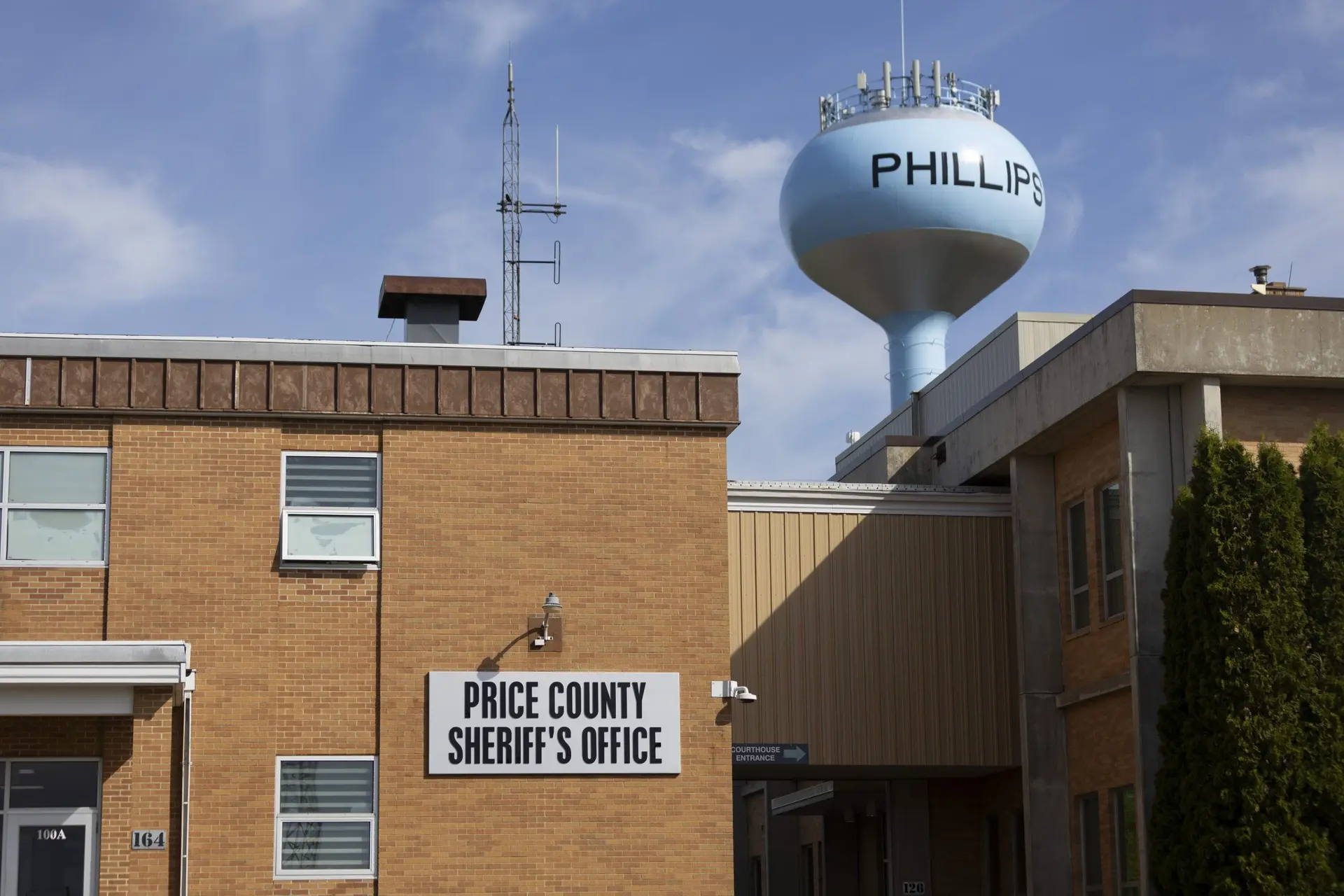


Nearly 40 years ago, Marchelle “Shelly” Hansen went missing in Price County, Wisconsin. Law enforcement officials have since told the public very little about what happened to the pregnant 23-year-old.
The sheriff in 1987 said investigators didn’t suspect foul play. They have never publicly stated that she was killed, and she remains listed in a state Department of Justice missing person database. Her body has never been found.
But a Wisconsin Watch investigation has uncovered substantial information about the case, including a never-before-named lead suspect whose DNA was obtained through a long-sealed search warrant in 2008, seven years before he died.

Law enforcement officials long ago determined that Michael D. Raskie, Hansen’s supervisor at Marquip Corp., was their top suspect and the likely father of her unborn child, according to the newly obtained court documents. The records — including a search warrant affidavit containing sworn statements from investigators — confirm the Price County Sheriff’s Office has been investigating the case as a first-degree intentional homicide.
Raskie was never charged in connection with Hansen’s disappearance. Wisconsin Watch is naming Raskie because the court document identifies him as a suspect. He died in 2015 at the age of 64.
Price County Sheriff Brian Schmidt, who took office in 2009 after 20 years as a deputy, declined to comment for this story. He denied Wisconsin Watch’s request to review the Hansen case file, calling it an “ongoing criminal investigation.” In a 2024 interview with WSAW he gave no new details and didn’t mention the unsealed search warrant, but said there is still hope there might be “someone that knows something now that time has passed who wants to come forward and at least talk about this with us.”
The Wisconsin Department of Justice also denied a records request, citing the open investigation and “any potential criminal prosecutions.” A spokesperson said the agency is limited to an assisting role in the investigation.
Hansen’s family declined to comment on the investigation.
Cold case warms up

For nearly four decades, the Hansen case has stumped investigators, divided Hansen’s siblings and featured in recent true crime podcasts. Many reports have speculated that the unknown father of her unborn child is a likely suspect, but have not named Raskie.
Two years after Hansen’s disappearance, Raskie was convicted of a brutal attack on his wife, whose brothers founded Phillips Plating, one of the largest companies in Price County.
Raskie was sentenced in August 1989 to seven years in prison for the attack. They divorced shortly after. A former Price County prosecutor told Wisconsin Watch that investigators didn’t have enough evidence to charge Raskie before he was paroled in December 1991.
The Hansen case had a breakthrough in 2003 when a former Phillips police officer belatedly reported seeing Raskie’s vehicle parked at Hansen’s apartment the night she disappeared, former Price County Sheriff Wallace Krenzke told Wisconsin Watch.

(facebook.com/KassandraSepedaTV)
It took five years of additional investigation before Price County deputy and lead investigator Christopher Jarosinski signed the affidavit seeking Raskie’s DNA. The affidavit reveals that Raskie was rumored to have been responsible for Hansen’s disappearance as early as September 1989.
A former Marquip employee who spoke with Wisconsin Watch, but is not mentioned in the affidavit, said she alerted the Phillips police officer in spring 1988 that officials should investigate Raskie in Hansen’s disappearance. A few days later, she said, Price County’s lead homicide investigator on the case at the time, Richard Heitkemper, contacted her and she told him she had seen Raskie and Hansen engaged in an intense conversation the day Hansen disappeared.
Who is Shelly Hansen?
Of the roughly 170 open missing person cases in Wisconsin, Shelly Hansen’s is the 40th oldest.

Hansen grew up in the Sheboygan County village of Random Lake, with six older siblings. When her parents divorced, she moved with her mother to Hawkins, Wisconsin, about 25 miles from the Price County seat of Phillips, about an hour-and-a-half northwest of Wausau.
Hansen graduated from Ladysmith High School in 1982. She then went to work at Phillips Plating and moved into the Starlite Apartments just north of Phillips. In November 1987 she was working second shift at manufacturer Marquip Corp. and a second job at the IGA grocery store in Phillips.
She saw her mother for the last time on Oct. 11, 1987, during a visit to Random Lake. Her mother told The Sounder newspaper that they picked apples at Waldo Orchards. Hansen surprised her mother with the news that she might be pregnant.
Two weeks later, Hansen sent her mother a letter confirming the due date was in July and she wouldn’t be getting an abortion. In another letter she wrote that the father was going to be paying the medical bills and “all of this stuff — dresser, bed, stroller, walker, everything. And my agreement is not naming him as father to anyone.”
“All I want to know is you’re with me and same with everyone in the family,” Hansen wrote. “If not, I’ll do it on my own.”
‘Her eyes told me everything’
An employee at the IGA grocery store where Hansen worked a second job reported her missing on Tuesday, Nov. 17, 1987.

Five days earlier, on Thursday, Nov. 12, the last day she was seen alive, Hansen spent the morning getting an ultrasound at Flambeau Hospital in Park Falls. Around lunchtime she brought the sonogram to the Park Falls bar that her brother Ron and sister-in-law Wendy were getting ready to open. Ron asked about the father, but she didn’t give a name — only that he was married, Wendy Hansen told Wisconsin Watch.
Later that afternoon Shelly went to a laundromat in downtown Phillips where she ran into Kathy Krenzke — whose husband later became sheriff. Hansen proudly showed off the ultrasound photos of her healthy baby and talked about not being sure whether to visit her mother that weekend or go to Ron and Wendy’s bar opening.
“She was excited,” Krenzke recalled in an interview with Wisconsin Watch. “She showed me the ultrasound of the baby, and I wonder if they ever found that in her purse, because she took it out of her purse to show me.”
Krenzke asked Hansen who the father was, but Hansen wouldn’t provide a name. Krenzke said Hansen told her she planned to “confront” the father to make sure he would financially support the child.
Krenzke said Hansen appeared to be in a hurry, removing her still-damp clothes from the dryer with plans to air-dry them at her apartment near Marquip.
Hansen worked the evening shift at Marquip, now BW Papersystems, on the north end of Phillips — the same shift Raskie worked as a supervisor at what was then a building materials machine manufacturer.
Former Marquip employee Tina Andersen told a state investigator that Hansen showed her the sonogram the day she disappeared and that Hansen described the father as a Marquip foreman with two small children, according to the affidavit. Those descriptions fit Raskie.
Cindy Miller, another former Marquip employee, told Wisconsin Watch she saw Hansen that same day at the plant having an intense conversation with Raskie. She recalled Hansen previously asking if she had any leftover maternity clothes.
Miller, who handed out equipment at the tool room counter window, said she saw Raskie and Hansen near the bubbler, the large analog clock above them showing it was before 6:30 p.m. Miller told Wisconsin Watch she saw Raskie pacing, his hand gripping his wrist behind his back.
“She looked up at me, and our eyes locked, you know, looked right at each other, and just the expression on her face, it was very sad,” Miller said. “Her eyes told me everything.”
Previously undisclosed Hansen sighting
The only official story law enforcement officials have put out about Hansen’s last known whereabouts is that she was seen leaving Marquip at 8 p.m. on Nov. 12.

But the affidavit reveals another, previously undisclosed Hansen sighting that came to light in an August 2003 interview with former Phillips police officer Leonard Shilts, who died two years later. Shilts told investigators he talked to Hansen at the Tasmanian Devil bar while on patrol duty between 10 and 11 p.m. that night. Shilts said Hansen indicated she was leaving her apartment “for a time” and asked him to check in on it.
Shilts told investigators he drove past Hansen’s apartment building later that night between 2 and 3 a.m. He said he saw only two vehicles — Raskie’s truck and a white or light-colored vehicle that likely belonged to another apartment resident.
Hansen’s maroon Dodge Omni was found hours later at the Lake Ten tavern, located on a small clear lake 10 minutes southwest of Phillips, according to the affidavit. It was parked at an angle that looked as if someone had left it in a hurry, the tavern owner’s mother told investigators in 2007. She reported the abandoned vehicle to the sheriff’s office the afternoon of Saturday, Nov. 14, 1987.

Doug Sprague, the Price County sheriff’s deputy who responded to Lake Ten, told Wisconsin Watch that the tavern owner reported the vehicle wasn’t there when he closed the bar at 9 p.m. on Nov. 12. Sprague said the car was locked in the tavern parking lot, which overlooked a 42-acre lake and boat landing. Sprague said he later checked Hansen’s apartment.
“I went to where she lived, just north of town in a room, and none of her clothes were disturbed,” Sprague recalled. “There was nothing packed in a suitcase or anything like that. It just looked like she wasn’t planning to go anywhere.”
Another Raskie connection
At that time, Michael Raskie’s brother Steven rented a home about a half mile from the Lake Ten tavern, according to the affidavit. Steven told investigators in September 1989 — a month after his brother’s spousal abuse conviction — that he had heard the rumors implicating Michael in Hansen’s disappearance, but that he had never seen them together.
He said his brother didn’t have a key to his home and didn’t appear to have used the residence during the times Steven was away working as a bricklayer.
But the landlord’s wife told an investigator in 2003 that Steven, who died in 2012, always left the rented residence unlocked.
Michael Raskie’s ex-wife, who at the time was the human resources manager at Phillips Plating, told investigators over the course of three interviews in 2006 and 2008 that her ex-husband stored a dirt bike, a motorized tricycle and a Harley motorcycle in a shed on the property his brother rented. She declined a Wisconsin Watch interview request.
She also said she found it strange when she overheard Hansen talking about Raskie to her former co-workers at Phillips Plating. She said her husband told her that Hansen would bring him dinners at Marquip and that he “couldn’t get rid of her,” according to the affidavit.
Raskie’s ex-wife told investigators when she told her husband that Hansen had gone missing, he replied, “Well, she was a sick human being anyway.”
Wallace Krenzke, who was sheriff from 2003 to 2009, told Wisconsin Watch that deputies dredged Lake Ten and dug in multiple places, including a garbage pit behind the house Steven Raskie had rented. But the search for Hansen’s body came up empty.
A breakthrough — and a denial

Krenzke said the Shilts interview in 2003 — 16 years after Hansen’s disappearance — was a turning point in the case. The affidavit cites interviews from 1987 and 1989, but then nothing for 14 years. Then there was a flurry of activity in the years leading up to the 2008 search warrant for Raskie’s DNA.
Raskie himself was interviewed three times in 2004 and 2005. He told investigators that Hansen was capable of manipulating someone over a pregnancy.
“Sometimes you had the feeling like she would do something like that to someone,” Raskie is quoted in the affidavit. Asked if he had any theories about what happened, he mentioned the 2004 murder of a woman in Salt Lake City whose husband confessed to throwing her body in a dumpster. He noted that without a body, police could not be sure that the Utah woman was murdered.
Raskie also denied a sexual relationship with Hansen, while speculating that his ex-wife could have been behind the disappearance because she suspected him of an extramarital affair.
DNA retrieved from car
In 2006, investigators collected DNA swabs from inside Hansen’s vehicle, which was still in law enforcement custody as of 2024. The State Crime Lab identified DNA from one unknown male. Investigators obtained DNA from Steven Raskie and ruled him out.
They also ruled out a former Marquip employee who told investigators he had an informal “sexual” relationship with Hansen, but suspected she was also seeing Michael Raskie. The former employee was unmarried at the time with no children and did not fit Hansen’s description of the father.
At one point, he told investigators he had confronted Raskie about having sex with Hansen. Raskie never admitted or denied it, according to his telling, but “would smile and walk away.”
When asked if he had ever been in Hansen’s vehicle, Raskie stated he may have sat in her passenger seat. He said he and Hansen were part of a group of Marquip employees who often drank together after work.

The affidavit notes two other witnesses who in the 2000s provided circumstantial evidence that Raskie and Hansen had a personal relationship.
Hansen’s next-door neighbor told investigators that in the days before Hansen’s disappearance she was awakened by a violent and extremely intense argument she could hear through the thin wall. She said she heard a male speaking in loud, accusatory tones and a female voice speaking in calming tones. She also told investigators the male’s vehicle was a “spruced up” “guy truck” pickup.
An investigator also spoke with a witness who said he saw Raskie and Hansen kissing outside the Stonecroft Tavern. The witness also said Hansen told him in November 1987 that the father of her unborn child was married with two children, according to the affidavit.
Based on all of the presented evidence, Price County Circuit Judge Douglas Fox ordered the DNA sample be taken from Raskie. Records show Jarosinski took three swabs from Raskie’s mouth.
Because the investigative file remains closed to public inspection, the results of the lab testing remain unknown to the public. Though Raskie acknowledged sitting in the passenger seat of Hansen’s vehicle, the unknown male DNA was found on the left side of the steering wheel, which could mean the person drove the vehicle.
For investigators to obtain DNA evidence, they must lay out their case in a sworn application filed in court. Then-Price County District Attorney Mark Fuhr, now the county’s lone circuit court judge, asked every six months that the search warrant records remain sealed to protect confidential informants in the case. In 2017, two years after Raskie died, the seal expired and was not renewed.
A search for Raskie’s name in the online statewide court record system does not reveal the existence of the search warrant, but Wisconsin Watch found it by searching on the single computer terminal in the Price County Clerk of Courts office.
Why wasn’t Michael Raskie ever charged?

a brutal attack on his wife in February
1989 and sentenced to seven years
in prison.
(Wisconsin Department of Corrections)
The affidavit renews questions about the Hansen case, specifically why Raskie was never charged and why law enforcement officials have kept so much of their investigation secret.
“I was asked once by the local paper what the status was of Michael Raskie,” recalled Krenzke, the former sheriff. “I said, ‘If I had information which would lead me to probable cause, he’d be arrested.’ I told them I had none.” Krenzke added that he was unaware authorities had obtained a DNA sample from Raskie during his time as sheriff.
Krenzke said he kept some distance from the investigation because as chief of security at Marquip in the 1980s and 1990s he had worked with both Hansen and Raskie. Schmidt, the current sheriff, also overlapped with Hansen and Raskie when he worked at Marquip from 1987 to 1989.
Heitkemper, the lead investigator on the case in 1987 and sheriff from 1995 to 2001, said the case got off to a slow start. Heitkemper said he was the county’s only homicide detective at the time and yet he wasn’t assigned to the case until many days after Hansen was reported missing. All that time Hansen’s car remained unattended in the Lake Ten parking lot, he said.
Heitkemper blamed then-Sheriff Wayne Wirsing, who died in 2018, for not assigning him the case sooner because he was a political rival. Heitkemper ran for sheriff against Wirsing and lost in 1986, 1990 and 1992 before defeating him in 1994.
Miller, the former Marquip employee, said not long after she left the company in spring 1988 she saw Shilts at a gas station and told him police should be looking at Raskie in the Hansen case. She said she got a call from Heitkemper a few days later and shared her account of seeing Hansen and Raskie at the bubbler.
Heitkemper acknowledged Raskie became the lead suspect while he oversaw the case.
Heitkemper said Hansen called her mother Joyce Hansen the day she disappeared and told her Michael Raskie was the father of her unborn child, although he said Joyce didn’t share that detail with investigators until years later.
Joyce Hansen died in 2022. Her obituary notes Shelly is “assumed dead.”

Heitkemper added that Raskie’s connections in Price County made the Sheriff’s Office particularly cautious in tying him to Hansen’s disappearance.
“Raskie was a very well-liked individual,” Heitkemper told Wisconsin Watch. “He had a lot of contacts throughout the community, a lot of people with money, and so we had to be very, very, extremely careful where we let information out.”
Buck Schilling, who served as Price County district attorney from August 1990 until January 2003, right before the breakthrough in the case, recalled Heitkemper telling him he wanted to be able to charge Raskie in Hansen’s disappearance before Raskie was released from prison.
“At the time I don’t believe they had enough evidence for me to charge him,” Schilling said. “Even (Heitkemper) knew he didn’t have enough evidence yet.”
Schilling reviewed the 2008 search warrant at Wisconsin Watch’s request. He said it shows the Price County Sheriff’s Office established probable cause to obtain Raskie’s DNA, a lower standard than proving someone’s guilt beyond a reasonable doubt in criminal court. Prosecutors generally must believe the available evidence can meet that higher standard before filing charges.
If the unknown male DNA on the left side of Hansen’s steering wheel matched Raskie’s, it might have strengthened the case because it could be used as evidence that Raskie drove the vehicle at some point.
A state Department of Justice spokesperson said the department is reviewing Wisconsin Watch’s request to reconsider its denial of releasing Hansen case records.
Anyone with information about the Shelly Hansen case should contact the Price County Sheriff’s Office at (715) 339-3011.