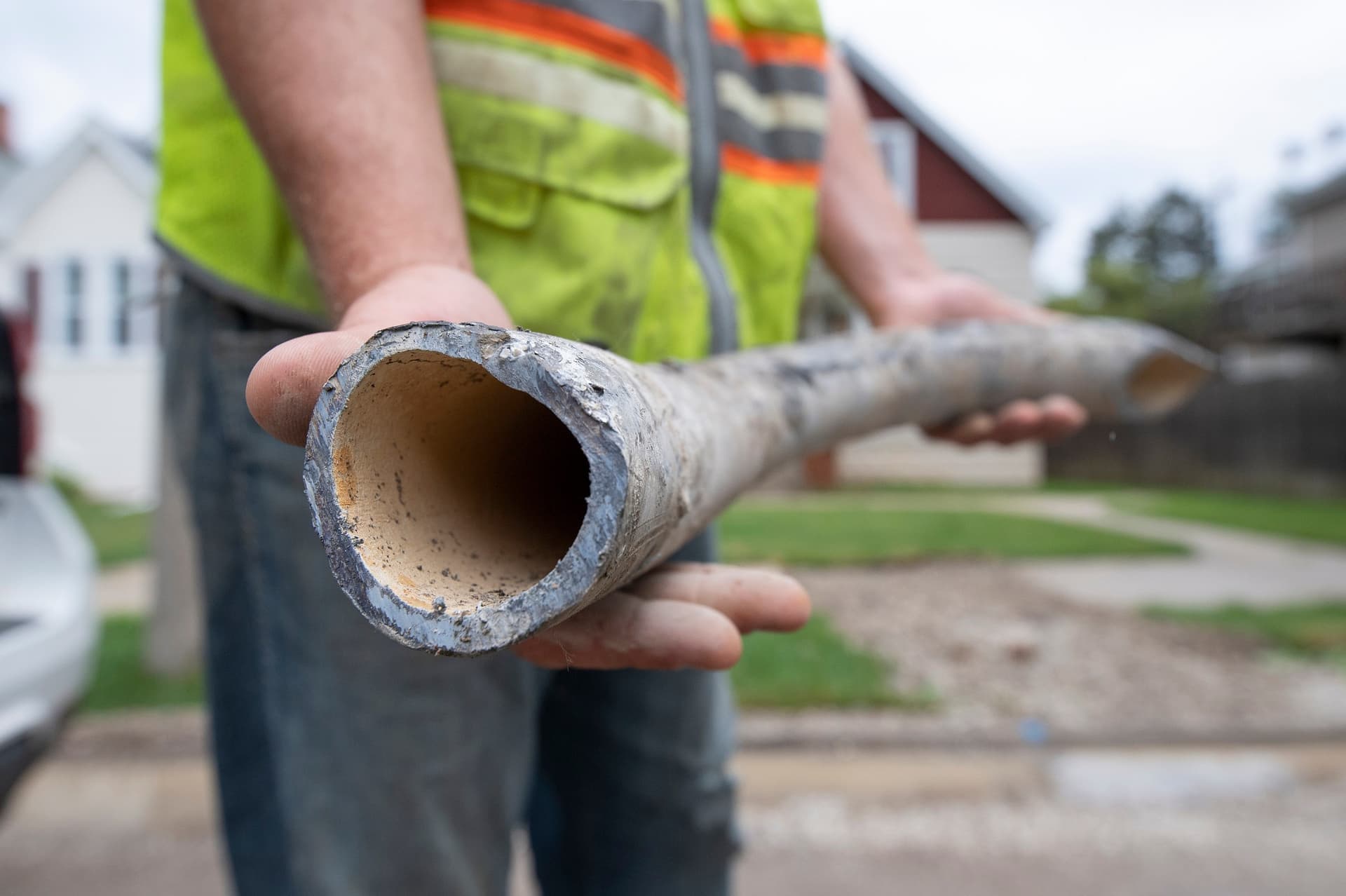


Wisconsin may be closer than previously thought to eliminating lead water pipes. About 164,000 municipal and community lead water service lines still need replacement with safer materials, according to a Wisconsin Watch analysis of water system data reported in April. That’s roughly one of every 10 municipal and community water lines statewide.
The estimate includes confirmed lead lines — roughly 146,000 across 137 municipal and community water systems — and an estimated share of service lines with unknown materials that are statistically likely to contain lead, based on EPA methodology.
Some data gaps remain, including some water systems that did not file a report on time.
Still, the total is far below previous government estimates as more complete inventories more clearly show where lead pipes remain, part of a nationwide effort to reduce exposure to the toxic metal linked to serious health risks.
The U.S. Environmental Protection Agency estimated in 2025 — before many water systems completed or updated their inventories — that nearly 180,000 water lines in Wisconsin were made of lead, a sharp drop from its 2023 estimate of over 256,000.
“We may be able to remove all (lead service lines) faster, fully, and forever – sooner and at a lower price tag than expected,” Erica Galante-Johnson, senior lead service line replacement policy analyst at Environmental Policy Innovation Center, wrote in a report comparing the lead service line estimate before and after new inventory data became available.
Why replace lead service lines?
Once a popular material for water service lines, lead was banned by regulators for such purposes in Wisconsin and nationwide beginning in the 1980s due to concerns about potential lead exposure.
“There is no safe level of exposure to lead,” the EPA’s website says.
Children are especially vulnerable to lead, since even low levels of exposure can lead to behavioral and learning problems. High levels of lead in blood can cause seizures, coma or death. Adults exposed to lead are more susceptible to cardiovascular and kidney problems.
Water systems limit risk by treating pipes with chemicals that reduce corrosion, but failures such as Flint, Michigan’s crisis a decade ago show how those safeguards can break down, exposing residents to lead.
That’s why federal regulators now require aggressive replacement timelines.
Municipal and community water systems must replace all lead or galvanized pipes before the end of 2037. Some Wisconsin cities, like Madison and Stoughton, have already replaced all lead pipes. Many others, including Eau Claire, Milwaukee and Wausau, have projects underway to replace them at no or low cost to homeowners.
At least 29 municipalities in Wisconsin have received more than $159 million through 2025 to replace lead service lines through the 2021 Bipartisan Infrastructure Law, signed by then-President Joe Biden.
The EPA in May announced an additional $94.3 million Wisconsin allocation under the 2021 law.
Biden’s EPA revised its Lead and Copper Rule, tightening monitoring requirements and establishing timelines for replacing lead pipes.
The first step: requiring water systems to document what’s underground.
More complete information helps identify where lead lines are concentrated, said Ann Hirekatur, the Wisconsin Department of Natural Resources’ lead and copper section manager.
The inventories are more than a bureaucratic exercise. Federal rules now tie them directly to replacement requirements.
Wisconsin water systems previously needed only to report estimates of their lead service lines to the state Public Service Commission.
Biden’s EPA changed that. Water systems were required to submit an initial inventory by October 2024, listing the best available information about each water line. That gave DNR officials line-by-line records for the first time, Hirekatur said.
By Nov. 1, 2027, water systems must improve those records by trying to identify service lines of currently unknown material and documenting connector materials. After that deadline, any service lines with an unknown material will be treated as lead, and water systems must start replacing at least 10% of lead lines under their control each year.
The new regulations require digging through historical documents — or even digging up pipelines one by one — to confirm the material and location.
The more rigorous process revealed more lead service lines in some communities than previously thought. That includes Whitefish Bay, which documented more than 56% of service lines as lead during the first draft of its inventory.
Locating pipelines can be challenging
Despite the new inventories, regulators still have yet to identify the materials in more than 181,000 Wisconsin service lines, or 12% of all statewide.
As of April, 312 of 610 Wisconsin municipal water systems identified materials in every service line. About 60% of systems recorded 5% or fewer pipelines as unknown material.
Meanwhile, 102 municipal water systems reported more than half of their lines as unknown, with 12 yet to submit inventories.
“Some systems kept good records, and some systems don’t have any records at all,” Hirekatur said.

Smaller water systems are less likely to know what their service lines are made of
The share of service lines with identified materials is much higher and more consistent among large water systems. Smaller systems are more likely to have incomplete records.
Large
(Over 100,000 customers)
Medium
(3,301 – 100,000 customers)
Small
(Less than 3,300 customers)
50%
0%
100%
Each shape represents water systems in that size group. Wider areas show where more systems fall. Most large systems have identified nearly all service line materials, while smaller systems range from nearly complete inventories to knowing very little about their service lines.
Source: WI-DNR
Hongyu Liu / Wisconsin Watch

Smaller water systems are less likely to know what their service lines are made of
The share of service lines with identified materials is much higher and more consistent among large water systems. Smaller systems are more likely to have incomplete records.
100%
50%
0%
Small
(<= 3,300
customers)
Large
(> 100,000
customers)
Medium
(3,301 – 100,000
customers)
Each shape represents water systems in that size group. Wider areas show where more systems fall. Most large systems have identified nearly all service line materials, while smaller systems range from nearly complete inventories to knowing very little about their service lines.
Source: WI-DNR
Hongyu Liu / Wisconsin Watch
Water system managers must show their work in documenting the makeup of service lines.
The best evidence is a “tap card” that describes the pipe’s primary features and installation history.
But many communities never preserved those records because they were not required to do so.
The city of Lancaster illustrates that challenge. Water system officials started looking for lead pipes in the 1990s, and they initially found only two and about 50 others whose material was unknown. But the DNR initially marked more than 1,700 out of the city’s 1,845 lines as unknown because the verification documentation fell short of standards.
The utility didn’t save old paper inspection records, said John Hauth and Jamie McCartney, the retiring and incoming directors of public works, respectively.
Calling DNR representatives “very helpful,” Hauth said his inventory is now getting into “pretty good shape.”
“We send it to them, they will highlight areas and send it back and say, ‘OK, well, you know you need to explain this better, or you need to match this up,’” Hauth said.
Gathering evidence
At the DNR’s suggestion, Hauth and McCartney used construction records to rule out neighborhoods built after lead was banned from new pipeline construction and found water meter replacement records to fill in some blanks.
The managers submitted a revised draft, still under DNR review, that labeled fewer than 400 service lines as unknown. The city plans to verify the remaining resident-owned lines through door-to-door visits and use hydro-excavation equipment to check city-owned lines.
“We’ve only got the few that we know of,” Hauth said. “I think it’s gonna be manageable.”
Josh Hyndman, Mount Horeb’s former water system manager, also has experience with thin documentation. The village started replacing lead pipes in 2011 and compiled its inventory as early as 2021 to apply for a DNR lead line replacement grant.
“We went down into our basement and started pulling out all the old records,” Hyndman said. “ I found a construction date that was from January of ’78, and it spelled out that everything would be three-quarter-inch copper for all businesses.”
That helped Hyndman determine that all service lines installed after 1978 were copper, reducing the number his team had to inspect or excavate.
In 2024, Hyndman left Mount Horeb for a job in Whitewater. Mount Horeb now has just one lead service line remaining, beneath a vacant lot. He said the inventory process was much easier in Whitewater because the city maintains comprehensive records for each line. As of April, Whitewater had 16 lead service lines and plans to replace all but one serving an abandoned water tower by the end of 2027.

Most unknown service lines are located on the private side of the water system, Cathy Wunderlich said. She is project manager and principal technologist with the engineering firm Jacobs, which the DNR contracted through 2028 to help local water systems finish their inventories. The service is free, with the costs covered by a federal grant.
Lead and copper are rarely used for water lines over two inches in diameter, so they’re more commonly used in private-side pipes instead of the public side, Wunderlich explained.
Although municipal water systems do not own the private side of service lines, they must document them. That requires permission and access from property owners.
A more cost-effective approach encourages residents to submit evidence, said Shawn Kerachsky, CEO of Community Infrastructure Partners, which used federal grants to contract with Wausau and Racine to inventory and replace the lead lines.
“This is not an engineering and construction problem,” Kerachsky said. “It’s a public health issue that happens to be solved through very simple engineering and construction, but world-class communication outreach and logistical planning.”
His company promoted the “Equiflow” campaign when helping Wausau complete its inventory — partnering with local organizations to encourage residents to identify their water lines by uploading photos or allowing technicians to inspect them. The approach helped Wausau reduce its share of unknown service lines to about 30%.
The DNR also offers grants to help water systems educate residents about inventory and replacement projects.
What’s next?
Water systems will ultimately use the data to apply for federal grants and loans to fund lead service line replacements.
“We encourage water systems to replace them as soon as possible, because it’s in the best interest of public health,” Hirekatur said. “Right now, there’s more money available through the Bipartisan Infrastructure Law funding, and once that gets used up, there’ll be a lot less funding available.”
The DNR will announce which projects it will select for federal pipeline replacement funds by year’s end. The program offers loans with a 0.25% interest rate, far below market rates, and principal forgiveness. The department expects to have some funding available in 2028, but much less than previous years.