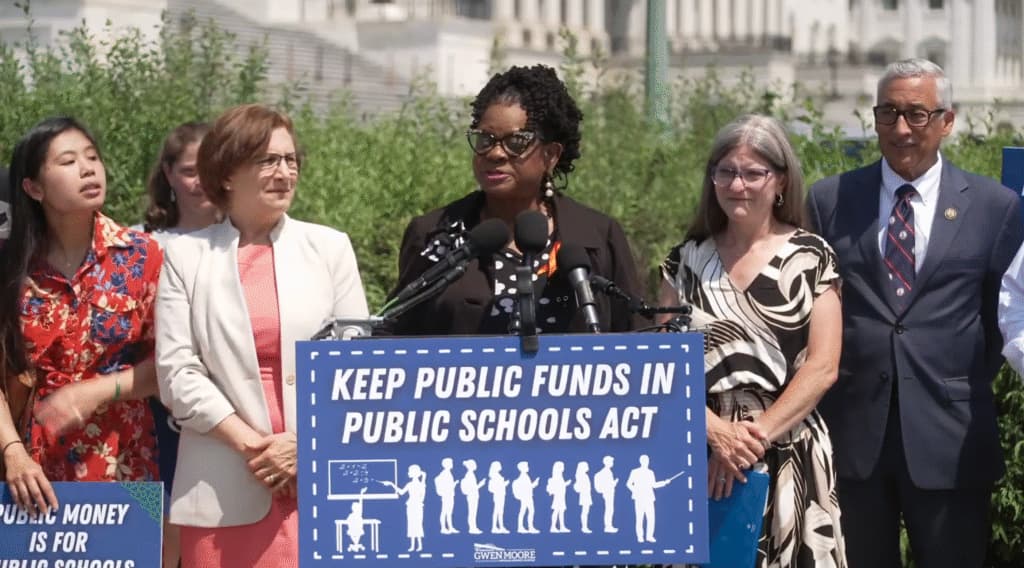


Wisconsin Rep. Gwen Moore is calling for the federal school voucher program created under President Donald Trump’s “One Big Beautiful Bill” to be eliminated.
Moore is leading U.S. House Democrats on a bill to repeal a provision creating a federal voucher program which allocates public money towards private schools in the form of a tax incentive. It’s the first federal school voucher program of its kind.
Under the program, donors would be given a dollar-for-dollar tax credit of up to $1,700 when they donate to eligible “scholarship granting organizations.” The donations would need to be used for educational expenses including tuition and board at private schools, tutoring, technology and books.
Moore said at a press conference Thursday held outside of the U.S. Capitol that a credit like this “doesn’t exist anywhere else for anything else in our tax code.”
“Instead of vouchers and tax cuts for billionaires, we could be investing more in Title I funding to serve low-income students,” Moore said. “We could put these monies into Head Start and special education. We could be securing universal school meals for our babies, and not just gutting SNAP and expanding vouchers.”
According to an estimate by the Institute on Taxation and Economic Policy (ITEP), the cost of the program could range to as high as $51 billion annually.
The governor of each state has until Jan. 2027 to opt into the program. Moore thanked Wisconsin Gov. Tony Evers for rejecting the proposal repeatedly, including by vetoing a bill sent to him by state lawmakers that would have required Wisconsin to opt in. Evers said Republicans in Washington are giving “private voucher expansion carte blanche to run roughshod over public education in this country.” He also noted that the specifics of the program are not in place yet.
The final regulations for the program are expected in September, according to the New York Times.
The only Democrats to sign on to the program are New York Gov. Kathy Hochul and Colorado Gov. Jared Polis. Other Democratic governors, including in New Mexico, Oregon and Hawaii, who have said they would reject the program also seem to be reconsidering.
Moore said that she is uniquely positioned to understand the effects of school voucher programs because she represents a district that houses the Milwaukee Choice Program, which was enacted in 1990, and was the first modern school voucher program in the country. Nearly half of students in Milwaukee attend publicly funded private schools and independent charter schools.
“We can tell you with our lived experience that it disproportionately benefits wealthy students who already attend private schools, and they sap monies from our public schools, which disproportionately and especially hurts disabled students and rural students,” Moore said.
U.S. Rep. Mark Pocan, who represents Madison, said voucher programs are a “failed experiment,” noting that 41% of all private schools that participated in the Milwaukee program closed between 1990 and 2015.
“To try to prop it up, as Donald Trump is trying to do, is just wrong,” Pocan said. “What we need to do is make sure that we support our public schools. The vast majority of our constituents attend those schools.”
Two candidates for governor have declared their support for letting Wisconsin opt in to the program: Republican U.S. Rep. Tom Tiffany and former Wisconsin Economic Development Corporation CEO Missy Hughes, a Democrat.
“Denying Wisconsin families access to these scholarships for the sake of partisan politics is irresponsible, unfair, and counterproductive to our shared goal of improving educational outcomes for Wisconsin students,” Tiffany and the rest of Wisconsin’s Republican delegation wrote in a letter in October.
In a statement, Hughes said joining the program could help bring money into public schools as many supporters of the program have argued. In addition to boosting taxpayer support for private schools, there could be scholarship granting organizations that provide resources to public school students for supplemental educational services and resources including tutoring, special-education services, school supplies, transportation and after-school programs.
Taxpayers in any state can donate to a scholarship granting organization and benefit from the tax credit, but only students in participating states would be eligible for scholarships from an organization. Students also wouldn’t be eligible for scholarships if their family makes more than 300% of the median income in their area.
“I will opt Wisconsin into the Federal Scholarship Tax Credit so that Wisconsin families, students, and communities benefit from resources that would otherwise flow to other states,” Hughes said in a statement. “I support Wisconsin participating in this program because I believe our students deserve every opportunity available to them.”
Hughes also said she would create a statewide scholarship granting organization to help “fast track the delivery of these dollars into Wisconsin’s public schools.”
The deadline for states to opt in is Jan. 1, 2027. While the general election takes place on Nov. 3, Wisconsin’s next governor will not be inaugurated until Jan. 4, 2027.