

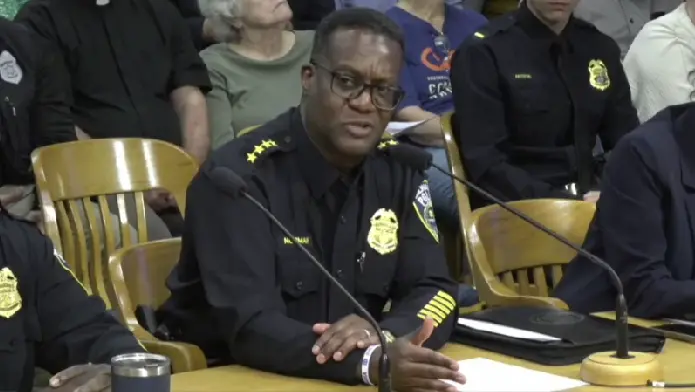
Source: City Channel
Milwaukee police chief admits he took his ‘eye off the ball’ on nuisance properties

Jun 8, 2026, 6:33 PM CT


Share
Milwaukee Police Chief Jeffrey Norman and his staff appeared before a city council committee on June 8 to answer for a declining amount of nuisance violations being issued to landlords while tenants and neighbors express dissatisfaction with police response times for issues.
Common Ground, a Milwaukee nonprofit coalition of faith institutions, neighborhood groups and schools, studied MPD practices of nuisance violations. The nonprofit examined all nuisance abatement letters sent between August 2017 to August 2025.
The study found that the Milwaukee Police Department was sending as many as 150 letters between 2017 and 2018, but that number had dropped to 46 for each of the most recent years of data.
The chief blamed the effects of the COVID-19 pandemic and homicide epidemic Milwaukee experienced.
“2020, 2021, 2023, were some hard years for us,” Norman said. “We were beyond in regards to homicides in our city and so I will admit that sometimes you take your eye off the ball. There’s so many things, luckily, in our rearview mirror that give us more of a breath to look at other things, quality of life issues. But … we were dealing with some nonfatals that were again in the stratosphere. It doesn’t make it an excuse.”
Ald. Marina Dimitrijevic said her constituents report waiting hours for police to respond to non-emergency calls. She suggested a separate phone line for nuisance-like complaints, such as loud noise and loitering. “We have to fix this,” she said.
Norman said he would work to “find a way to figure out what might be a platform for dealing with these particular types of concerns. I know this is an ongoing issue for as long as I’ve been an officer.”
Dimitrijevic said her constituents remark how they see increases for police funding and more officers but response times seem to never improve.
MPD admits it was not reviewing nuisance call data
The Nuisance Ordinance was created in 2001 to give MPD the ability to recoup costs associated with responding to properties frequently. Police also have a department policy.
City code lists over 30 nuisance activities, including loud music, loitering, illegal drug activity, harassment, disorderly conduct, battery, indecent exposure, prostitution, loitering, littering, keeping animals that disturb the peace and discharge of a firearm.
There are instances, such as domestic violence and mental health-related incidents, when the calls do not qualify as nuisance. Further, MPD has to verify and substantiate that a crime occurred and many residents opt to report crime anonymously out of fear of retaliation.
Ald. Russell Stamper said he would also like to stop getting calls from constituents who reported crime anonymously only for a Milwaukee police officer to show up to their residence. Norman didn’t respond.
Norman said when the department recognizes that a property might be headed for nuisance status, they are sent a pre-nuisance letter or a district captain will reach out to the property owner to find a solution. Norman said the majority of the nuisance complaints are resolved during this stage.
But If MPD gets three nuisance calls in 30 days or two serious crimes in one year, the property owner is supposed to be sent a Nuisance Letter, requesting an action plan within 10 days. Typical action plan ideas include adding locks to lobby doors, installing lighting and cameras, and hiring security.
If approved, property owners get several more weeks to institute the plan and if crime persists, the landlord is given a second chance before the property is monitored and billed.
If landlords completely ignore the letter, the property could reach “Chronic Nuisance” status with citations between $1,000-$5,000.
Common Ground found that 81% of cases were resolved without any billing.
Ald. Bob Bauman added that the fines are too small for many big landlords worth millions of dollars.
“The actual billing amounts tend to be nominal,” he said. “To a large deep-pocketed landlord, that’s the cost of doing business.”
The whole process can take multiple months before a solution is found as landlords have appeal rights as well.
“Nuisance isn’t as easy as we want it to be for the bad situations,” said MPD Chief of Staff Heather Hough.
Norman said the department is bound by the ordinance and any attempts to speed up the process would have to be initiated by the Common Council.
“We’re the police department, we follow the rules,” Norman said. “If you want something different then you gotta change the law.”
Hough also admitted that the department was not actively reviewing its data to determine if three calls to the property took place and thousands of properties were falling through the cracks.
Common Ground identified 2,900 properties in Milwaukee that reached nuisance threshold, but did not receive a designation. About 60% of those were residential not commercial properties.
Hough said changes have been made, including now district captains will be reviewing data monthly to determine more properties that reached nuisance status. If a property is not deemed a nuisance but appears to have met the threshold, police must provide a reason why a citation was not issued.

Drake Bentley is an award-winning investigative journalist who has worked for the Milwaukee Journal Sentinel, Wisconsin State Journal, Newsweek, Heavy and The Sporting News. He is a northside Milwaukee native, former political staffer and graduate of the University of Wisconsin-Whitewater and the University of Nebraska.
Want More Local News?

Civic Media
Civic Media Inc.
The Civic Media App
Put us in your pocket.


