




A super-sized breakdown of the new Marquette poll of Wisconsin politics

Feb 26, 2026, 5:07 PM CST


Share
The Marquette University Law School Poll is the gold standard survey for measuring public opinion in Wisconsin politics. As I’ve done for now going on nearly seven (!) years here at The Recombobulation Area, I am digging through the crosstabs and all the issue questions to bring you our unrivaled breakdown and analysis of the poll results.
New this time: Part of this breakdown will be available for to all, while part will be available only to paid subscribers. For that reason, we went even more in depth than usual — which, for us, is saying something. So, be sure to subscribe for all of our analysis on issues like data center politics, immigration issues, and a regional breakdown of the Democratic candidates running for governor.
There will be some here that we’ve included since the beginning, and for recent polls, I’ve also started including this ranking of net favorability of the major politicians, parties and political movements included in each set of results. Here’s the latest:
With this being the first Wisconsin poll of 2026, and there’s a lot here to make sense of, so let’s recombobulate.
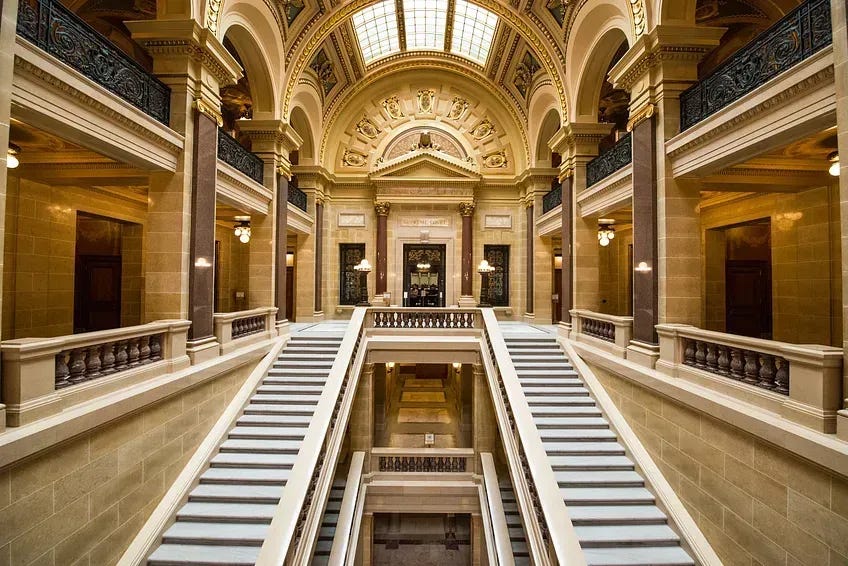
Chris Taylor leads the race for Wisconsin Supreme Court. But is anyone really paying attention to this election?
The next election for a 10-year term on the Wisconsin Supreme Court is now less than six weeks away. The stakes for this race are not quite what they’ve been in the last two races, where the balance of power on the court was on the line. This is not the Protasiewicz-Kelly race of 2023, nor the Crawford-Schimel(/Elon) race of 2025.
But this race is still extremely important, and would give liberals the opportunity to grow their majority to 5-2, which would cement their control of the state’s highest court through the end of the decade (at least). Chris Taylor, the former Democratic state representative and current Dane County judge, is thought to be the clear favorite in the race, with a gargantuan fundraising advantage over conservative candidate and Waukesha County judge Maria Lazar.
Here’s how the head-to-head polling breaks down:
-
Maria Lazar: 12%
-
Chris Taylor: 17%
-
Undecided: 66%
That’s with registered voters. With likely voters, Taylor has a slightly wider advantage, at 22% to Lazar’s 15%. Taylor also has stronger favorability numbers at a net +5 to Lazar’s net minus-4. In the Madison market, where the Dane County turnout powerhouse has helped fuel liberal victories in these state Supreme Court races in recent years, Taylor leads Lazar 29% to 4%. Taylor is certainly ahead in this race.
But not many are paying all that much attention to it. The undecided numbers are quite high, and in the poll’s question on whether people have heard about the race in the April 7 election, 38% said they’ve heard nothing at all, 55% said they’ve heard a little, and only 6% said they’ve heard a lot.
During a recent podcast I joined with Pat Kreitlow of UpNorth News (watch here!), he remarked about how the 2019 race also had a liberal candidate that appeared to have a lead at around this same stage of the race, but things turned in its late stages and Brian Hagedorn pulled off a come-from-behind win over Lisa Neubauer by a razor-thin margin.
It’s a good reminder to never get too comfortable in a race like this. And while Taylor still has the clear edge here, the fact that the numbers for Lazar were not completely bleak might be a signal to the right-wing donor class that it might be worth spending in this race, after all. Poll director Charles Franklin said there would be one more poll of this race before the April election, so we’ll see how this evolves over the next month. I’d certainly expect we’ll all be seeing a whole lot more campaign ads over the next 40 days.
Making sense of the Democratic primary in the race for governor
Let’s start with the breakdown of the full field:
That’s right, State Rep. Francesca Hong of Madison holds a very slim early lead over the former and current lieutenant governor, respectively, with the overwhelming majority of voters still undecided. And like the Wisconsin Supreme Court race, folks are just not yet engaged in this race, as only 8% of voters said they’d heard “a lot” about the Aug. 11 primaries (both Republican and Democratic).
This is the first poll to include former lieutenant governor Mandela Barnes, who still has rather high name ID, far ahead of all other candidates, at 61% (current Lt. Gov. Sara Rodriguez is next at just 33%). His overall favorability numbers, though, are a net minus-7, and regionally, his favorability outside of Milwaukee and Madison is not great (net minus-21 in Green Bay area, net minus-23 in northern and western Wisconsin). He does fairly well with more moderate voters in this poll, though — an edge over the field in that ideological group, and a net plus-9 favorability with moderates. And yet, despite being far better known than the rest of the field of candidates, he has not walked into this race as the clear frontrunner, as some of the polls that preceded his announcement might have suggested.
Hong’s numbers in this poll are rather intriguing. She has a lot of support from younger voters — ahead in the 30-44 age group, and way out in front among the 18-29 group (at 21%, with no other candidate above 7%) — and has strong support with the “very liberal” ideological group, at 27%, with no other candidate in double digits. A big story of these primary results is just how few people are truly paying attention to this race, and she might be doing better with a constituency that tends to be more hyper-engaged. The true test will be whether she can build on this early success.
But one thing is for sure: She is not going to be out-worked in this campaign. When she started in this race, I referred to her as the “wild card” in the primary, and noted that the former restaurant owner and chef would be working extremely hard in this campaign, and that would make the rest of the primary field have to work that much harder. Other candidates could easily draw some ideological contrast with the Democratic Socialist from Madison, but they’re also going to have to up their hustle to better compete in the rapidly evolving political environment we’re seeing in 2026.
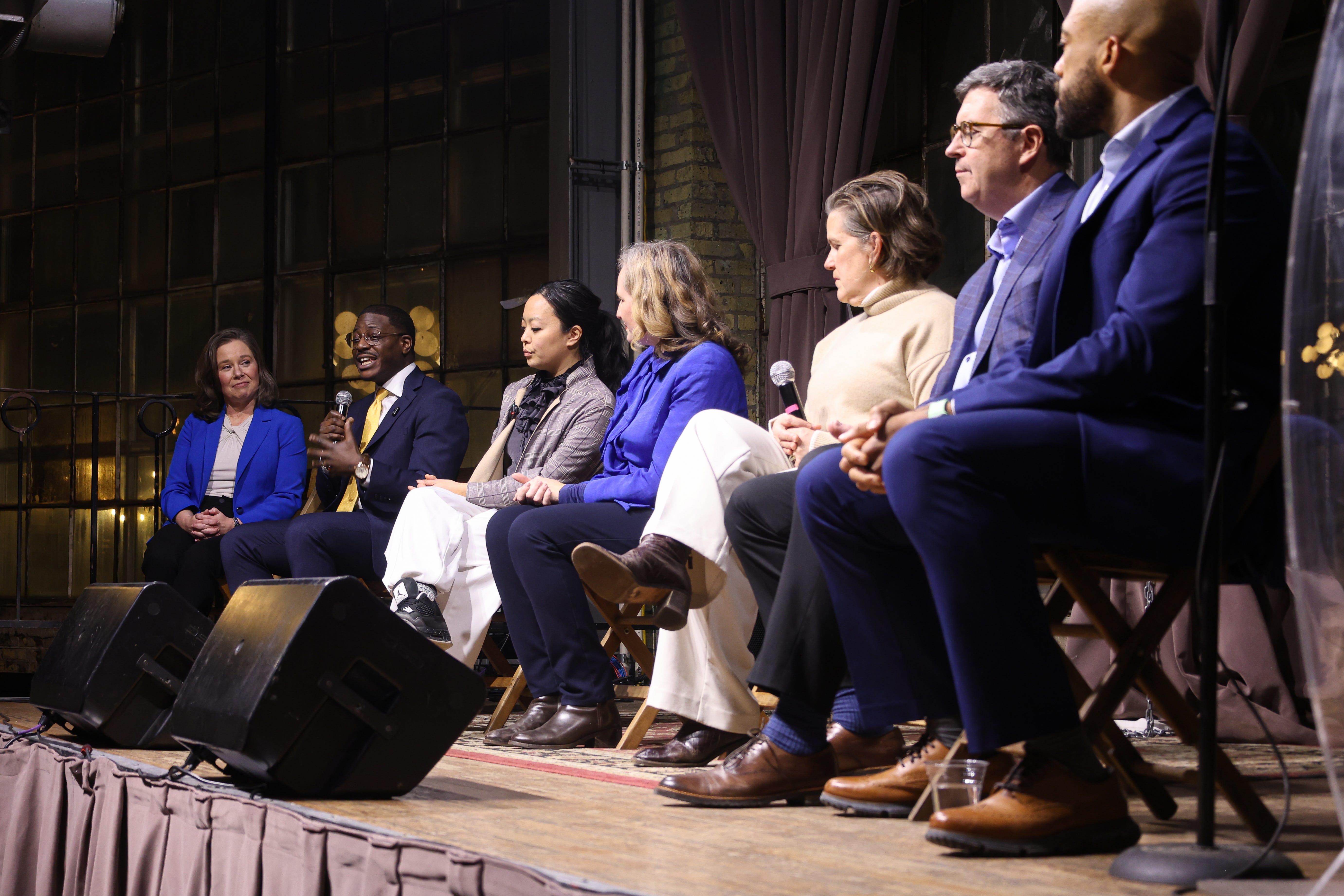
Rodriguez polled below Hong and Barnes, but a notch above the rest of the field. Crowley may have led the field in fundraising, but is only at 3% here. Each could see jumps as more attention turns to this race, but of the two, Rodriguez is polling better. Crowley appears to have very little name ID outside of the Milwaukee area — more than 80% of Madison area voters have no opinion of the Milwaukee County Executive1.
As the non-electeds in the group, Hughes and Brennan have a long way to go to establish the name ID necessary to win a primary. Each is barely above Brett Hulsey, who is not a serious candidate in this race. Hughes’ lone standout mark is some relative strength in the “rest of state” regional group, which includes northern and western Wisconsin, where she topped the field with 8%, but that’s the part of the state least engaged with this primary, with more than 75% undecided. For Roys, my too-early assessment of the field last year had her in the top tier of potential candidates, but right now, the polling is not there for her campaign.
Perhaps the next question for this race will be: When will people start getting engaged in this race? Will attention — and perhaps more importantly, campaign spending — ramp up after the April 7 Spring Election? Because outside of Barnes, people just do not know enough about these candidates. Time for this group — a group I do find rather impressive — to get to work.
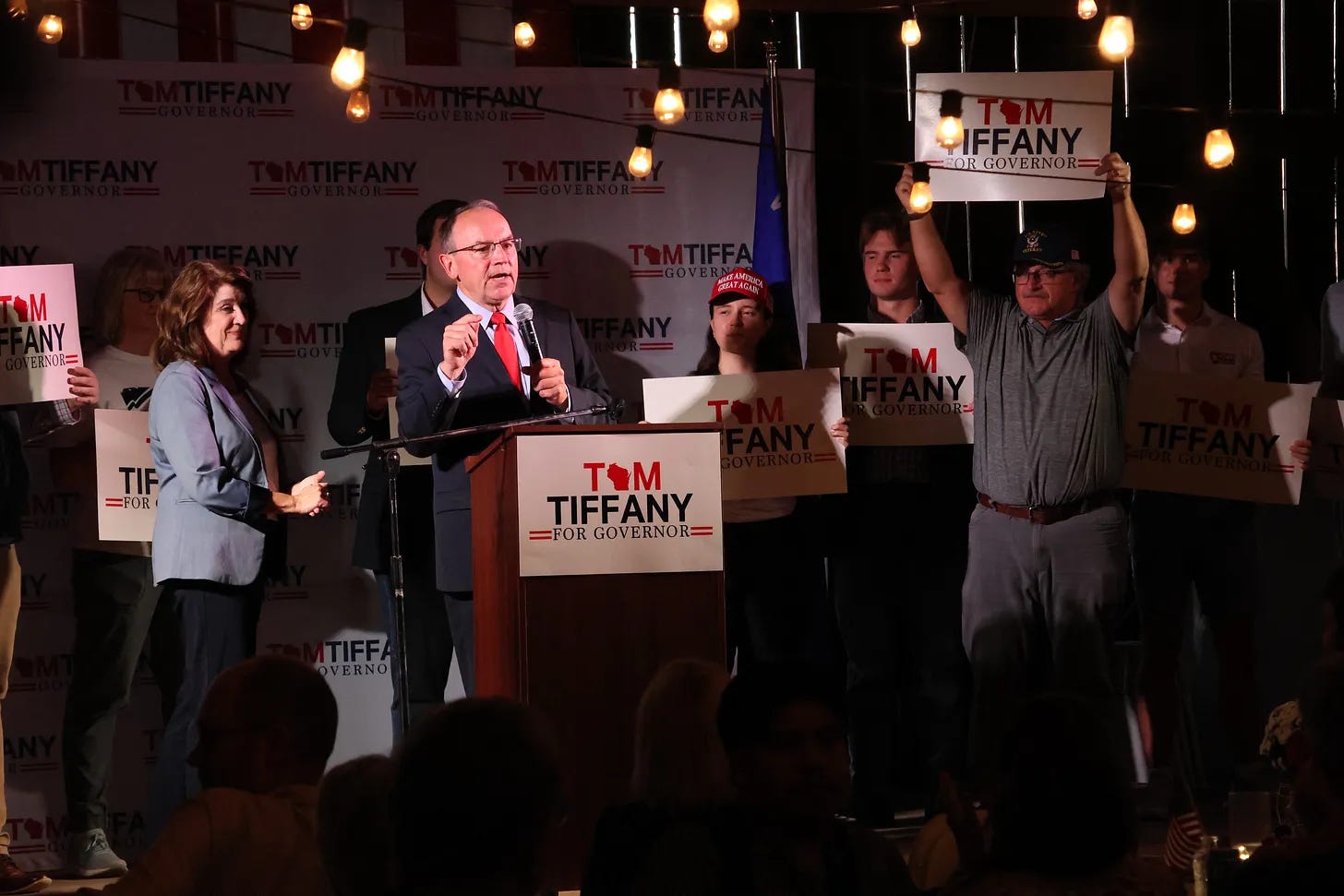
This is a bad poll for Tom Tiffany
In the Democratic primary, perhaps people have not yet made up their minds on a preferred candidate in a large field, leading to the high undecided number. But the Republican field, which only has one viable candidate, more than 60% of voters are also undecided.
That means Congressman Tom Tiffany, the only viable candidate in the Republican primary, has not yet cleared the field in the Republican primary. That’s not a great sign for him. Not even the Trump endorsement thought to cement his status in the race has really moved the needle for him. The number of undecideds being similar in a seven-candidate race and a one-candidate race is astonishing.
Tiffany’s favorability numbers are not good, either. He’s at net minus-5, with more than half of voters still not having an opinion of him. While he’s a bit more well known in the “rest of state” region, which includes northern and western Wisconsin — understandable, given the congressional district he represents — he’s not particularly well known in the state’s major media markets, and has a net-negative favorability in the Milwaukee area suburbs, not as typical for a Republican candidate (Ron Johnson, for example, is +3 in the region despite being -6 overall).
The highest number of undecideds — a whopping 73% — in the Republican primary for governor are also found in the Milwaukee area suburbs. And that’s undecided between Tiffany and fringe candidate Andy Manske, who polled at 2% overall.
Tiffany becoming the presumptive nominee is emblematic of the realignment we’re seeing in the Republican Party becoming less suburban and more exurban and rural in its base, and it will be a central question of his campaign whether or not he can capture a level of support in the typically Republican-leaning WOW counties, which have been shifting toward Democrats over the last decade, required to win statewide.
But the story here on the Republican primary as it stands is that given a choice between Tom Tiffany and remaining undecided, most voters are still remaining undecided.
Trump’s net approval nears an all-time low in Wisconsin
President Donald Trump’s net job approval just reached another new low for his second term, and has been on the decline since his return to office. It’s at a net minus-10 now, nearing his lowest mark overall in the poll across his two terms.